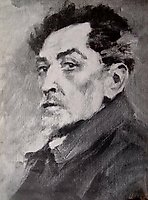
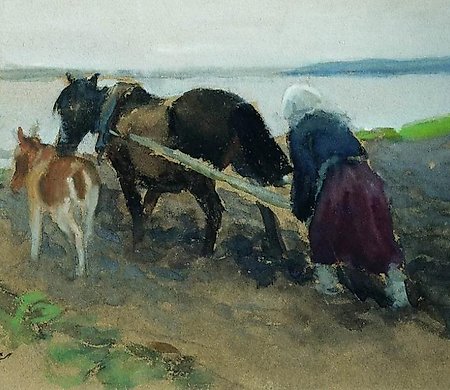
The modest, delicate, and kind A. S. Stepanov, nicknamed "Stepochka" by his friends, was beloved and appreciated by colleagues such as S. V. Ivanov, N. P. Chekhov, the brothers S. A. and K. A. Korovin, I. I. Levitan, M. V. Nesterov, and numerous students including P. D. Korin, A. A. Plastov, L. V. Turzhansky, and others. After Stepanov's exhibition, Korin remarked: "It's as if I had just read Pushkin's poetry. It is so simple, so lofty... What can be said about him? He was an artist. That's all that matters. Everything about him was straightforward, without effects. He had soul, and that is most important. But he also had great artistry and unparalleled skill. He shone in his great simplicity." Alexei Stepanovich Stepanov lost his parents very early. From the age of seven, he was raised by a guardian who insisted that in 1879 the young man graduate from the Land Surveying Institute in Moscow, earning the profession of a land surveyor. However, he did not pursue this career. Instead, in 1880, he enrolled in the Moscow School of Painting, Sculpture and Architecture (MUZhVZ), studying in the class of I. M. Pryanishnikov. He was a successful student and graduated in 1884 with a large silver medal. In the second half of the 1880s, Stepanov spent several summer seasons working with I. I. Levitan—first near Zvenigorod, then on the Volga. Alongside Levitan, he is considered one of the creators of the so-called "mood landscape," where the artist not only seeks a motif in nature that corresponds to his inner state but also imparts psychological depth to the landscape, projecting his own thoughts and emotions upon it. Stepanov’s works are plein-air in character, painted broadly, sketchily, with fluid and transparent brushstrokes, very softly, and with a limited color palette. ("Use less color," he later advised his students.) Stepanov loved to depict country roads with peasant horses pulling sleds or carts. He also loved to show peasant children observing the world—bare, poor, autumnal, but native and wide. A trip to Europe, especially the French Impressionists, had a certain influence on his art, though this was denied by contemporaries. In response to his trip, Stepanov painted 'The Laundresses in Vichy.' Stepanov relished painting hunting scenes, as well as animals, having a rare ability to convey their behaviors and even psychology. The genre in which he preferred to work can be termed landscape-animalistic. M. V. Nesterov considered Stepanov the best animal painter after V. A. Serov. Serov also greatly valued this talent and therefore insisted on inviting Stepanov to teach at MUZhVZ, where he led the "animal class" for almost twenty years (1899–1918). His students adored him, and little is known about his personal life, as shortly before his death, he destroyed his archive. However, Stepanov lives on through his paintings. Especially interesting is Stepanov’s gouache "Grand Opera" (c. 1922), painted in such an impressionistic manner that even renowned French art experts could mistake it for the work of Degas or someone from his circle. Yet, this was not blind imitation—it was inspired, impassioned practical exercise, characteristic of an artist eager to learn until his last days. The Russian theme, however, remained closest to his heart. A hard worker who demanded originality and perception from his students, Stepanov sought to convey the essence and character of his subjects, discarding the nonessential and delving into the core. Years of relentless labor, thousands of observations from life, meticulous study of animal anatomy, and mastery of all painting materials—colors, solvents, canvas, cardboard—formed the basis of Stepanov’s method. He forbade students to imitate him, teaching them instead to see, select the primary, and perceive the finest nuances of tone. In 1920, Stepanov fell seriously ill but continued to work. One of his last paintings, "Swings" (1923), was acquired by the Carnegie Institute for their collection. Alexei Stepanovich Stepanov died in 1923 and was buried at the Vagankovo cemetery.