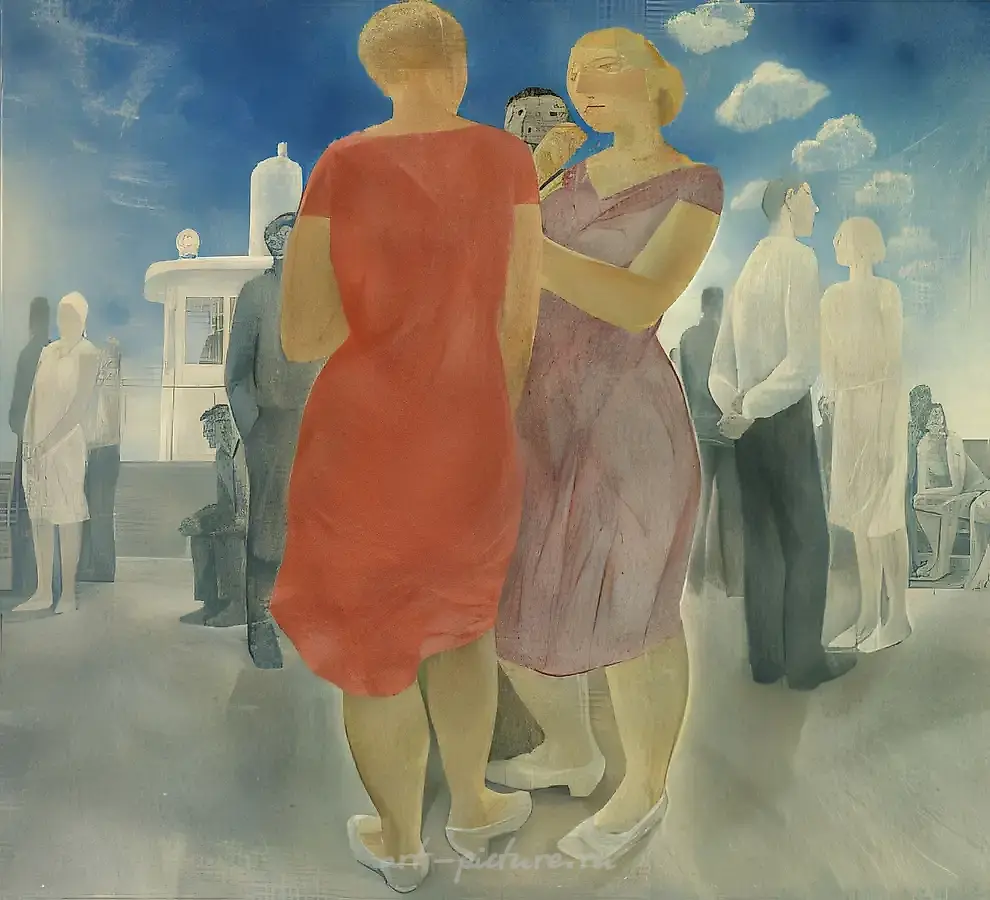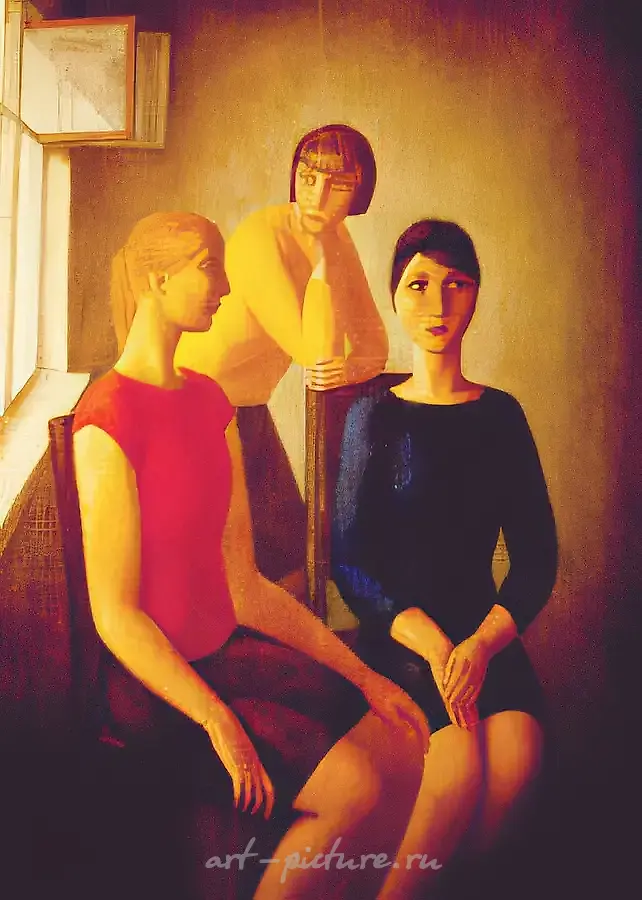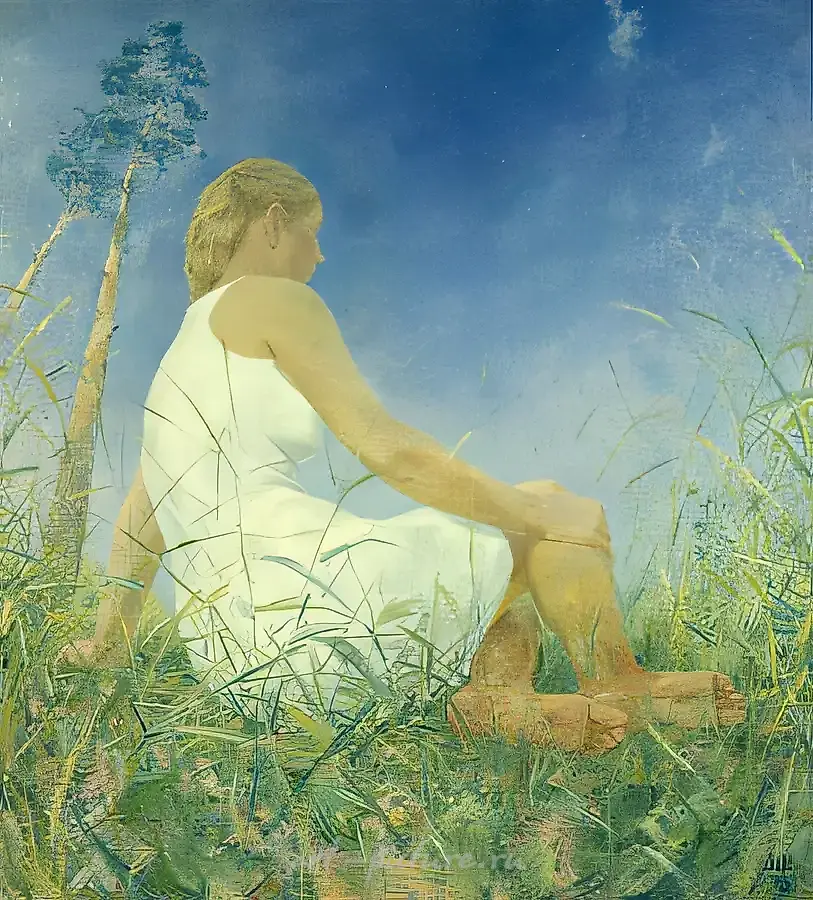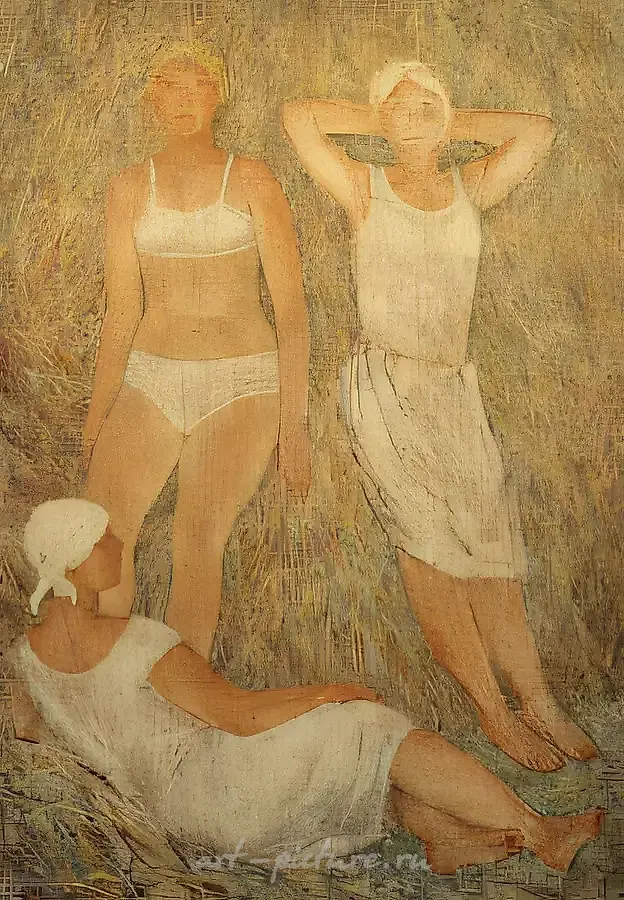
Sterenberg David Petrovich
David Petrovich Sterenberg (born Leizer-Duvid Pinchusovich Sterenberg; July 7 (19), 1881, Zhytomyr – May 1, 1948, Moscow) was a Russian painter and graphic artist of Jewish descent, one of the main Moscow artists in the first Soviet decades, and a co-founder of the 'Society of Easel Artists'.
Biography
=== Youth and Parisian period ===
He was born on July 7 (Old Style), 1881, into a family of Zhytomyr petty bourgeois—clerk Pinchus Leizerovich (Pinchus Leizer-Duidovich) Sterenberg (1858—?) and Frima Volkhovna Sterenberg (née Beim, 1859—?), who married in Zhytomyr on December 14, 1877. The family lived in the Boym house on Sobornaya Street. He apprenticed with a photographer in Odessa and was interested in revolutionary ideas. In 1906, as an active member of the Bund, he was forced to emigrate from Russia to Vienna. From 1907 to 1917, he lived in Paris. In Paris, he worked in phototype printing and studied painting, first at the School of Fine Arts and then at the Académie Vitti. Among his fellow students was the Dutch painter Kees van Dongen. Sterenberg lived in the famous Parisian artist commune, 'La Ruche'.
The artist was influenced by the work of Paul Cézanne and Cubism. Since 1912, he took part in the exhibitions of the Paris Salon. Later, he joined the Salon of Independents, associating with other artists of the Paris school: Lipchitz, Kisling, Diego Rivera, Marc Chagall, and others. Sterenberg's paintings from his Paris period are often contradictory and heterogeneous. He developed a recognizable style only by the end of his stay in Paris.
=== Return to Russia ===
After the October Revolution of 1917, Sterenberg returned to Russia, where his political past and acquaintance with the Commissar for Education A. V. Lunacharsky played a role. Familiar with his Parisian work, Lunacharsky appointed him head of the visual arts department (IZO) of the People's Commissariat for Education (Narkompros). Along with Nathan Altman and other figures of Russian culture, he participated in a conference of writers, artists, and directors about cooperation with the Soviet government in Smolny in Petrograd. In 1918, Sterenberg took part in an exhibition organized by the Jewish Society for the Promotion of Art in Moscow, along with Altman, Baranov-Rossine, and Lissitzky.
The October Revolution caught Altman in Crimea, where he was on vacation. He received news of the proletarian revolution enthusiastically and, not waiting for his vacation to end, returned to Petrograd. Still, like many Russian intellectuals, the artist did not understand the scale and significance of the events. Altman decided that it was the perfect time to realize his long-standing intention to hold a solo exhibition in New York. Carrying out this decision proved difficult, but persistence won. The paintings were collected and packed, and a new foreign passport and a travel ticket were ready. But at that moment, a strange man came to Altman: short, with sticking out, slightly graying hair. It was the recently returned painter David Sterenberg.
Some years before, Altman and Sterenberg lived in Paris in the same house—a polygonal structure resembling a provincial circus. Parisians call this house 'La Ruche d'art'. It still serves as a haven for aspiring artists.
In 1914, Lunacharsky visited Sterenberg's studio. 'I note not so much the richness of Sterenberg's quests, but the unusually rapid progress he has made... and most of all his confident taste,' Lunacharsky wrote after the visit in his correspondence for the newspaper 'Kiev Thought'.
Now, Sterenberg came to Altman for an urgent reason. The visual arts department was being established at the People's Commissariat for Education, and Lunacharsky invited both Sterenberg and Altman to participate in the work of the Commissariat.
From 1918 to 1920, he was head of the Department of Visual Arts at the People's Commissariat for Education. In 1918 he published his programmatic article "The Tasks of Contemporary Art" in the News of the Petrograd Soviet. From 1920 to 1930, he taught at VKhUTEMAS. In 1922 in Moscow, Sterenberg participated in the exhibition of Jewish artists (which included Marc Chagall). He also wrote an essay for the catalog of the First Russian Art Exhibition at the Van Diemen Gallery in Berlin. He was a member of the Komfuts (Communist Futurists) association but refused to join LEF due to its theorists' rejection of easel painting. From 1925 to 1932, he was the founder and leader of the Society of Easel Artists (OST).
Sterenberg played a significant role in the development of Soviet art, especially in the post-revolutionary period, when the IZO department of Narkompros brought together avant-garde artists rejected by the previous official art establishment. Sterenberg paid great attention to the organization of exhibitions and questions of art education. For Soviet art, he saw the main task as raising artistic culture, thus downplaying the importance of narrative, socially active art.
Artistic Work
He worked in the genres of landscape, portrait, and still life. Imitating Impressionists in his early landscapes, in which his exploration of texture was already evident, the artist began to create works with a futuristic character. A challenge arose for Sterenberg that led him from Futurism to Cubism—the problem of texture and volume. The artist’s main goal was to convey real three-dimensionality on the canvas by varying the treatment of the two-dimensional surface (for example, in 'Soured Milk', etc.). However, his works show signs of overcoming the abstract formalism that led Cubism to deform reality. Sterenberg was an innovator and avant-gardist. His paintings did not resemble traditional painting, yet were strictly concrete and representational. These are images of simple things: sponges and soap, a kerosene lamp, knife, and bottle. Two herrings on a dish and half a loaf of black bread... One, at most three things, rough and poor, on the bare emptiness of the canvas, explicitly flat, devoid of spatial depth, devoid of uniting, enveloping atmosphere. At the same time, he emphasized the material and surface structure: smooth faience and rough bread crust, laminated board and slippery fish scales.
The artist also made use of relief—some images rise from the canvas surface. This kind of painting, though appealing to vision, rather evokes tactile, materially concrete sensations. Lonely objects seem to want to leave the canvas, into real human hands. The simplest still life, as a visual text, is filled with dramatic tension, signaling the elemental and necessary values of human life. 'All his art is a story about the daily bread, of which so little is needed to live, but for which so much effort is required to obtain,' said art critic A. M. Efros about Sterenberg. In portraiture, the artist also combines utmost generalization with the tactile concreteness of a type-image: a peasant girl ('Anis'ka', 1926) with the same poor still life on the table behind her; a stern old peasant, majestic in the cold emptiness of a snowy field ('The Old', 1925–26).
Such too are the peasant images in his narrative works—'Collective Farmer', 'Agitator in the Village' (1927)—sublime and stern, closed and concentrated. The artist achieved in them the monumentality of ancient frescoes. Along with such narrative works, the master did not neglect still lifes and landscapes, in which he was a major practitioner.
Painting was Sterenberg's main occupation, but he also worked as a stage designer in theater, did graphic work—book engravings, and illustrated picture books, using principles of schematic, two-dimensional children's drawings, in many ways close to his painting style.
Creative Legacy
Among Sterenberg's students were such well-known Russian artists as A. A. Deineka, Yu. I. Pimenov, A. A. Labas, P. V. Williams, A. D. Goncharov, and others. In 1930, Sterenberg was awarded the title of Honored Art Worker.
After the 1930s, Sterenberg was forced to work in a more realistic manner, as by the mid-1930s his art was increasingly at odds with the direction of state policy in the arts. In the 1940s, he was harshly criticized for formalism. His independent style fell out of favor, his works gradually disappeared from public view. The criticism had a negative effect on the artist's morale and was reflected in his late works. Sterenberg became acutely aware of his Jewish heritage, writing to his wife Nadezhda: 'Eastern blood flows in my veins, the blood of my ancestor who wrote the Song of Songs, and there is no better song.' At the very end of his life, in his sketchy 'Biblical Motifs' series (1947–48), Sterenberg's painting developed a new language and new dramatic intonations began to appear, though he did not have time to fully realize them. After his death in 1948, he was almost forgotten. Sterenberg was buried in Vagankovo Cemetery, Moscow (Plot 37).
In the global context of visual art, Sterenberg's work stands out for its individuality. His merit to world art is that, in solidarity with avant-garde art, he at the same time defended the fundamental value of easel painting in the development of a new aesthetic of the 20th century. 'The foundation of Sterenberg’s art is the object, embodied in an original, unique system of painterly still life. Though analytically self-sufficient, his still life was fully endowed with rich social and philosophical content.' His works are in museums in Moscow, St. Petersburg, Zhytomyr, and private collections.
In Russia, collector Andrey Yeremin has established the International Sterenberg Foundation, which supports young artists, organizes exhibitions worldwide, and engages in publishing. With the Foundation's involvement, a large exhibition of Sterenberg's still lifes opened at the Arts Center on Neglinnaya in April 2000.
Family
First wife (from 1907 to the second half of the 1920s): Nadezhda Davidovna Sterenberg (née Paltseva, later Denisovskaya; 1891–1979), native of Odessa; her second marriage (1956) was to the artist Nikolai Denisovsky (1901–1981).
Daughter: Violetta (Fialka) Davidovna Sterenberg (1908–1995), artist.
Second wife (since 1930): Maria Stepanovna Granavtseva (1904, Cheremkhovo, Irkutsk province – February 14, 1989, Moscow), artist, studied with D. P. Sterenberg’s daughter Fialka at VHUTEIN (1925–1928).
Son: David Davidovich Sterenberg (December 29, 1931 – January 30, 2014), graphic artist, painter, member of the Union of Artists of the USSR.
Son: Vladimir Iosifovich Veksler (1907–1966), physicist-experimenter.
Brothers: Abram Petrovich Sterenberg (1894–1979), photojournalist and photo artist; Yefim Pinhusovich (Petrovich) Sterenberg (1887–1967), state and economic official, member of the All-Russian Central Executive Committee; sister: Maria Petrovna (Malka Pinhusovna) Sterenberg (1902–1974); brothers Shaya Pinhusovich Sterenberg (1896–?) and Yikhil Pinhusovich Sterenberg (born April 22, 1880).
Author about himself
I was born into a family
Works 25