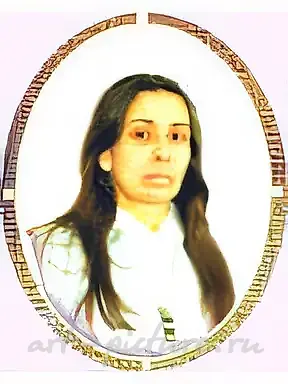
Ziangirova Olga Removna
1961 Born in Moscow
1986 Graduated from Moscow Architectural Institute
1988 Graduated from the Faculty of Print Artists at the Moscow Union of Journalists
Since 1992 Member of the International Federation of Artists (IFA)
Since 1994 Continuing education at the Faculty of Philosophy and Methodology of Science at Moscow State University, majoring in Social Philosophy
1992 Lectures at the Summer International Architecture School, Pereslavl-Zalessky
1993 Special course 'Design and Archetype' (Fashion and Design Department, Russian State University for the Humanities)
1994 Guest teaching at the Art Institute
1995 Special course 'Information Technology and Culture'. Department of History and Theory of Culture, Russian State University for the Humanities
1996-97 Interdisciplinary project for distance education on the Internet 'Spatial Models of Traditional Cultures'. Institute of Eastern Cultures, Institute of Media, RSUH
Guest participant in art project 'Le Petit Setland', Frauenfeld, Switzerland
Participant in HESP University program 'Performing Gender: Visual Arts, Cultural Studies', Central European University, Budapest, Hungary.
Works in collections
Collection of Contemporary Art, State Museum-Reserve Tsaritsyno, Moscow
State Historical Museum, Moscow
Museum of Contemporary Art, Odessa
Gallery 'Rotor', Gothenburg, Sweden
Exhibitions and auctions
SOLO EXHIBITIONS (together with M. Chuikova and S. Anufriev)
1993 'Aqua Vita', Museum of Contemporary Art, Odessa
1994 'Mentale Landschaften Ruslands', Galerie Parzifal, Berlin, Germany
'Auf der Suche Nach Neuen nervi rerum', Sprinkenhoff, Hamburg, Germany
1995 'Passenger Node', Museum of Contemporary Art, Odessa
GROUP EXHIBITIONS
1990 'Shizochina', Club of Avant-gardists (CLAVA), Exhibition Pavilion on Frunzenskaya Embankment, Moscow
Presentation of the 'Club of Billionaires', Almazny Cinema, Moscow
1991 'Visitation', Club of Avant-gardists, Peresvetov Lane, Moscow
'Novecento', L Gallery, Central House of Artists, Moscow
1991-92 'White River', Series of exhibitions and actions in studios on Petrovsky Boulevard, Moscow
1992 'Soc-Art', Collection of Contemporary Art, Tsaritsyno Museum-Reserve, Lenin Museum, Moscow
'Zero Arcana', Laboratory 'Idioma', Central House of Artists, Moscow
'Hearts of Four', ISI. Officers' House, Moscow
'House Number 100', Profsoyuznaya, 100, Moscow
'Malevich Center in the Paleontological Museum', Paleontological Museum, Moscow
1993 'Creativity of Happy Dreams', Russian Academy of Arts, Moscow
'Vehi: Monuments, Transformation for the Future', ISI, Central House of Artists, Moscow; ICA, New York, USA
'ART MYTH 3', Manege, Moscow
1994 Exhibition-action in the swimming pool 'Moscow', Moscow
'Reincarnation', Gallery 'A 3', Moscow
1995 'Apocalypse', Russian State University for the Humanities, Moscow
'Worker-2', L Gallery, Moscow
1996 'Limits of Interpretation', Museum Center RSUH, Moscow
1997 'Surrealism and Revolution', Gallery 'A-3', Moscow
Autumn exhibition of RSUH Media Gallery on the Internet
PERFORMANCES
1990 'Wind', Yasenevo, Moscow
'Back to the Original Order', Donskoy Monastery, Moscow
1991 'Transparent Fixer', Moscow
'On the Origin of Art', Magunos Festival, Druskininkai, Lithuania
'Funeral of Hero Abramych', Petrovsky Boulevard, Moscow
1993 'Foundation', 'Patotopology and Localism', Arkadia, Odessa
VIDEO FILMS
1990 'Wind' (collaborative with S. Zhil, A. Sidorov), Moscow, Gothenburg, Sweden
1993 'Transparent Fixer', Video Art Festival, Quebec, Canada
1994 'Levels', 'Chain', Odessa
CURATORIAL PROJECTS
(within the 'Idioma' laboratory: O. Ziangirova, M. Chuikova, N. Kamenetskaya, jointly with the Department of History and Theory of Culture, RSUH, Moscow)
1993 International Conference 'Postmodernism and National Cultures', Seminar 'Farewell to Times', State Tretyakov Gallery, Moscow
1995 International Conference 'Gender and Culture: Changing Paradigms', RSUH, Moscow
International Conference and Exhibition 'Apocalypse: Cultural Self-Consciousness at the Turn of the 21st Century', RSUH, Moscow
1996 Interdisciplinary Conference and Exhibition 'Limits of Interpretation', Museum Center, RSUH, Moscow
Author about himself
The foundation of my creative activity is the combination of artistic practice with interdisciplinary and cultural studies, as well as creating a space for interaction between science and art.
In recent times, I have focused my efforts on implementing international exhibition art projects in collaboration with other authors. These projects develop as cultural models over time, each one based on research and taking into account the specifics of the location where it is realized.
Currently, I work at RSUH, engage in teaching, mastering new technologies, and multimedia.
In my research, I am most interested in exploring universal means of organizing space, stable visual models (archetypes) of collective consciousness, and gender issues.
Our group's interests focus on the intersections of art and science, and the humanities, natural, and exact sciences. Functioning at the junction of research activity and artistic practice, we tend to view our creative pursuits as experimental and laboratory-like, helping us to formulate our discursive constructs.
The processes occurring in contemporary art often manifest the postmodernist discourse, treating art as part of the market. They therefore tend towards increasing spectacle, akin to the carnivalesque, pushing other functions into the background. This lightweight and superficial tendency of recent art prompted us to turn our attention to the opposite area of the natural and human sciences characterized by seriousness, specificity, and fundamental principles.
Among the ongoing processes in this domain, the most relevant one seems to be the convergence and fusion of different disciplines, thus giving rise to new fields with a broader integral perspective, such as synergetics and applied linguistics. However, it is clear that massive changes in scientific worldviews are necessary for such a unification of sciences to become dominant, including both natural and humanistic sciences. Each is a closed world with its specific terminology and rarely reflects on itself from a general cultural perspective.
After a series of artistic and exhibition experiments, we found the method of immersing individual scientific theories into the space of contemporary art and using its language to discover new and sometimes unexpected conceptual solutions to be quite fruitful.
This method, combining two modes of describing reality—the rational-logical and the artistic-imagistic—seems both natural and promising. On one hand, it can catalyze integration in science; on the other, it can reveal creative tendencies in contemporary art.
In the process, we have drawn upon various scientific fields—both natural and humanitarian—such as mathematics, theoretical physics, computer science, structural linguistics, paleontology, archaeology, and geology.
Among our projects is the object 'Letter of Happiness', which utilized the principle of geometric progression to introduce new geometric parameters into the game-text.
In the installation 'Magnetic Monopole' (Belyaevo Gallery), the basis is a hypothesis from theoretical physics about magnetic poles.
Recently, we have been working on the international project 'Geological Mythology', which will include a series of exhibitions in different countries. In these installations, parallels between the 'mental' and geological landscapes of a country will be drawn at the conceptual and visual levels, meaning the specific mental characteristics of peoples inhabiting an area will be compared to and paradoxically overlaid onto its physical and geological conditions through the language of contemporary art.
We were pleased to see that our activities have garnered interest from both sides—scientists, artists, and art critics are intrigued by the possibility of accessing previously unreachable areas of each other's fields.
As confirmation, the Russian State University for the Humanities invited us to establish an experimental cultural studies laboratory under its roof. The current plans of the laboratory include organizing international seminars and conferences, and exhibition activities. We hope that at the intersection and combination of different fields—art and science—unexpected perspectives on familiar topics and new solutions to questions and issues will emerge.
Critic
I am interested in what you do because, in a certain sense, we stand on opposite sides in relation to art, but there is clearly a boundary where we interact and communicate, as your projects suggest a certain transparent membrane at this boundary. These projects are not only spaces but also planes—this plane is part of another space, and they are interconnected, while you belong to both. Outwardly, you are neutral, but in reality, you are interested in the other: while maintaining all the neutral traits of conceptualism, you imply the presence of other spaces. In following the conceptual tradition, you incorporate other—both scientific and artistic—concepts. Conceptualism is limited by linguistic boundaries, the idea that everything is in language, that language develops itself, that everything happens through language. But in addition to language, there is energy, and besides the signs of language, there are also gaps, which are very important. It seems to me that you work with this intermediate zone, with this energy. But you work with it as with language objects, oscillating in one direction or another, although you still give preference to linguistic forms over energetic ones.
Being on the other side of the door, I may not understand everything, but I always try to maintain a dialogue. It seems that you are on the surface of your own experience, from where you can not only grope for internal space but also for the unknown, for what is still emerging.
Moreover, your projects are significant because they are open to others, and one can attempt to inscribe something personal into them. This is even assumed—there are empty lines, sections left for others to fill in, and thus, new possibilities emerge.
V. Aristov
Works 1