Maksim Karlovich Kantor
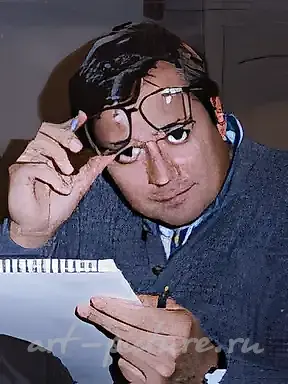
1957 Born in Moscow
1980 Graduated from the Moscow Polygraphic Institute
Works in collections
The State Tretyakov Gallery, Moscow
The State Russian Museum, Saint Petersburg
Novosibirsk Art Gallery, Novosibirsk
Perm State Art Gallery, Perm
Yekaterinburg Museum of Fine Arts, Yekaterinburg
Sprengel Museum, Hannover, Germany
National Gallery, Berlin, Germany
Galerie Eva Poll, Berlin, Germany
Private collections: Germany, Luxembourg, Milan (Italy)
Städtisches Kunstinstitut und Städtische Galerie, Frankfurt am Main, Germany
Museum Bochum, Bochum, Germany
Kunsthalle Emden/Stiftung Henri Nannen, Emden, Germany
Museum Ludwig, Cologne, Germany
Neue Galerie - Sammlung Ludwig, Aachen, Germany
Ulster Museum, Belfast, UK
Patrick and Beatrice Haggerty Museum of Art, Milwaukee, USA
Shedhalle, Zurich, Switzerland
Exhibitions and auctions
SOLO EXHIBITIONS
1988 Galerie Eva Poll, Berlin, Germany
Centraal Museum, Utrecht, Netherlands
1989 Goethe-Institut, Düsseldorf, Germany
Landesvertretung der Freien und Hansestadt Hamburg beim Bund, Bonn, Germany
1990 "Facing Apocalypse." Newport Art Museum and Art Association, Newport, Rhode Island, USA
"Russia: Within and Without." The Patrick and Beatrice Haggerty Museum of Art, Milwaukee, Wisconsin, USA
Galerie Lupfert, Hannover, Germany
1991 Stuart & Co. Gallery, New York, USA
Galerie Asbaek, Copenhagen, Denmark
Galerie Eva Poll, Berlin, Germany
"Art Cologne" (Galerie Eva Poll), Cologne, Germany
1992 "Maxim Kantor - Retrospective." Museum Bochum, Bochum, Germany
Galerie Lupfert, Hannover, Germany
1993 "Art Frankfurt" (Galerie Lupfert). Frankfurt am Main, Germany
"Salle d’Exposition de l’Hotel de Ville." Colmar, France
Galerie Lupfert, Hannover, Germany
"FIAC" (Galerie Asbaek), Paris, France
Galerie Eva Poll, Berlin, Germany
1994 Stiftung Henri Nannen. Kunsthalle Emden, Emden, Germany
Galerie Asbaek, Copenhagen, Denmark
Galerie im Haus Dacheroden, Erfurt, Germany
1995 "Retrospective." Tuttesall, Luxembourg; Berliner Kunsthalle, Berlin, Germany; Pori Taidemuseo, Helsinki, Finland
1995 "Maxim Kantor: Painting and Etchings," at the 5th Richard Wagner Festival. Bayreuth, Germany
1996 "Maxim Kantor. Painting 1982–1994." Rostock, Emden, Germany; Herning, Denmark; Lausanne, Switzerland
"Maxim Kantor," at the Richard Wagner Festival. Bayreuth, Germany
"Art Cologne" (Galerie Eva Poll). Cologne, Germany
1997 Royal College of Art, London, UK
"Criminal Chronicle." XLVII Venice Biennale, Russian Pavilion. Venice, Italy (catalog)
"Maxim Kantor." Lüneburg, Germany
"Maxim Kantor. Painting. Etchings." The Pushkin State Museum of Fine Arts, Moscow
GROUP EXHIBITIONS
1987 "30 Years of the Avant-Garde and Underground in Russia." Moscow
1987-89 "Schrecken und Hoffnung – Künstler sehen Krieg und Frieden." Hamburger Kunsthalle; Munich City Museum; Tretyakov Gallery, Moscow; State Hermitage Museum, St. Petersburg
1988 "Glasnost – die neue Freiheit der sowjetischen Maler. Ausstellung zeitgenössischer russischer Kunst." Stiftung Henri Nannen; Kunsthalle Emden; Galerie Valentien, Stuttgart, Germany
"Artisti sovietici contemporanei." Studio Marconi, Milan, Italy
"Soviet Art Today – From the Neue Galerie Sammlung Ludwig." Museum Ludwig, Cologne, Germany
1989-90 "From Revolution to Perestroika. Soviet Art from the Ludwig Collection." Kunstmuseum, Lucerne, Switzerland; Palau de la Virreina, Barcelona, Spain; Musée d’Art Moderne, Saint-Étienne, France
"Glasnost – Soviet Paintings from the Henri Nannen Collection." BAWAG Foundation, Vienna, Austria
1990 "Classic and Modern Sculpture." Gallery Nielsen, Boston, Massachusetts, USA
"Masterpieces of the Henri Nannen Collection and Classic Modernist Sculptures." Kunsthalle Emden, Emden, Germany
1991 "Graphics of Classic Modernism and the Present." Wolfgang Wittrock Kunsthandel, Düsseldorf, Germany
1995 "Charity Auction in Aid of the Children’s Hospital No. 9 Burn Center. Contemporary Russian Painting and Graphics." Sotheby’s, "ART MYTH." Metropol Hotel, Moscow
Author about himself
... For me, engaging in art is an entirely organic necessity. If I'm not painting, it means I am eating, traveling somewhere, making love, or fighting.
... I have always relied on a simple thing: all that we live through is bound to be forgotten, but there are things I want to make unforgettable.
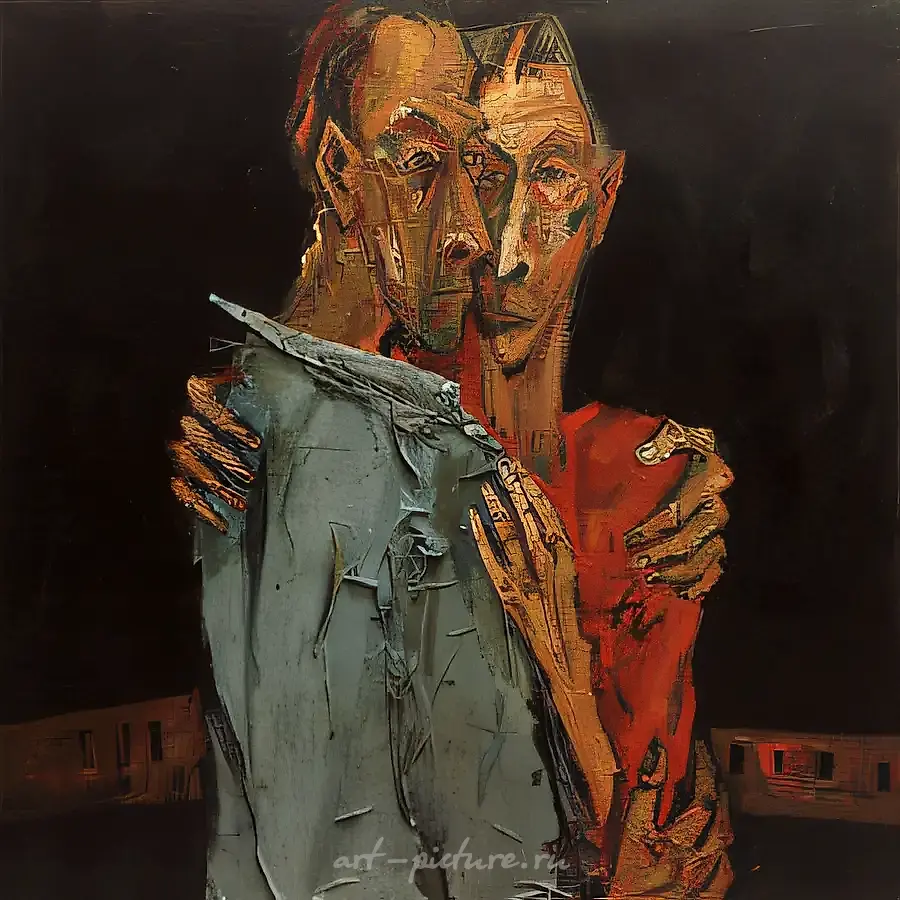
... More important than the criterion of 'completion' is the desire to stand athwart, to stop the flow of time. And to mark values that have no temporal boundaries. I started with portraits. I painted them as icons. In this wretched, empty, ever-changing life, I fixed faces as something meant to endure.
... My values were formed in a very enclosed world. I grew up in a family where the concepts of family name and tradition were revered. Thus formed my understanding of a narrow 'own' world, and another—'external.'
... Many years ago, I formulated my main principle—the principle of standing apart. It was as 'separate' that I recorded the images of people and things. Above all, I wanted separateness. I did not want scenes, I did not want still-lifes, I did not want landscapes; I wanted separate presence.
... 'Separateness' and 'Situatedness' can be common. 'Involvement' and connection surely exist. But the main thing is 'separateness'—an endlessly solitary and endlessly independent state of being in the world.
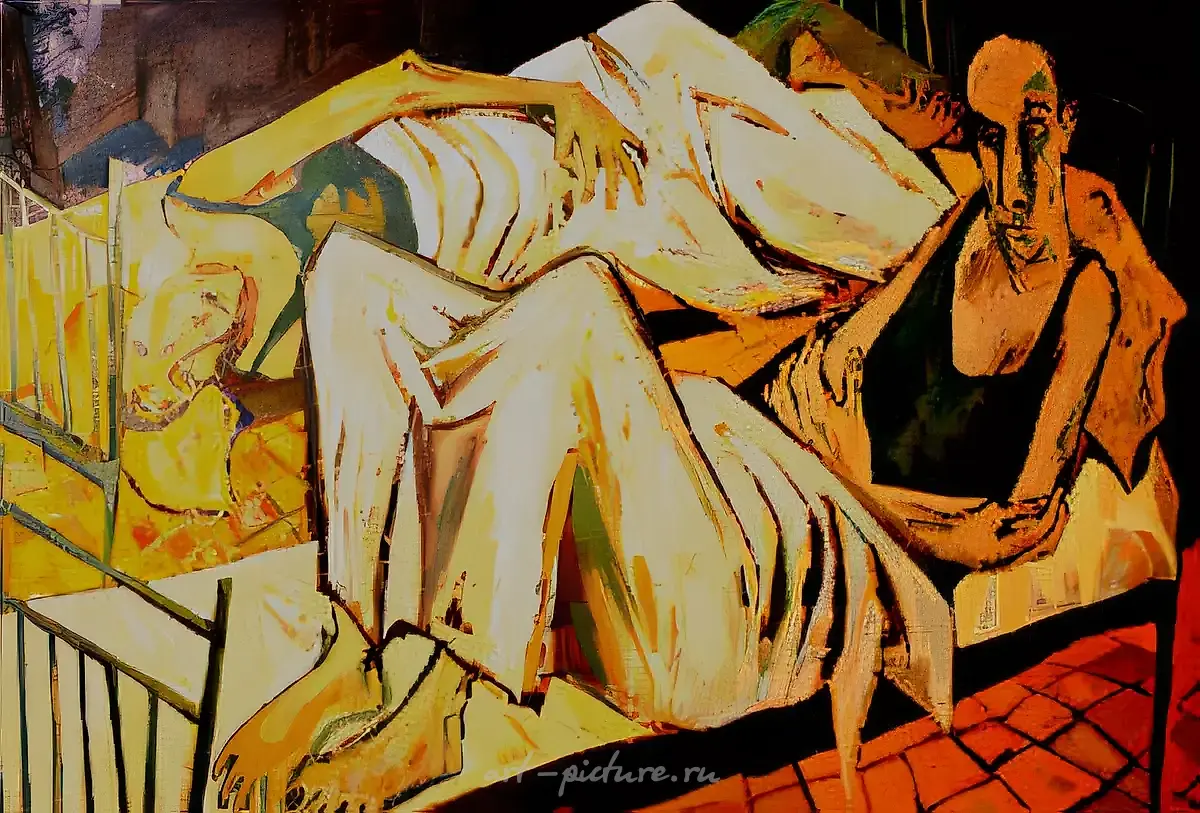
... this is undoubtedly a separate book—from my paintings, drawings, etchings, articles, stories, plays. In this book the characters wear their own coats, they have their own glasses, they drink wine in their own way, they love women in their own way, lie in bed their own way, take off their pants with one kind of movement, unbutton their shirts with another, eat dumplings this way, embrace a friend or father thus... This is their way of life. And I cannot imagine a great artist who lacks this conglomerate, this complex of images.
... Art, like any other manifestation, is for me connected with such a concept as responsibility. And in domestic, everyday, and those minimal social manifestations that are inherent to me, and in creative activities, I am always guided by one and the same feeling—a sense of responsibility.
... In everyday life, it is a responsibility for one's neighbor. There is no responsibility for art as such. There is my responsibility to the world, understood both broadly and narrowly at the same time. It is expressed in everything, from everyday trifles to painting and literature. This is how I understand freedom.
Fragments from an interview with G. Nikich
Critic
The spirit of denial, mockery, and defiance—this, as we are accustomed to think, characterizes 20th-century art. It demystifies and exposes ceaselessly. Jean-François Lyotard declared that this demystification knows no bounds and never ends. An excellent perspective—Western art revels in this freedom to dismantle values and truths, like a kind of drug. And Eastern Europe is becoming accustomed to it after a heavy sleep under an ideologically motionless, tombstone-like, official Communist ideology.
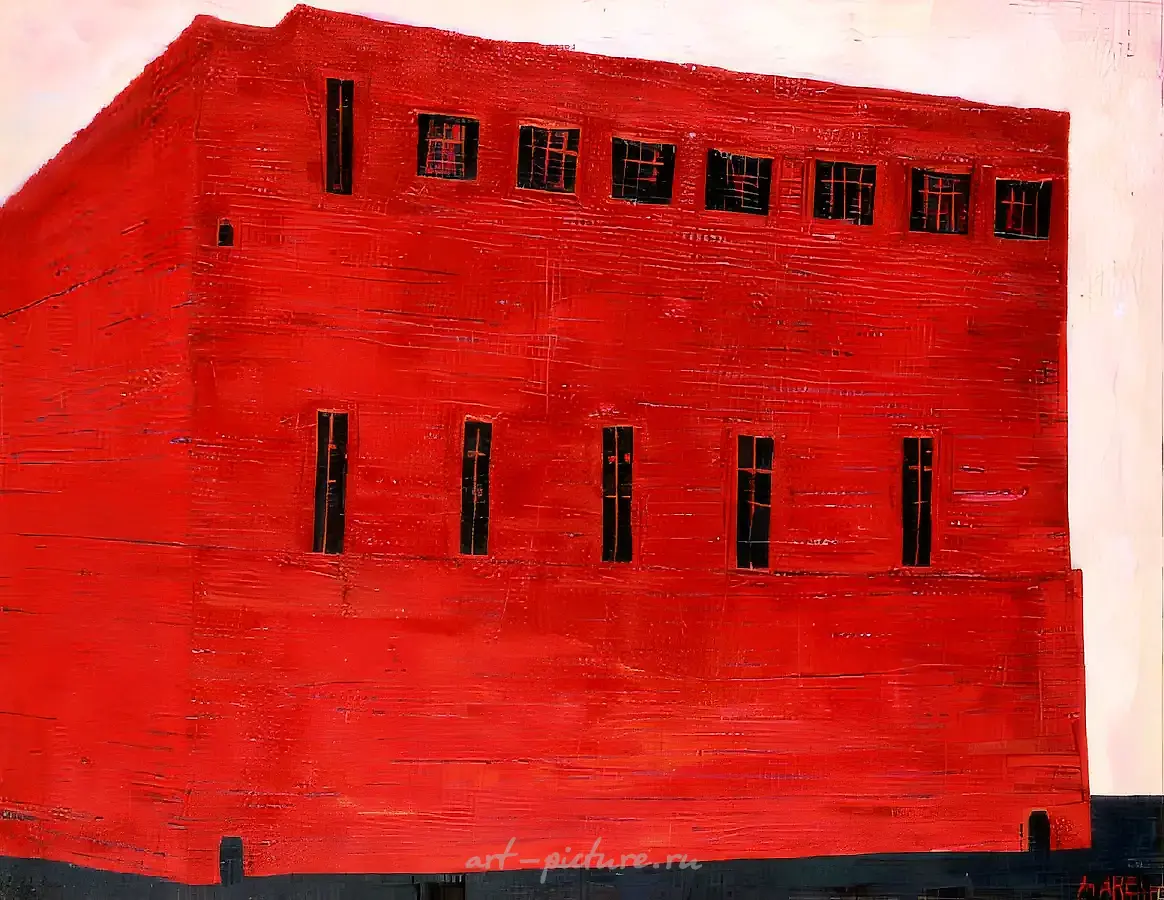
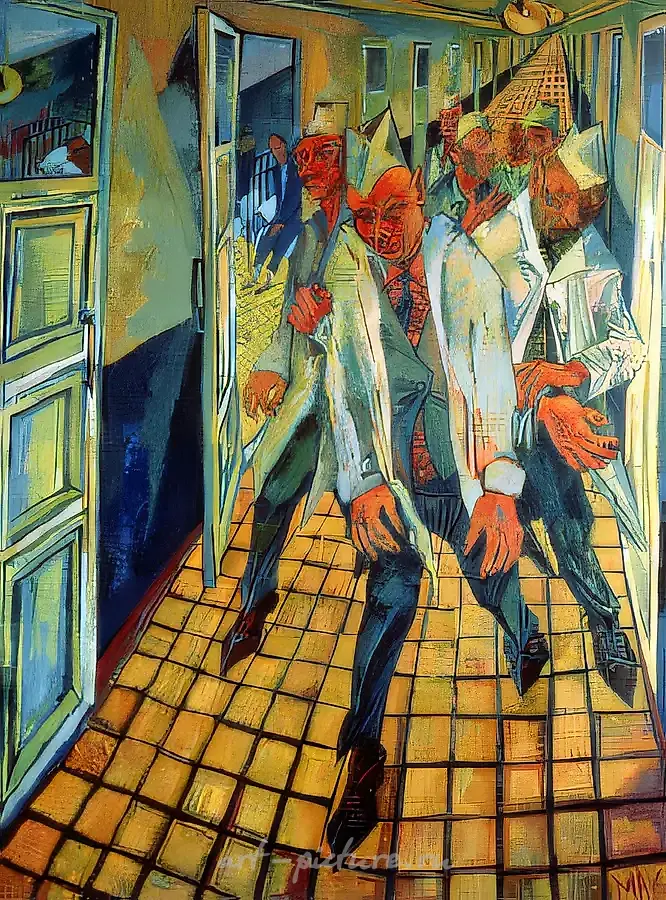
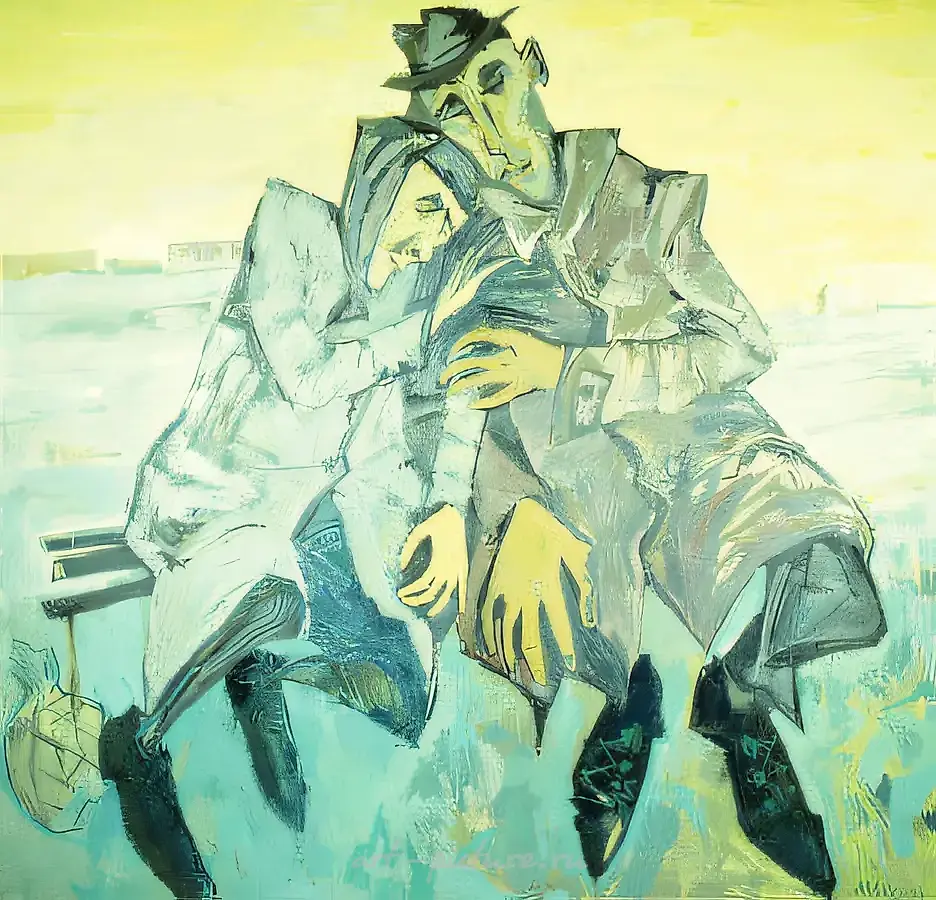
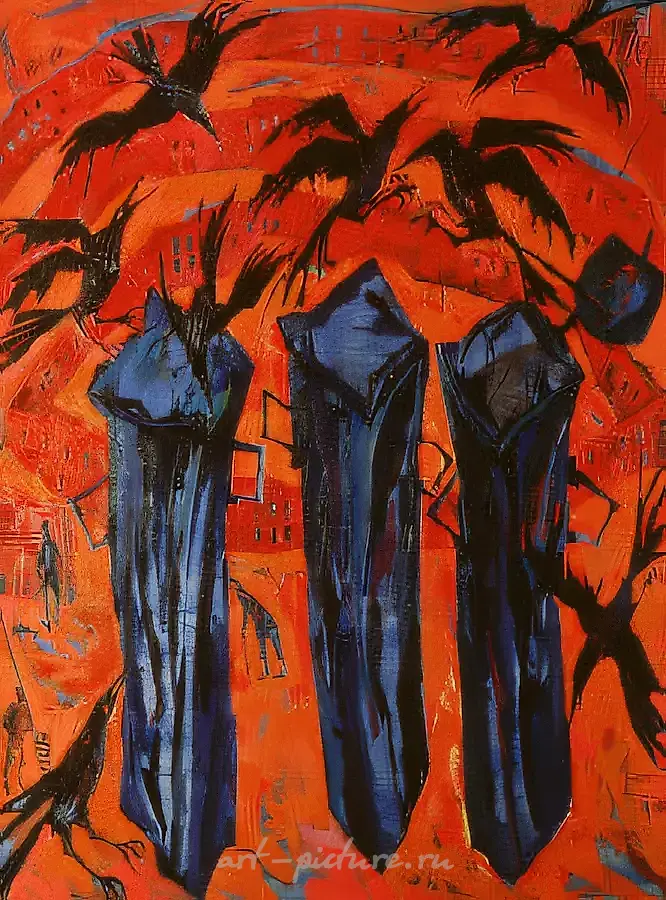
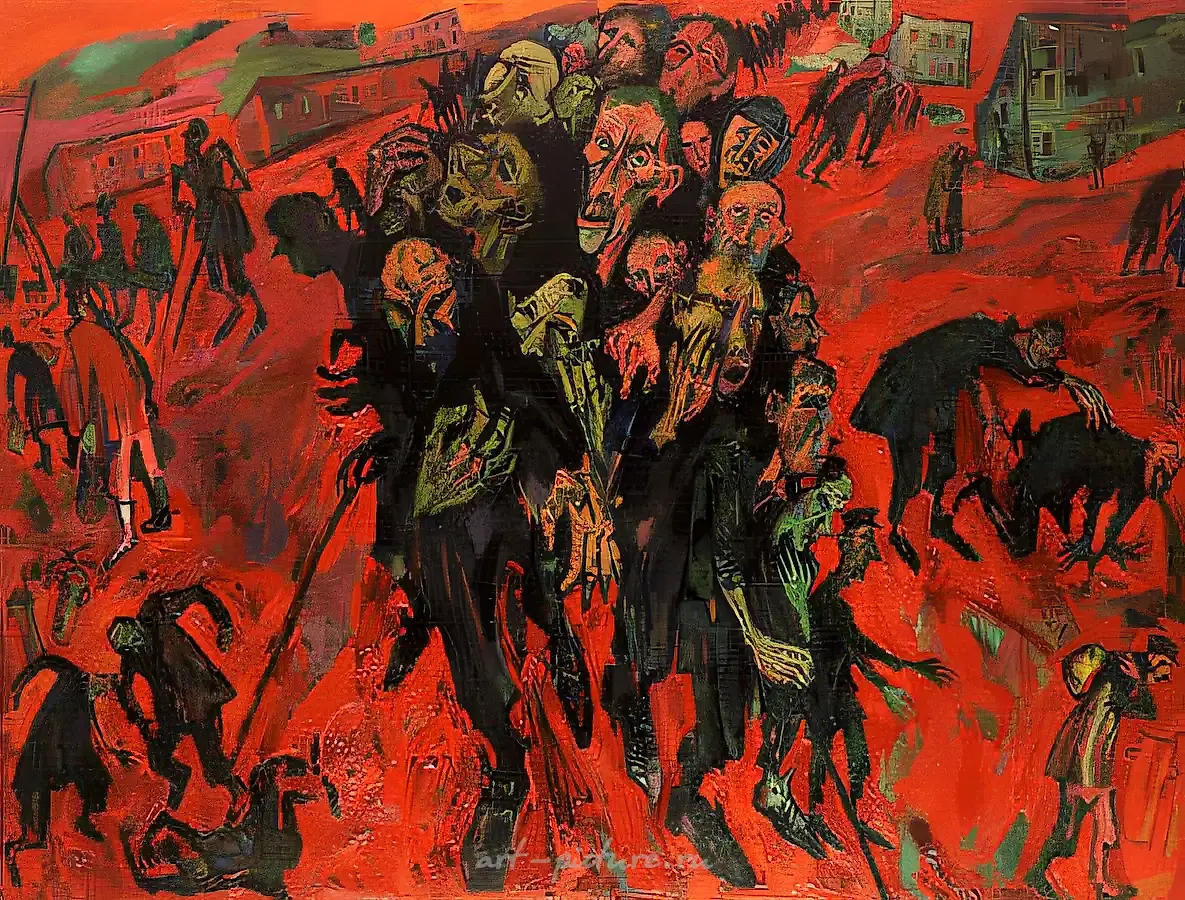
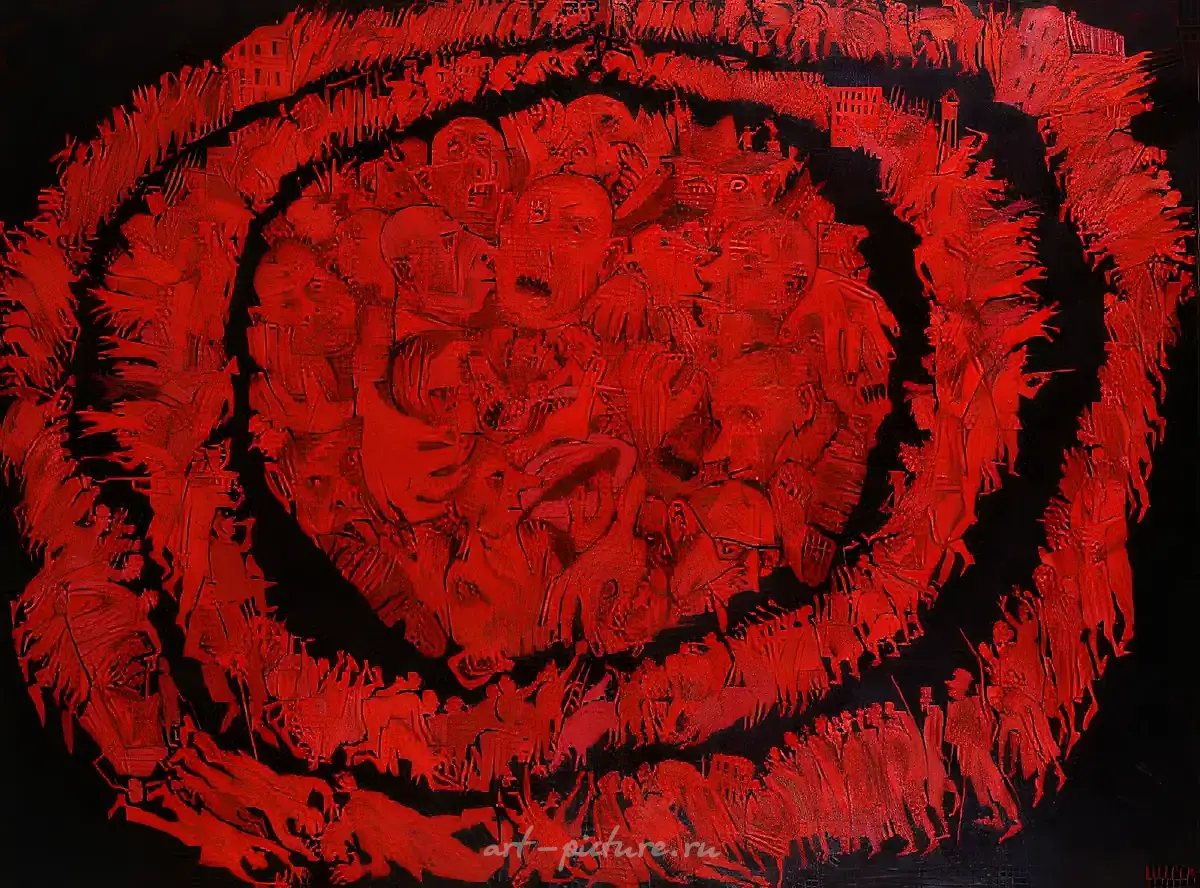
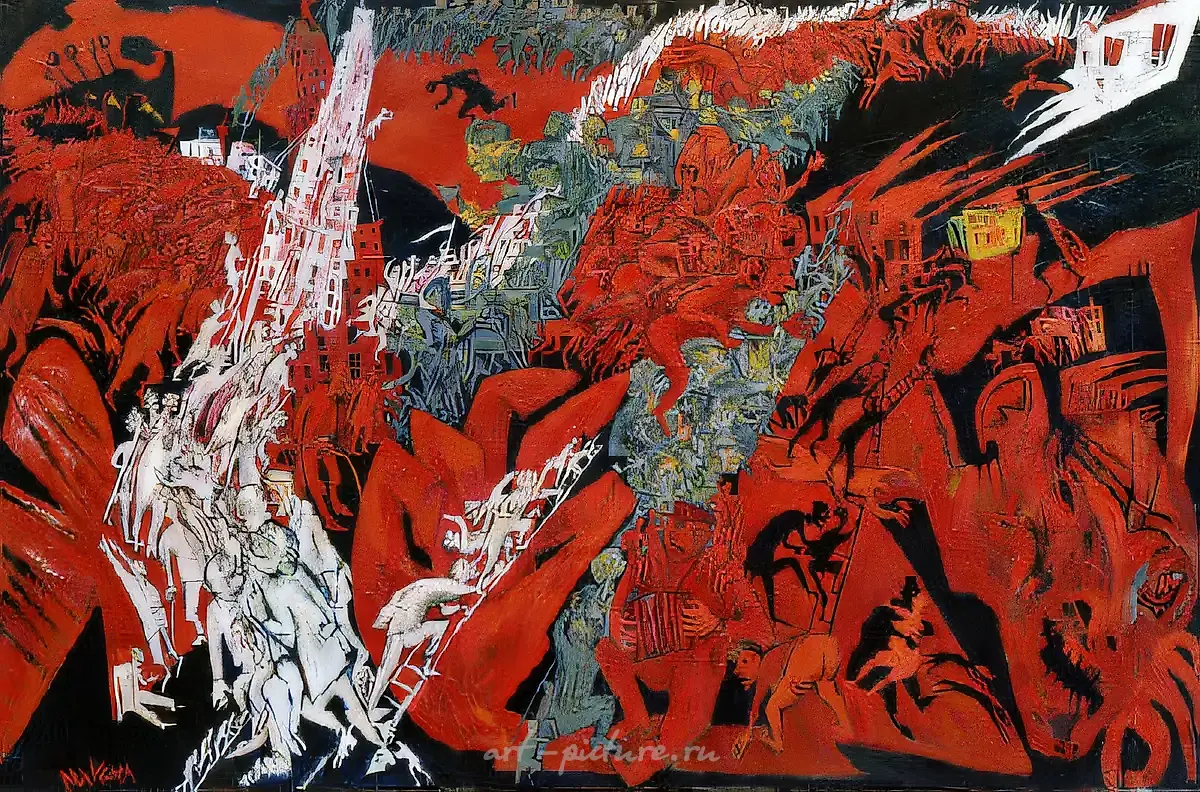
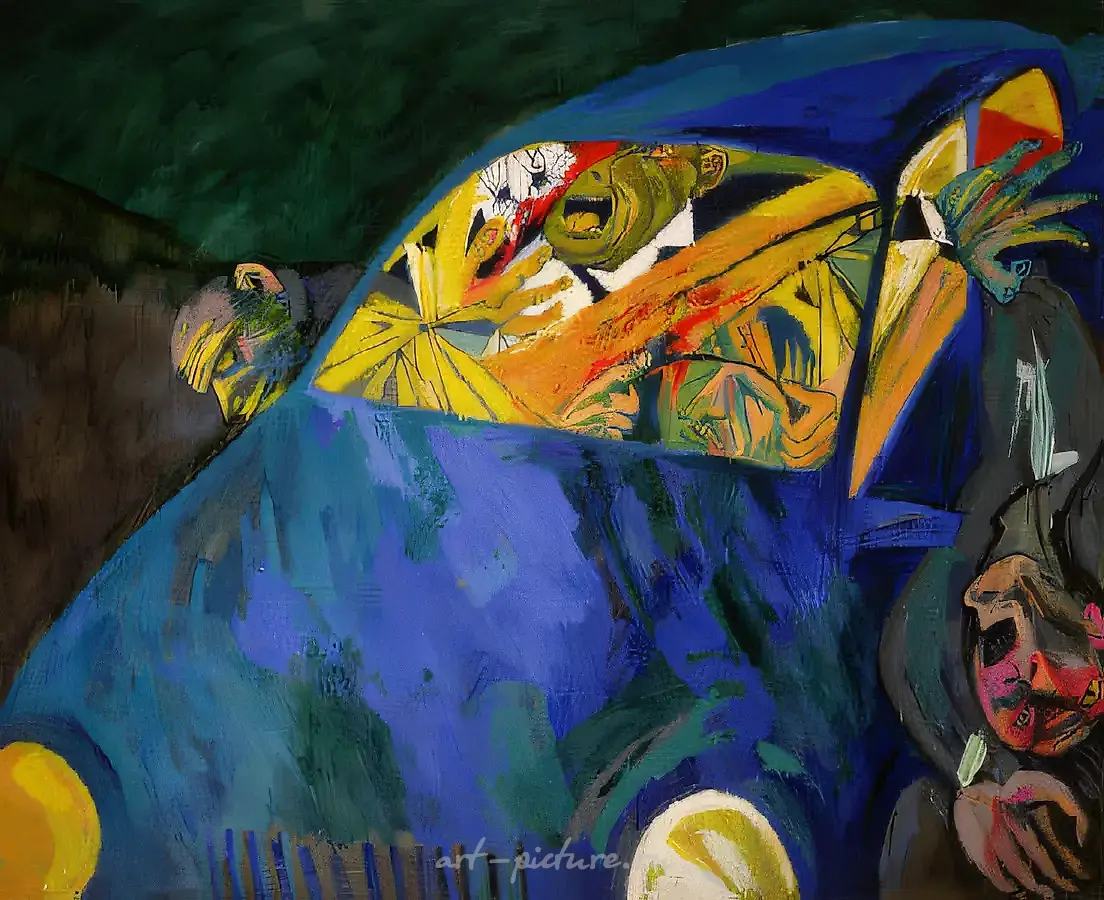
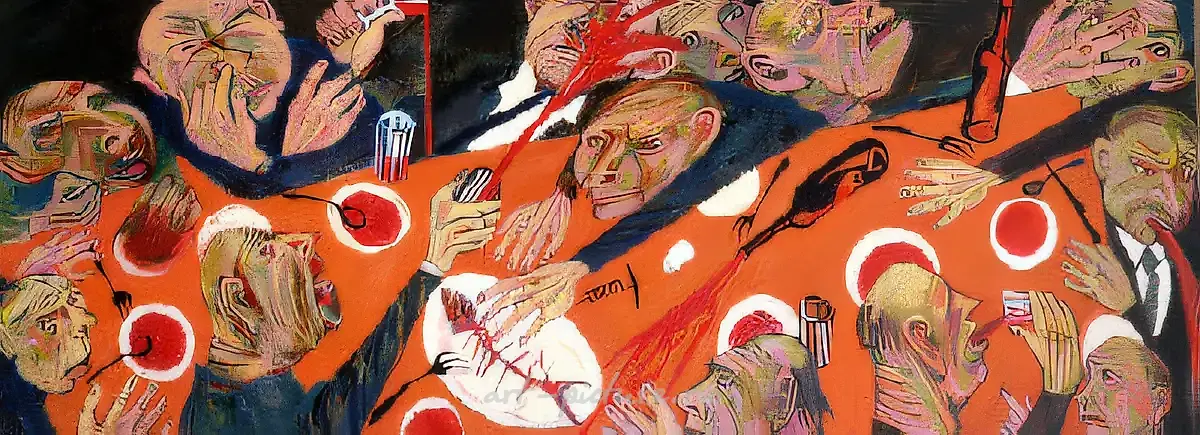
Moscow native Maksim Kantor is more a kindred spirit to Sartre and Picasso than to Lyotard and the postmodernists. He seems harsh toward objects, figures, and space. He twists, squeezes, almost breaks them. Skin and bones crack in his portraits. Hard to imagine his 'Rising Man' standing up, as if half-crushed by some monstrous force. People reach out and huddle together, seeking support in each other in the face of the voids and absences of existence, amid tottering walls, littered wastelands, slum-like corridors ('On a Wasteland', 'Corridor', 'Father and Son'). They hope for something, although we do not yet know what exactly. The excellent graphic sheet 'Lonely Crowd' only confirms that all these wretches cannot escape their loneliness, their imperfection and exhaustion, no matter how much they cling to each other.
So then, one more cynic from Eastern Europe, as if there are not enough on the West? Doesn't he mock the victims of his age, and should we not protest, as believers did against the blasphemous 'Madonna' of Max Ernst, or humanists against 'The Night Porter' by Liliana Cavani?
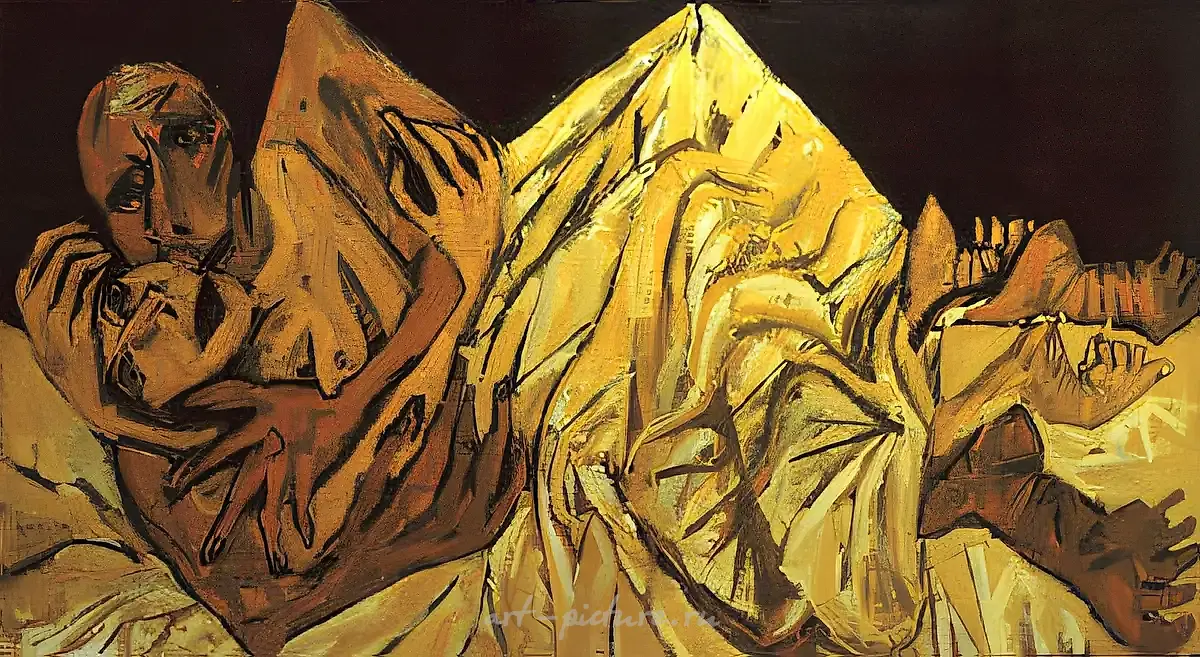
With Maksim Kantor, it is always about victims and defeats. The large—more than two meters high—painted relief 'Married Couple' is like two bloodied deformed shells of people left after treatment by some terrible machine borrowed from Franz Kafka. 'The scale of a person is measured by the volume of his losses,' the artist writes in his essay 'Fragments of Existence.' This is a frequent thought in his literary-philosophical texts. He is a person of the word as much as of the eye, that is, both a philosopher and an artist.
His philosophy’s address is easily recognizable. The significance of a person (his 'scale') is determined by the ruins and remnants marking the existence of each of us. Existence empties; but this emptiness is the main treasure. Karl Jaspers wrote half a century ago that the result of any life is inevitable defeat, das Scheitern. What to do with this? Modern mass culture and elitist postmodernism advise: make fun and demystify. Create 'cheerful apocalypses' (as one critic has written) and 'have fun to death' (as another has said). But this does not suit Maksim Kantor one bit.
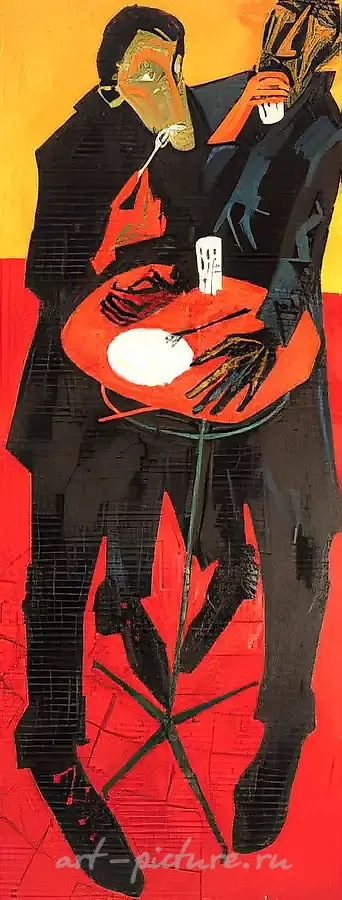
He is not always tragically serious. He is the author of a whole series of still lifes in which, according to him, he refutes the idea of the certainty and stable materiality of objects—a thought inherent in the classic still life (for example, Dutch). What is an object? Is it a condensation of matter—or, on the contrary, a hole and gap in existence, through which emptiness, Nothingness, peers out? Both possibilities are mockingly offered to our view. Again, it is about loss, about absence, about defeat—but this turns out to be both amusing and aesthetically refined. The artist knows how to play with concepts and to be witty.
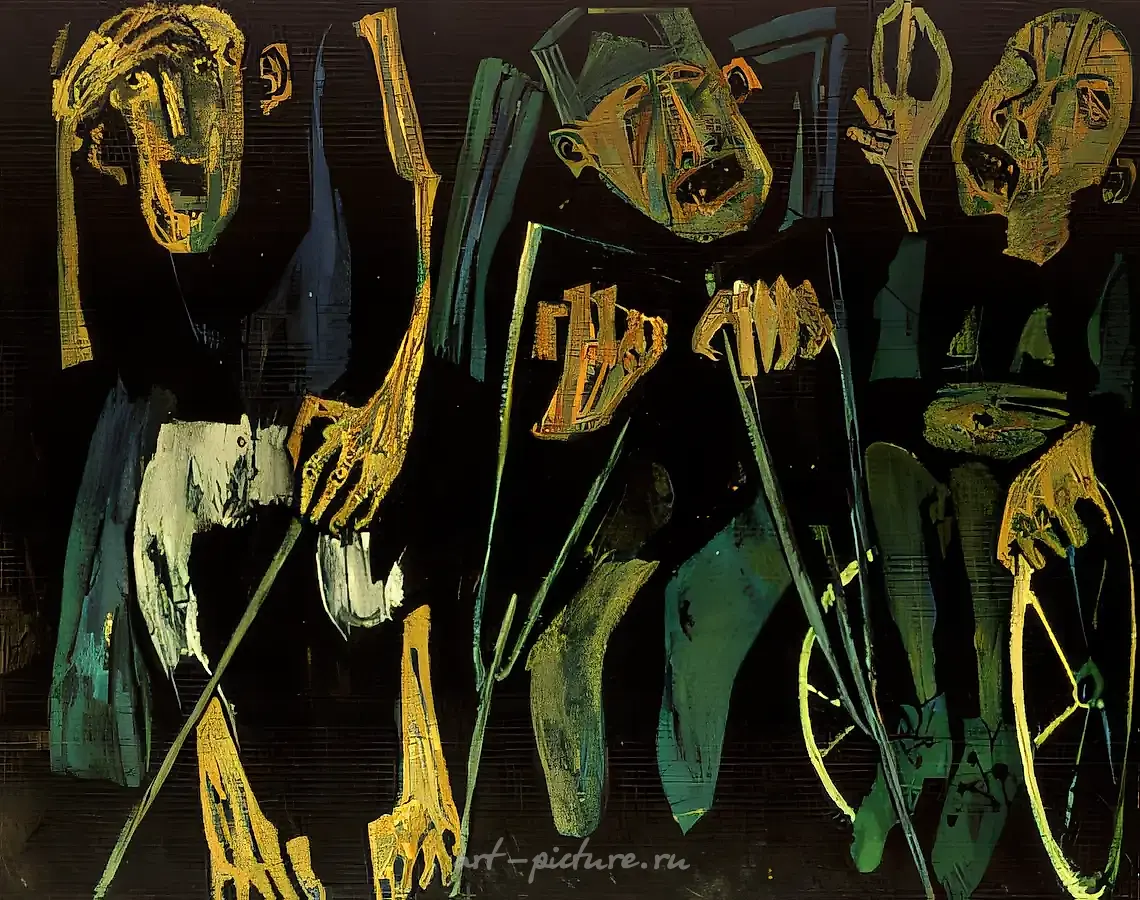
What does not suit him at all is the show on the edge of the abyss, the farce of errors and troubles—that which most interests contemporary art. Kantor’s monumental 'Card Index' reminds me of the 'archives of departed lives' by French artist Christian Boltanski. Before the coming void, fully armed with losses and defeats, a man—almost already a ruin, a shadow—radiates a certain inexplicable awareness of his spiritual nature. In this, the Russian artist agrees with Rembrandt, maker of marvelous portraits of old men and women, and with Pascal, who spoke of the 'thinking reed'...
A. Yakimovich. 'Maxim Kantor,
Bibliography
R. Menzel, "Exhibition of the Eight from Kuznetsky Most," magazine "Bidlende Kunst," No. 1, 1987;
O. Polyanskaya, "Maxim Kantor," magazine "Ogonyok," No. 11, 1989;
A. Yakimovich. Debuts. Young Artists of the Eighties. Moscow, 1990;
Exhibition catalog "Maxim Kantor. Facing Apocalypse," Newport, USA, 1990;
Exhibition catalog "Maxim Kantor," Hanover, 1990;
Exhibition catalog "Maxim Kantor," Copenhagen, 1991;
Exhibition catalog "Maxim Kantor," Berlin, 1991;
Exhibition catalog "Maxim Kantor. Retrospective," Bochum, 1992;
V. Meiland, "Time of Free Choice," magazine "Literary Study," No. 5, 1987.
Works 14