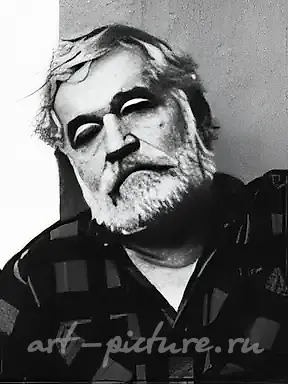
PLAVINSKY, Dmitry Petrovich
Dmitry Petrovich Plavinsky (April 28, 1937, Moscow – September 1, 2012, Moscow) was a Soviet and Russian artist and graphic artist of the nonconformist generation of the Sixties, a representative of unofficial art. Creator of the movement of structural symbolism. From 1991 to 2004, he lived and worked in New York.
Works in collections
State Tretyakov Gallery, Moscow
State Pushkin Museum of Fine Arts, Moscow
Collection of Contemporary Art of the State Museum-Reserve Tsaritsyno, Moscow
State Russian Museum, St. Petersburg
Simferopol Art Museum, Simferopol, Ukraine
Museum Ludwig, Cologne, Germany
Metropolitan Museum of Art, New York, USA
Museum of Modern Art, New York, USA
Norton and Nancy Dodge Collection, Zimmerli Art Museum, Rutgers University, New Brunswick, USA
Duke University Museum of Art, North Carolina, USA
Private collections in Russia, Germany, France, USA, and others.
Exhibitions and auctions
SOLO EXHIBITIONS
1958 Lomonosov Moscow State University, Moscow
1960 Exhibition in the apartment of I. Tsirlin, Moscow
1970 House of Science at the Joint Institute for Nuclear Research, Dubna
1985 House of Culture of the I.V. Kurchatov Institute of Atomic Energy, Moscow
1990 Gallery "Today", Moscow
1993 Alex & Edmund Gallery, New York, USA
"Exhibition of Painting and Graphics." Mansion of the Ministry of Foreign Affairs, Moscow
1995 "Dom Nashchokina" Gallery, Moscow
GROUP EXHIBITIONS
1957 III Exhibition of Young Artists of Moscow and the Moscow Region. Artists' House on Kuznetsky Most, Moscow
1957 Exhibition of Young Soviet Artists. IV World Festival of Youth and Students. Academy of Arts, Moscow
1957 Exhibition of Artists from International Studios. IV World Festival of Youth and Students. Central Park of Culture and Leisure, Moscow
1958 IV Exhibition of Young Moscow Artists. Artists' House on Kuznetsky Most, Moscow
1959 V Exhibition of Young Moscow Artists. Artists' House on Kuznetsky Most, Moscow
1960 Exhibition in the apartment of I. Tsirlin, Moscow
1960 Exhibition in the apartment of G. Costakis, Moscow
1960 Exhibition of graduates of the Art School in Memory of 1905. Central House of Writers and Artists, Moscow
1964 "Aspects of Contemporary Soviet Art." Grosvenor Gallery, London, UK
1965 "The Fielding Collection of Russian Art." Arleigh Gallery, San Francisco, USA
1966 Exhibition of works. 19th Festival of Fine Arts. Sopot, Poznan, Poland
1967 "Exhibition of Twelve Artists." Club "Druzhba", Moscow
1967 "Painting and Graphics from the Collection of A. Glezer." Union of Artists of the Georgian SSR, Tbilisi
1967 "A Survey of Russian Painting, Fifteenth Century to the Present (including the Huntington Garford Collection)." Gallery of Modern Art, New York, USA "Quindici giovani pittori moscoviti." Galleria il Segno, Rome, Italy
1967 "Peinture nouvelle dURSS." Maison de la Tour; Galerie ABC; Saint-Restitut (Drome), France 1968 "Autumn Exhibition of Moscow Artists." Exhibition Hall of the Moscow Union of Artists on Begovaya, Moscow 1969 Institute of World Economy and International Relations, Moscow 1969 "Neue Schule von Moskau." Galerie Interior, Frankfurt; Galerie Behr, Stuttgart, Germany; Galleria Pananti, Florence, Italy 1970 "Open Air" Exhibition in the courtyard of American journalist E. Stevens' mansion. 11 Ryleeva St., Moscow 1970 "Panorama de la jeune peinture slave." Latelier du soleil, Versoix, Geneva, Switzerland
1970 "Nuove correnti a Mosca." Museo Belle Arti, Lugano, Switzerland
1970 "Russische Avantgarde in Moskau heute." Galerie Gmurzynska, Cologne, Germany
1970 "Alexei Smirnov und Russische Avantgarde von Moskau." Kunstgalerie Villa Egli-Keller, Zurich, Switzerland
1971 "10 Kunstnere fra Mosca." Komune Kulturfond i Samarbejde med Billedkunstnernes Forbund Nicolai, Copenhagen, Denmark
1973 "Avant-garde russe de Moscou 73." Galerie Dina Verny, Paris, France
1974 "Progressive Stromungen in Moskau 1957-1970." Museum Bochum, Bochum, Germany
1974 "8 peintres de Moscou." Musee de Peinture et de la Sculpture, Grenoble, France
1975 "Painting Exhibition at VDNKh." VDNKh, Pavilion "Beekeeping", Moscow
1975 "Russischer Februar 75 in Wien. Sammlung Alexander Gleser." Kunstlerhaus, Vienna, Austria
1975 "Nonkonformistische russische Maler. Sammlung Alexander Gleser." Kunstverein Braunschweig; Kunstverein Freiburg; Kunstamt Charlottenburg, West Berlin, Germany
1976 "Seven Artists." City Committee of Graphic Artists, Moscow
"Exposition at the Russian Museum in Exile" (A. Glezer Collection). Mongeron, France
1976 "Nonkonformistische russische Maler. Sammlung Alexander Gleser." Stadtgalerie
1976 "Die Fahre", Saulgau, Germany
1976 "Deuxieme Biennale Europeenne de la Gravure." Mulhouse, France
1976 "Nonkonformistische russische Maler. Sammlung Alexander Gleser." Kunstverein, Konstanz, Germany
1976 "New Art from the Soviet Union." Convention of the American Association for the Advancement of Slavic Studies, St. Louis, USA
1976 "Image of Modern Russia (A. Glezer Collection)." Parkway Focus Gallery, London, UK
1976 "La peinture russe contemporaine." Palais des Congres, Paris, France
1977 "Unofficial Art from the Soviet Union." Institute of Contemporary Arts (with the collaboration of the Russian Museum in Exile, Mongeron). London, UK
1977 "Biennale Internationale des eaux-fortes." Mulhouse, France
1977 "Autumn Painting Exhibition." 28 Malaya Gruzinskaya, Moscow
1977 "La nuova arte Sovietica." The Venice Biennale, Venice, Italy
1977 "Russian and Soviet Painting. An Exhibition from the Museums of the USSR." The Fine Arts Museums of San Francisco, San Francisco; The Metropolitan Museum of Art, New York, USA
1977 "Arts et Matière. Avec la participation des artistes russes contemporains." Orangerie du Luxembourg, Paris, France
1977 "Les peintres non-officiels de lUnion Soviétique." Maison de la culture, Saint-Maur, France 1977 "New Art from the Soviet Union." Herbert F. Johnson Museum of Art, Cornell University, Ithaca; The Arts Club of Washington and the Kiplingert Editors Building, Washington, USA 1978 "Lart russe non-officiel." Musee des Beaux-Arts; Musee du Vieux Chateau, Laval, France
1978 "Review on Cultural Dissent in Eastern Europe." Art and Crafts School, Aula Magna Cantonal Commercial School, Aula Magna Town Hall, Patriziale Hall, Bellinzona, Switzerland
1978 "Russische Maler der Gegenwart Peretz Auktion 76." Modern Gallery Auktionshaus Peretz. Saarland Museum, Saarbrücken, Germany
1978 "La nuova arte sovietica." Turin Biennale. Palazzo Reale, Turin, Italy
1978 "Libera arte sovietica." Milan, Italy
1978 "Contemporary Unofficial Soviet Art." Municipal Museum, Tokyo, Japan
1978 "Aspetti e documentazione degli artisti non conformisti dellUnione Sovietica." Museo Civico di Lodi, Lodi, Italy 1979 "Color, Space, Form." 28 Malaya Gruzinskaya, Moscow 1979 "20 Years of Independent Art from the Soviet Union." Art Collection. Museum Bochum, Bochum, Germany 1980 "19 Moscow Artists." 28 Malaya Gruzinskaya, Moscow 1980 "Exhibition of new acquisitions 1970-1980." State Pushkin Museum of Fine Arts, Moscow 1980 "Lart russe a Paris a 75 ans." Galerie Chantepierre, Aubonne, Switzerland
1980 "First Biennale of Russian Painters." Centre des art et Loisirs de Vesinet, Vesinet, France
1980 "15 from Moscow." Galerie Moscou-Petersbourg, Paris, France
1980 "Biennale de l`Art Graphique-80." Galerie Moscou-Petersbourg, Paris, France
1980 "Nonconformist Russian Art." Vancouver, Canada
"Exhibition of Russian Unofficial Art." Salon Fieristico, Rimini, Italy
1981 "25 Years of Soviet Unofficial Art: 1956-1981." Museum of Soviet Unofficial Art in Exile. C.A.S.E., Jersey City, USA
1981 "Autumn Exhibition of Painting and Graphics." 28 Malaya Gruzinskaya, Moscow
1981-82 "25 years of Contemporary Soviet Art." Museum of Contemporary Russian Art, Mongeron, France
1982 "10 Moscow Artists." 28 Malaya Gruzinskaya, Moscow
1982 "50 years of the Moscow Union of Artists." Central Artists' House, Moscow
1983 "Unofficial Art from the Soviet Union." Capitol Hill, Cannon Rotunda and Russel Rotunda, Washington, USA
1983 "Exhibition of the Works of Moscow Artists." University of San Jose, Costa Rica
1983 "Object Exhibition." Artists' House on Kuznetsky Most, Moscow
1984 "Unofficial Russian Art." Meerbuscher Kultursommer, Meerbusch, Germany
1984 "Exhibition of Drawings." Galerie Marie-Terese, Paris, France
1984 Painting Exhibition. 28 Malaya Gruzinskaya, Moscow
1985 Painting Exhibition. 28 Malaya Gruzinskaya, Moscow
1986 "Scientific and Technical Revolution (NTR) and Fine Arts." Central Artists' House, Moscow
1986-87 Painting Exhibition. 28 Malaya Gruzinskaya, Moscow
1987 "Retrospective of Moscow Artists' Works. 1957-1987." "Hermitage" studio, 100 Profsoyuznaya St., Moscow
1987 "Watercolor, Drawing, Print." 28 Malaya Gruzinskaya, Moscow
1988 "SOTHEBY’S. Russian Avant-Garde and Soviet Contemporary Art." World Trade Center, Moscow
1988 "Ich lebe – Ich sehe." Kunstmuseum, Bern, Switzerland
1988 "Exhibition of Moscow Artists." Museum Bochum, Bochum, Germany
1988 "Exhibition of Soviet Artists." Copenhagen, Denmark
1988 "Exhibition of Artworks of the 16th-20th Centuries from the Collection of G. Basmajian." State Tretyakov Gallery, Moscow; State Hermitage, Leningrad
1989 "Avant-Garde Art Festival." Glinka Museum of Musical Culture, Moscow
1989 "Spiritual Art" (in cooperation with the Moscow Patriarchate). Exhibition Hall on Solyanka, Moscow
1989 "Phillips Auction." London, UK
"Graphics by Moscow Artists." Central Artists' House, Moscow
1989 "From Revolution to Perestroika. Soviet Art from the Ludwig Collection." Kunstmuseum, Lucerne, Switzerland
1990 "Towards the Object." "Kashirka", Moscow
1990 "ART MYTH 1." Central Artists' House, Moscow
1990 "Anniversary Exhibition of the City Committee of Graphic Artists." Manezh, Moscow
1990 "Exhibition of new acquisitions 1980-1990." State Pushkin Museum of Fine Arts, Moscow
1990-91 "Other Art. Moscow 1956-1976." "Moscow Collection" Gallery. State Tretyakov Gallery, Moscow; State Russian Museum, Leningrad
1991 "Contemporary Soviet Art: From Thaw to Perestroika." Collection of Contemporary Art, Tsaritsyno Museum. Setagaya Art Museum, Tokyo, Japan
1991 "Modern Art from Russia – Contemporary Artists." Tang Collection, Hong Kong
1991 "Russian Art Now: the Moscow Avant-Garde." Gregory Gallery, Washington, USA
1991 "Shemiakin, Tselkov, Plavinsky, etc." Alex & Edmund Gallery, New York, USA
1991 "V izbah/In Rooms." House of Culture, Bratislava, Slovakia
1991 "In the USSR and Abroad." Stedelijk Museum, Amsterdam, Netherlands
1992 "Moscow Romanticism." Central Artists' House, Moscow
1992 "New Directions." Selected from the George Riabov Collection of Russian Art, the Norton and Nancy Dodge Collection of Nonconformist Art from the Soviet Union, the Gordon Henderson Collection of Stained Glass Design. The State University of New Jersey, Rutgers, Jane Voorhees Zimmerli Art Museum, New Brunswick, USA
1993 "The George Riabov Collection of Russian Art." The State University of New Jersey, Rutgers, Jane Voorhees Zimmerli Art Museum, New Brunswick, USA
1993 "National Traditions and Postmodernism." State Tretyakov Gallery, Moscow
1994 Cetinje Biennale II. Cetinje, Montenegro
1994 "Nie i Konformosci." Krolikarnia, Warsaw, Poland
1995 "On the 20th Anniversary of the Bulldozer Exhibition," 10 Gogolevsky Blvd., Moscow
1995 "Charity Auction for the Benefit of the Burn Center of the Children’s Hospital No. 9. Contemporary Russian Painting and Graphic Art." Sotheby's, "ART MYTH." Metropol Hotel, Moscow
1995 Mimi Ferzt Gallery, New York, USA
Author about himself
I was born in Moscow in 1937 in the lanes of the Arbat. That same year, my mother was repressed; I met her only eleven years later. I began to draw at the age of ten, copying extensively from Gnedich's three-volume history of art, which I found by chance in my father's library.
From 1951 to 1956, I studied in the theater department of the Art School in Memory of 1905. The department was headed by V.A. Shestakov, formerly the chief artist of the Meyerhold Theater. Another teacher, Leonid Fedorov, introduced me to the secrets of painting technique. I owe the willful transformation of the white sheet in composition, of course, to the excellent teacher Ovseyan, with whom I worked in 1952. At various times, my future comrades Krasnopevtsev, Sveshnikov, and Zverev also studied there.
In 1957, Russian artists first became acquainted with contemporary European and American art at the Moscow International Youth Festival. This served as a powerful impetus for the emergence of new art in Russia—a time of painful searching for one's own path. "Still Life with Scissors" and "Girl at the Window" (Zimmerli Art Museum, New Brunswick, USA) were among my first works built on the combination of different textures.
In 1958, I traveled to Central Asia for the first time and discovered the genius poetry of Khlebnikov. This marked the beginning of my abstract-material period and a particular attention to texture.
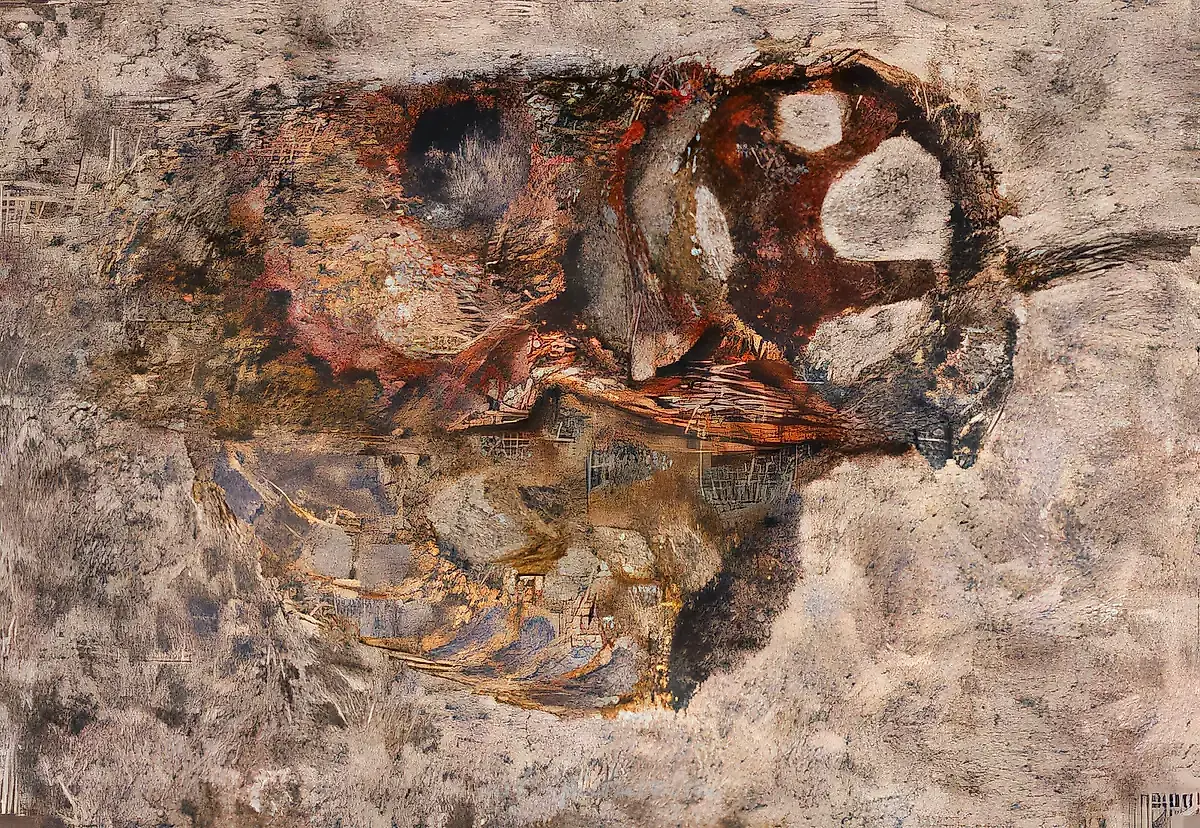
In 1960, my first solo exhibition opened in the apartment of the forward-thinking art historian Ilya Tsirlin. George Costakis, the world-famous collector of Russian 1920s avant-garde, acquired my work "Screaming Fish" from this exhibition. This work began my explorations of the themes of fish, turtles, lizards, beetles, and butterflies. A year later, Nina Stevens began to collect my works. By the 50th anniversary of Soviet power in 1967 at the Museum of Modern Art in New York, there was an exhibition of Russian art from the 15th–20th centuries. Stevens presented her collection of contemporary Russian avant-garde there, which included twenty-two of my works. The Museum of Modern Art in New York acquired three of them.
In 1962, my composition "Voices of Silence" (Museum of Modern Art, New York) for the first time developed the theme of Time, where lines of fate from various human cultures, interweaving, create a chiromantic imprint of the Single Time.
In 1965, I painted "Coelacanth" (Museum of Modern Art, New York), presenting a dramatic image of the most ancient fish painfully giving birth to man. The black night of Stalinism attempted to obscure the past of the great Russian culture. We all passionately set about restoring broken connections. Since 1959, I traveled and worked extensively in northern Russia: Novgorod, Pskov, the Ferapontov Monastery, Yaroslavl, and Kostroma provided me with rich material on the contemporary catastrophic state of ancient Russian culture. I worked enthusiastically in local museums and monastery libraries on Slavic paleography. Based on this material, I created several works, the main ones being "The Gospel of John" (1966) and "The Word" (1967, Tretyakov Gallery, Moscow).
In the "Word" composition, the opening phrase of John's Gospel—"In the beginning was the Word, and the Word was with God"—is mathematically multiplied and develops from the center of the painting outward, following a cryptographic system. This is a panorama of the emergence of the Word on Earth, bestowed upon man by God.
Since 1969, I have spent long periods in rural villages. I witnessed the tragic picture of their extinction and the unbearable life of Russian peasants. I devoted a series of etchings to this theme over 15 years. This series was concluded by the painting "Running into Darkness" ("Dog"), which was acquired by the Ludwig Museum, Germany.
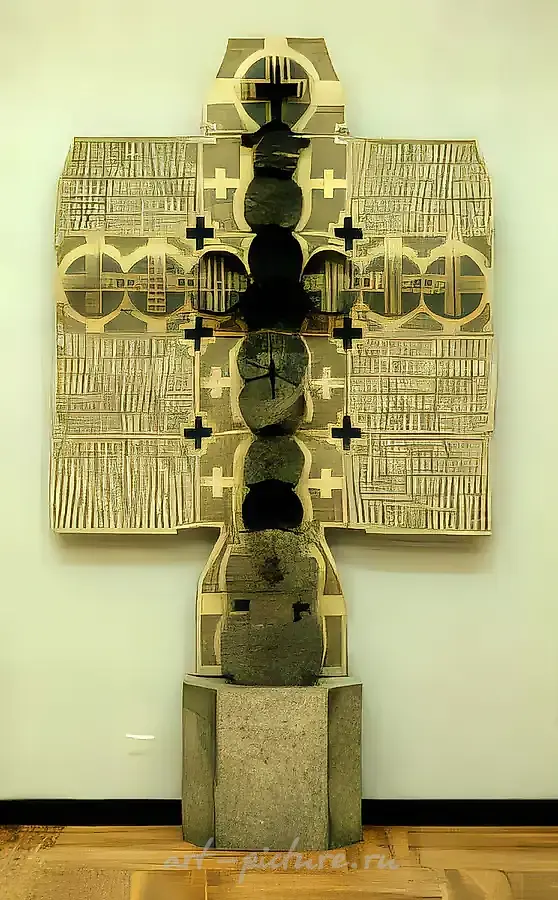
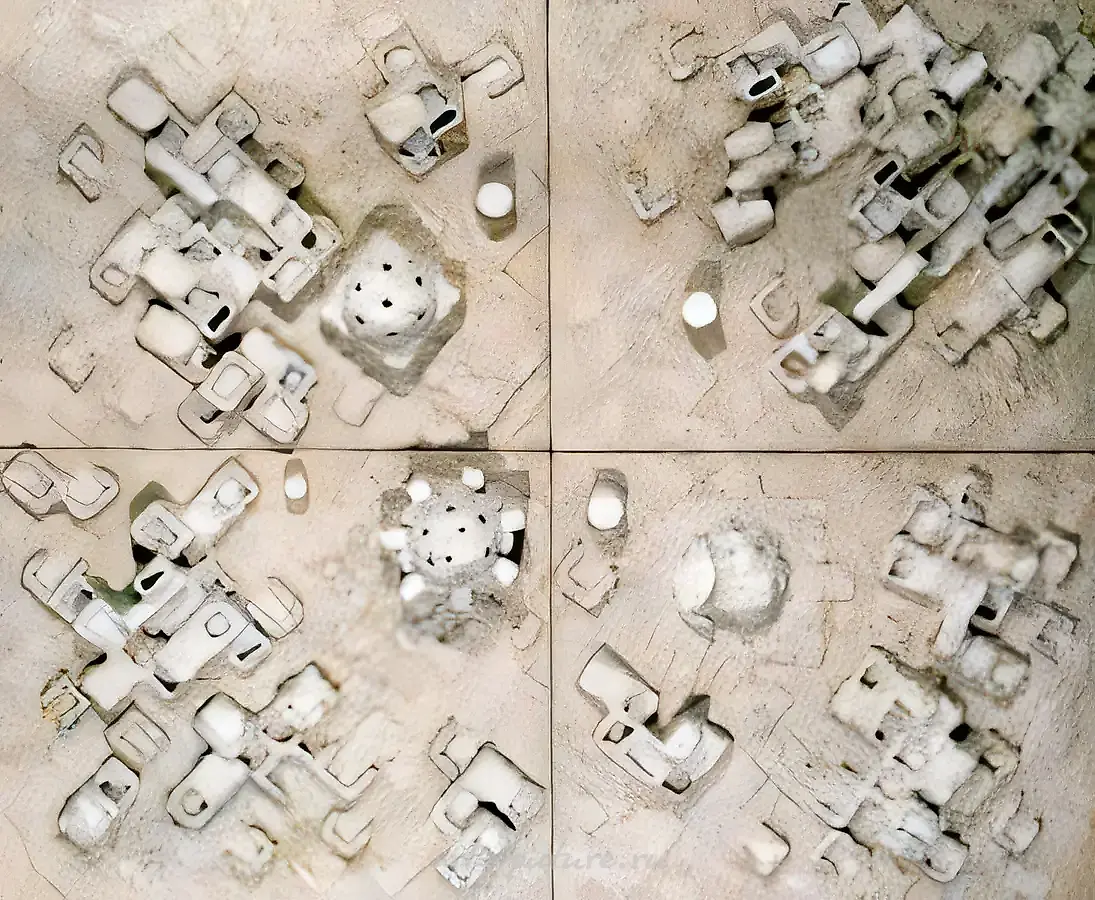
The complex architectural construction "Cross," 1976, summarized my ideas over nearly twenty years.
In 1977, I made a sharp transition from textured and semi-volumetric works to a lacquer-glaze space that absorbs and dematerializes the object. The focus shifted from the object to space itself.
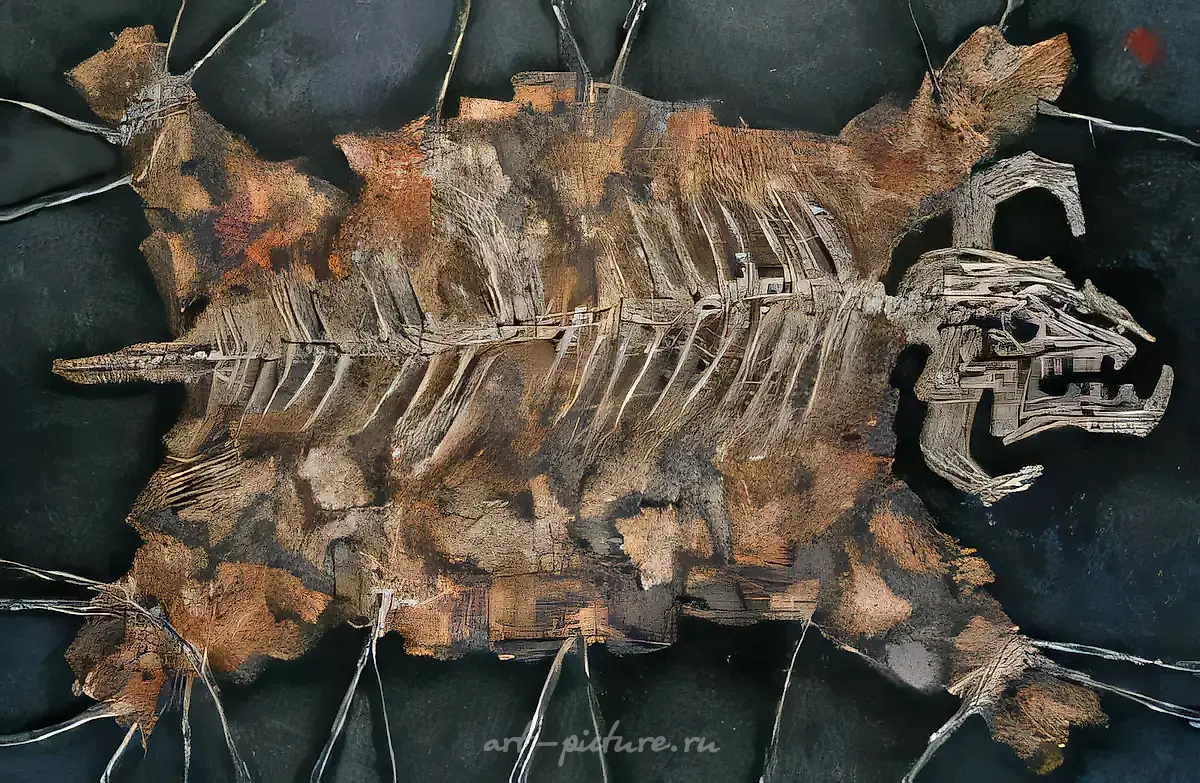
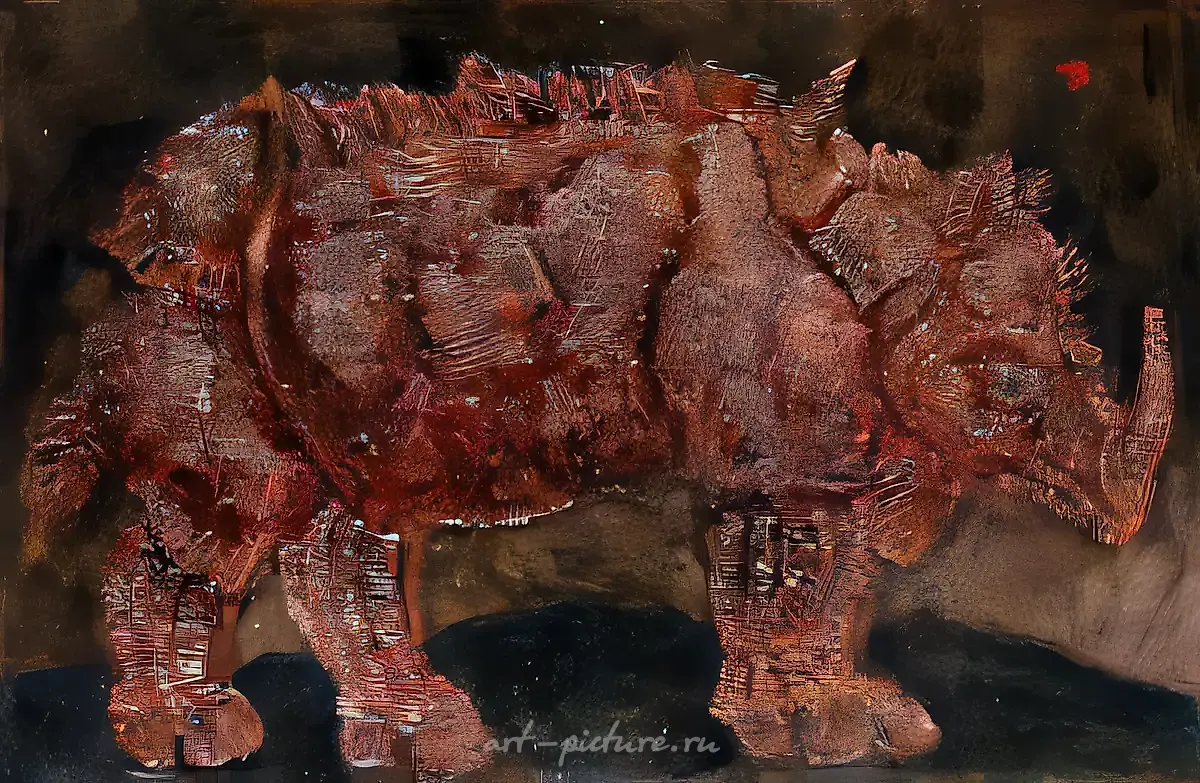
My many trips to Central Asia were summed up in the "Skull and Koran" series and the complex object "Asia. The City of the Dead" (Museum of Modern Art, Tsaritsyno, Moscow). In this new glaze-space system, I painted: "Old Chair" (1977), "Flying Fish" (1978), "Ray" (1981), "Turtle" (1982).
I have always sought association not so much with artists as with people who truly enrich my inner world: poets, musicians, mathematicians, geologists, and astronomers.
Since 1988, I have included rhythmic constructions of Bach, Mozart, and Stravinsky's musical notation in my compositions, and here in America, I work with the scores of the American composer George Crumb.
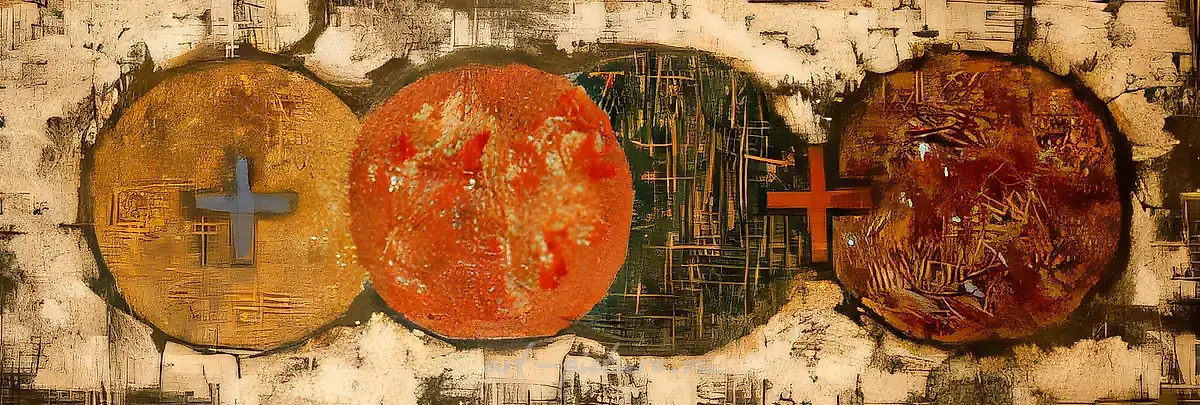
By fate, finding myself in New York, I discovered that the Earth is indeed round. The circle, as the geometry of the painting, asserts itself in my art. In the circle, essentially, there is no top or bottom, concepts of right and left are shifted. The linear perspective of the Renaissance loses its meaning on a spherical surface where the viewpoint moves from the Earth to space. These ideas formed the basis for the "Genesis" installation; it is simultaneously the music of the creation of the world and the creation of the world of music.
As an artist formed in the sixties, I am, involuntarily, a follower of the ideas of the early twentieth-century German philosopher Spengler. His morphological approach to culture—seed, flower, withering—forms the basis of my left-to-right, thought-recording composition "From Mozart to Salieri." In the first part, on the left, there is a tree—a symbol of the natural development of culture. In the central part, Mozart's world of divine harmony unfolds through the concentric steps of an ancient theater toward the ruins of a Greek temple. The right, final part, titled "The Night of Salieri,” presents the theme of the collapse of high ideals in today’s spiritual void of the electronic world.
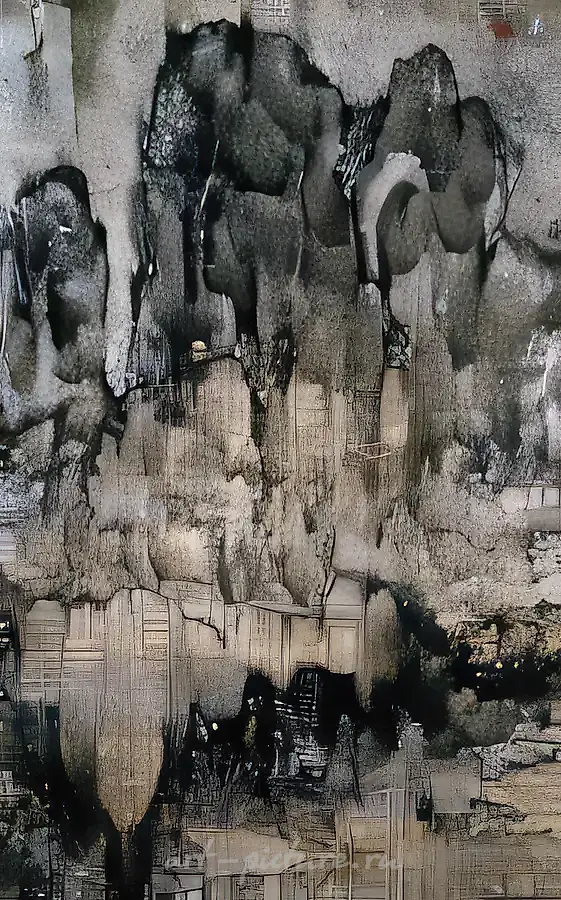
The panorama of New York from the bay at sunset is a grand, unforgettable sight. Developing vertically, the city seems to rise from nothing into nowhere, the parallelism of the quartz surfaces of skyscrapers, refracting the sun's rays, creates the illusion that this city was not built by human hands, but is a crystalline natural formation on a piece of Earth's crust. It seems to have been created at the same time as the planet, and only two centuries ago, suddenly, it emerged from the ocean floor to the world. At the same time, I was seized with an anxious premonition that this part of the world might one day meet the same fate as the empire of Montezuma. These conflicting impressions and anxious feelings inform the installation of seven three-meter verticals, "Nostradamus's Altar." It concludes a cycle of works with scores by the contemporary American composer George Crumb, on which I worked in America for more than two years.
Critic
In conversation, Dmitry Plavinsky calls himself a gypsy. By this, he means that in his art, he travels spiritually and intellectually through geological, geographical, and religious Time, and that his art reflects his own interests more than the culture of either his native Russia or the United States, where he has lived since 1991. Indeed, the idea of movement is key to his art and the unifying theme of the works in this exhibition. The fact that they were completed in the last year and a half in this country is less important than the fact that they convey ideas Plavinsky has nurtured for years.
The series of works linked with music points to the spectrum of ideas within which Plavinsky moves. They originate in a concert by George Crumb, the American avant-garde composer, which he once heard in Moscow. Plavinsky found this music, in some sense, reminiscent of the city of New York. Thus, by mentally merging the eye of the composer with the eye of Nostradamus, the French astrologer of the 16th century, the artist allowed the round forms to 'look' through the panels into an as yet unrevealed future, and at the same time, the panel compositions resemble the outline of New York at sunset. For Plavinsky, therefore, future time is integrated with the past and present in his early works, painted back in Russia. In later works, painted in this country, the past is integrated with the present.
"Manhattan Fish" provokes similar thoughts about interpretation, continuity, and ruptures of time, although the images here are paradoxically realistic. Plavinsky perceives Manhattan both cosmically and comically. Perhaps only a person with a very peculiar sense of time could notice the obvious: the outline of the island of Manhattan coincides with the form of a prehistoric fossilized fish. But its scales, or whatever resembles them, turn out to be the subway map. By connecting geological and present-day time, Plavinsky, equally adept at wordplay, sees Manhattan as an island grounded on the shoals of the past, yet still absolutely modern.
Similarly whimsical combinations of eras are apparent in Plavinsky's view of the Incan city Machu Picchu, seen through the grid of coordinates used by astronauts. This is very clever and profound, for the artist knows we cannot truly understand another civilization distant in time, inevitably looking at it from a modern viewpoint. The view from ground level or from the air provides us with information, but not necessarily understanding. A literal displacement or distancing takes place when concepts of a new era, symbolized here by the coordinate system, are projected onto the past.
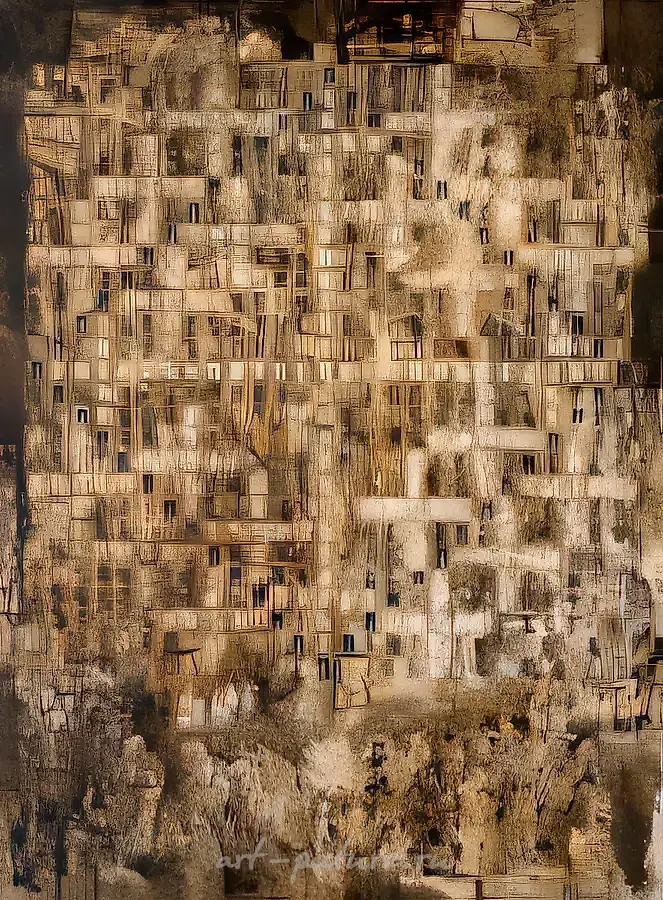
The comparison of the Dead Sea scrolls to skyscrapers creates yet another intriguing collision of epochs, drawing attention to personal and societal values. Although the scrolls appear in the form of skyscrapers, Plavinsky wants us to see them not as buildings but as a mirage, as a sanctuary that magically appears to the wandering traveler. Yet, the traveler, of course, brings his modern baggage with him. The collision of eras, biblical and contemporary, suggests a collision of ethical values. In such works as this, and in the Machu Picchu painting, Plavinsky reveals himself as a moralist, deeply searching for truth but knowing it is socially conditioned and elusive.
His most abstract statement is the painting series "Turtle Shell," inspired by repeated visits to the museum of natural history. It is meant to symbolize the flow of time in general, as well as the epoch when the earliest inhabitants populated the continent, for whom such shells took on sacred meaning in religious rituals. Especially fascinating in these images is the combination of ancient texture and modern style. As in all of Plavinsky's paintings, but especially in these turtle shells, the image is flat, frontal, centralized, and lacks any atmospheric environment. This means they are based on contemporary stylistics, yet evoke associations with far-off and ancient times and objects—a memory, not physical, but as if seen in a dream, spiritual. At the same time, Plavinsky's sharply honed technique draws attention to the physical presence of the painted surface. The tension between theme and style here is brilliantly balanced and harmonized, combining contemporary painted surface and past history, immediate objectness and intellectual imagination, as well as ironic commentary and psychological depth. Few artists today execute their paintings so perfectly and simply, or invite us on such an organized journey with transfers through time. Plavinsky's paintings, in this sense, are as easily readable and as tangled as our perception of the present and the past.
M. Baigell. From the catalog of D. Plavinsky’s solo exhibition, Alex & Edmund Gallery, New York, 1993
Works 8