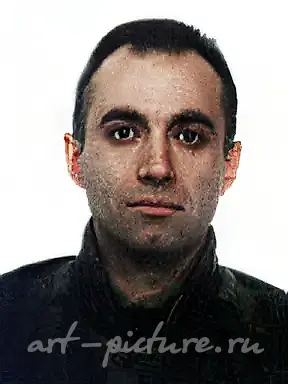
RIGVAVA Gia
RIGVAVA Gia (Georgy Sergeevich)
1956 born in Tbilisi, Georgia
1978 graduated from Moscow State Institute of International Relations (Faculty of International Relations)
1986 graduated from Surikov Moscow State Art Institute (Workshop of Easel Painting, Faculty of Painting)
1986-91 taught art theory at the Academy of Arts, Tbilisi
1990-91 involved in film projects of independent film studios in Tbilisi (feature film "Home", participant of Munich Film Festival 1992; "On the Edge", prize-winner at the Locarno Film Festival, Switzerland, 1993)
Works in collections
Modern Art Collection of the State Historical, Architectural, Art and Landscape Museum-Reserve Tsaritsyno, Moscow
State Russian Museum, St. Petersburg
Exhibitions and auctions
SOLO EXHIBITIONS
1990 "White Gallery", Tbilisi
1993 "Gia Rigvava". Gallery at Trekhprudny Lane, Moscow
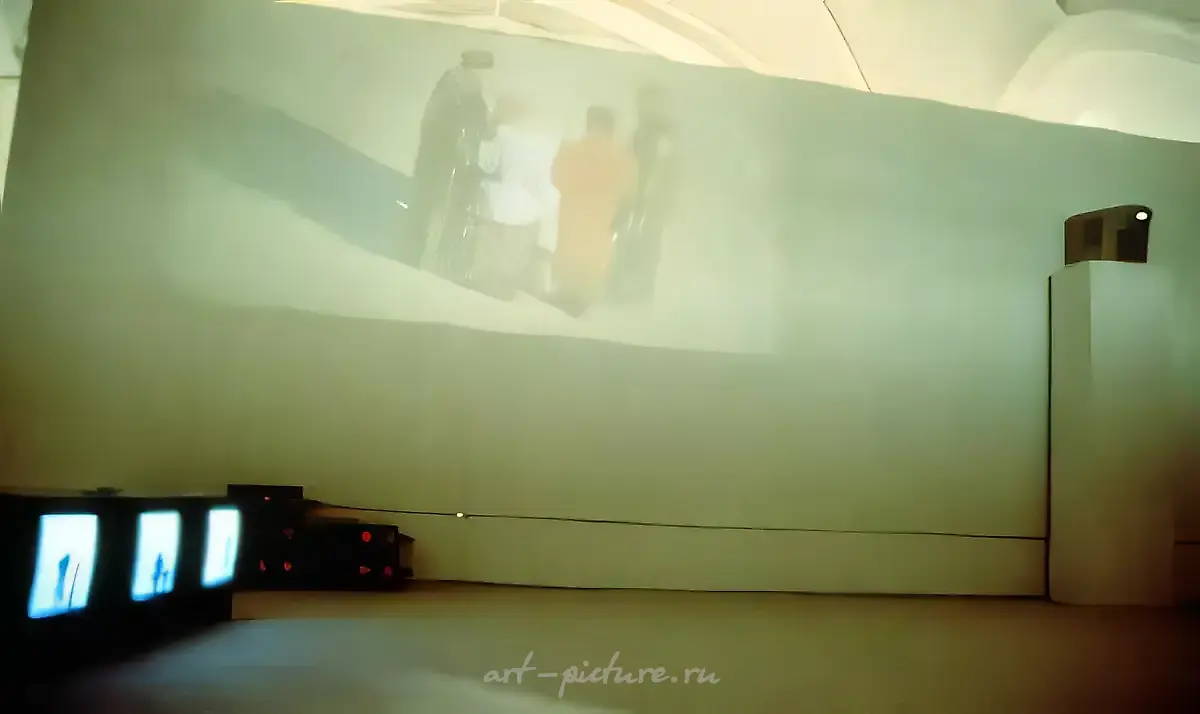
1993 "You Are Powerless, or Actually Everything is Not So Bad" (performance). Center for Contemporary Art. TV-Gallery, Moscow
1994 "I Hate the State -1". Gallery 1.0, Moscow
1995 "Bad Humor (Clarification of the Unknown)" (with M. Traib). M. Gelman Gallery, Moscow
GROUP EXHIBITIONS
1987 Republican Exhibition Dedicated to 70th Anniversary of the Great October Revolution. Artists' House, Tbilisi
1987 All-Union Exhibition of Young Artists. Manezh, Moscow
1987 Exhibition of Young Artists from Socialist Countries. Manezh, Moscow
1988 "Labyrinth". Palace of Youth, Moscow
1988 Contemporary Art Festival. Narva
1989 "Rauschenberg - to us, we - to Rauschenberg". First Gallery, Moscow
1989 “Les temps de re-evaluation”. Contemporary Art from the Soviet Union. UNESCO. Paris, France
1989 "Affordable Art". First Gallery, Moscow
1990 Sommer Atelier-Inspiration. Hannover-90. Hannover, Germany
Author about himself
Art is a romance with reality.
Critic
For the first time, the artist's face appeared on the monitor at the exhibition 'Dedicated to the VII Congress of People's Deputies', organized by Marat Gelman in April 1993. The politicized nature of the exhibition, perhaps, influenced Gia Rigvava to significantly change his artistic strategy: up to that point, his works hardly related to any social or political issues. But this turn had its internal logic. Rigvava, a Surikov Institute graduate, successively went through 'neo-expressionism of the new wild ones,' postmodernist games with the phenomenon of the painting, and ultimately faced the problem of viewer-communication with the artwork.
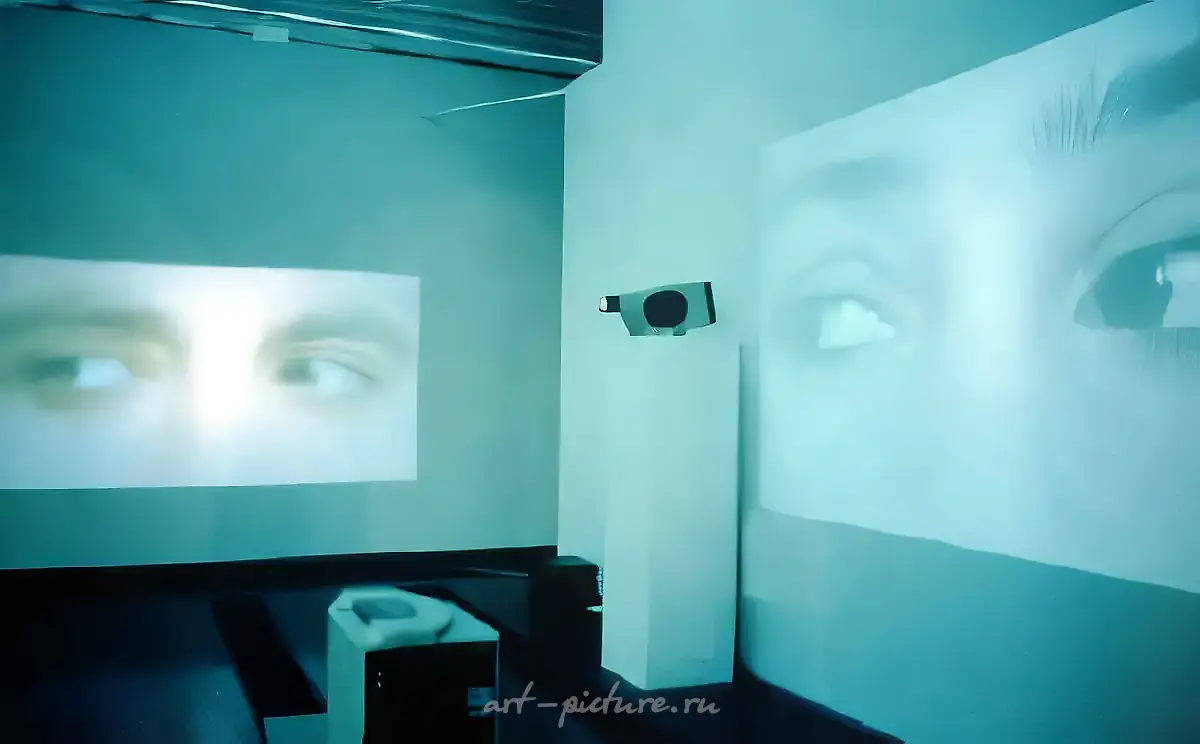
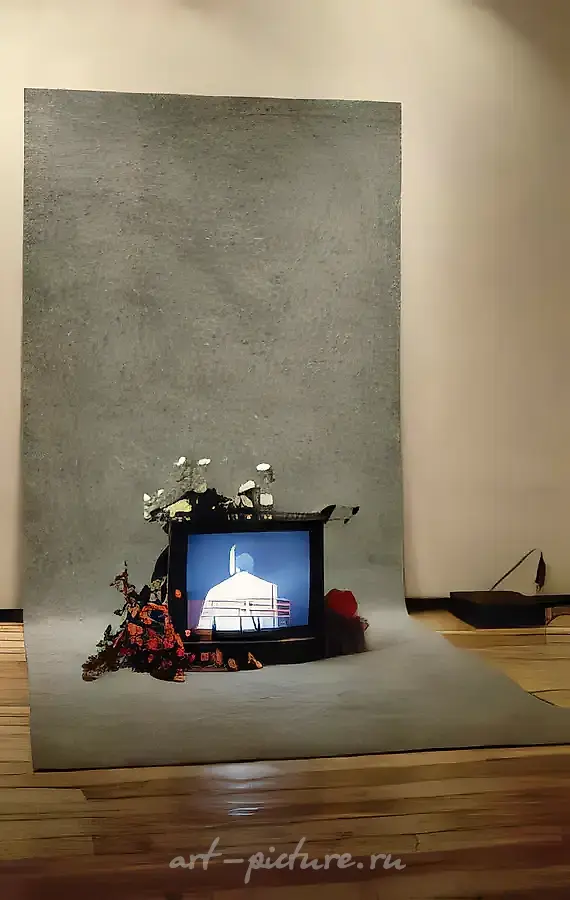
The artist's transition to video coincided with the boom in Moscow art circles regarding the possibilities of 'new technologies.' However, Gia Rigvava turned out to be almost the only one among new media adherents for whom this transition followed from the logic of the artistic project itself, and was not just a transposition of old ideas into new material that could as well have been realized in traditional techniques. Rigvava's works can be classified as video performance and, ideally, teleperformance, as they are conceived as presentations of a certain tele-commentator (usually played by the artist), pronouncing sentences of a general kind. An example is the work 'Official Statement,' created by the artist in collaboration with TV-Gallery for the exhibition 'Dedicated to the VII Congress...'. The statement consisted of only one phrase: 'Don't believe them, they all lie.' Slightly later, at the 'Conversion' exhibition, the second stage of Gelman's major project, Gia switched the role of total skeptic to that of a benevolent prophet, reassuring his flock with 'You can rely on me.' Meanwhile, a halo shone around the hero's head, highlighting the author's irony about the sincerity of such statements. In these works, the artist referred to two main media images of social leaders: the critic and the comforter.
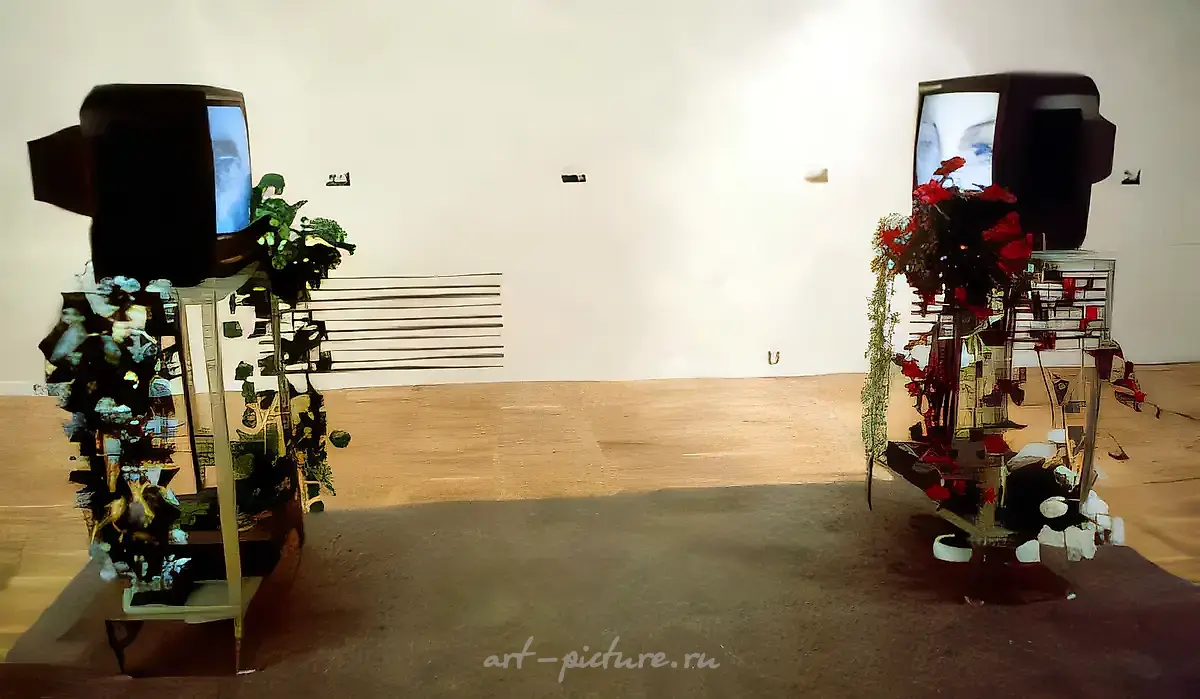
The idea of making television an object of art brings together the current leaders of the 'political' or 'social' trend in Moscow art (including Rigvava) with the Russian classical avant-garde and, above all, with the idea of a total art project, of total artistic power. However, the current era produces different figures, a different type of artist—less a conqueror and aggressor, more an investigator; less an agitator and shouter, more a commentator and reasoner. Paradoxically, the tautological demonstration of what 'everyone already knows' turns out to be more effective and mesmerizing, more 'piercing' than any inventions or additional elements. This is fully true of Rigvava's grand performance on 7 May 1993, entitled 'You Are Powerless, or Actually Everything is Not So Bad.' The essence was to demonstrate to the art audience, gathered at the Center for Contemporary Art and highly sophisticated in media theory, the practical side of the mechanisms of consciousness manipulation developed by the mass media. Rigvava, through TV-Gallery, invited a TV crew that conducted a live report from the scene, broadcast to monitors in the hall. The on-screen action fully imitated the structure of a traditional TV program—with commercial breaks, news summaries (dedicated exclusively to art life and touching many present) and live feeds. The initial snobbish skepticism of the audience, involuntary participants in this happening, gave way for some to euphoria at their perceived significance, and for others to confusion at having been 'fooled.' This was aided by an ingenious trick: in one room was a huge, spread bed—seemingly unrelated to the action. At one point, the 'live broadcast' panned to show a nude girl lying on the bed. Spectators in the room with the bed were unmoved—it was still empty (the footage with the girl had been pre-recorded), but everyone else rushed to see her live, succumbing to the magic of the 'documentarity' of the live broadcast.
A direct reference to the contemporary political context was the project 'Morse Alphabet' for an exhibition dedicated to the fifth anniversary of the fall of the Berlin Wall. A large monitor installed on a Berlin street transmitted a warning in Morse code (the screen flashed according to the lengths of the signals): 'Russia is still dangerous.' Later, a second part of this project appeared: at an exhibition in Holland a pink screen flashed to inform 'Russia is still loved.' Shown in Moscow, both parts proved to be a concise formula for current states of mind.
Rigvava's attempts to 'call things by their proper names' are not always met with understanding. One can only guess why authorities forbade Rigvava from realizing his idea for the Russian-Dutch Exchange project in autumn 1993, which was to place on a Moscow rooftop a word in giant letters—'Kakistocracy' (the rule of the worst), with a dictionary explanation. Perhaps because the inscription seemed subversive, or perhaps because the word sounded too undignified for Russian ears.
The issue of noise and distortion as inevitable aspects of communication (be it TV static, the language barrier, or merely the artist's Georgian accent) is part of the acute issue in Moscow art of recent years—its 'convertibility' on the international scene, which is in turn a particular case of the broader philosophical problem of identity. Despite its optimism, Rigvava's approach to the problem is not without ambiguity. The personal nature of his artistic statements contrasts with the anonymity of the language he adopts and tries to mimic. This tendency was appreciated by Marat Gelman, who decided to display a potpourri of Rigvava's videos on a huge advertising board at the Moskovsky department store. The artist's message blended so seamlessly with the flow of advertising messages that it could 'smuggle' itself into the consciousness of the viewer as something familiar and native.
Overall, the series of actions realized by Rigvava in recent years undoubtedly fits within the wide international movement of artists demonstrating and analyzing the laws and paradoxes of mass communication mechanisms. However, due to the relative novelty of this subject in Russian art, Gia Rigvava rightfully may be considered one of the first singers of the information and television revolution taking place before our eyes.
M. Orlova
Works 9