Alexander Brener
Born in 1961 in Alma-Ata
1978-80 Leningrad State Pedagogical Institute named after Herzen (Faculty of Philology)
1988 emigrated to Israel
1989-91 regular contributor to the weekly 'Sign of the Times', Tel Aviv, Israel
Since 1992 lives in Moscow
Since 1993 member of the 'Netseziudik' group (together with A. Osmolovsky, O. Mavromatti, D. Pimenov, A. Revizorov, A. Zubarzhuk)
Since 1994 member of 'Group Without a Name'.
Exhibitions and auctions
SOLO EXHIBITIONS
1993 'My Vagina'. M. Gelman Gallery, Moscow
1993 'Loves me – Loves me not' (with A. Osmolovsky). XL Gallery, Moscow
1994 'Conformists' (with B. Mamonov). M. Gelman Gallery, Central House of Artists, Moscow
1994 'Last Ecstasy'. M. Gelman Gallery, Moscow
1995 'Chimeras, Come to Me!'. CSI, Moscow
1995 'A cloud traveling around the world should not approach airplanes'. TV Gallery, Moscow
GROUP EXHIBITIONS
1989 'Here'. Artists’ House, Jerusalem, Israel
1990 'The heat acts as anesthesia'. Deadend Gallery, Tel Aviv, Israel
1993 'The war continues'. CSI, Moscow
1993 'Conversion'. M. Gelman Gallery, Central House of Artists, Moscow
1993 'Labour and Capital'. Central House of Artists, Moscow
1993 'You and I are of the same blood'. Hamburg Art Messe, Hamburg, Germany
1993 '777 Distance Communication'. Aspex Gallery, Portsmouth, UK;
Kunstnernes Hus, Aarhus, Denmark; Storm Gallery, Amsterdam, Netherlands;
Galeria Nova, Bratislava, Slovakia; Reykjavik Art Museum, Reykjavik, Iceland;
M. Gelman Gallery, Moscow
1993 'ART MYTH 3'. Manege, Moscow
1993 'Transition'. 'Gallery M', Bratislava, Slovakia
1994 'Conversion'. ISEA, Helsinki, Finland
1994 'Walking Through Darkness at Midnight'. Video Art Festival. Petrovsky Boulevard; Cinema Center, Moscow
1995 'No Man’s Land'. Contemporary Art Center 'Nikolaj', Copenhagen, Denmark
1995 'Corporeal Space'. Russian State Center for Contemporary Art, M. Gelman Gallery, Central House of Artists, Moscow
1995 'Kraftmesse'. Kunsthalle, Munich, Germany
1995 'Jenseits der Mauer'. Kleine Humboldt-Galerie of Humboldt University, Berlin, Germany
ACTIONS AND PERFORMANCES (main events)
1991 Street actions and performances (in collaboration with R. Bayembaev). Tel Aviv, Israel
1993 'Art and Life' (with O. Mavromatti). 'ART MYTH 3', Manege, Moscow
1994 'The Tower' (with A. Litvin, A. Revizorov, as part of 'Moscow Pool' exhibition-action). Moscow Pool, Moscow
1994 '100 years of MAO (The Yellow Devil in GUM)' (with 'Group Without a Name'). GUM, Moscow
1994 'Hunger Rules the World' (with O. Mavromatti and D. Pimenov). M. Gelman Gallery, Moscow
1994 'Languages' ('Group Without a Name'). McDonald's, Moscow
1994 'The Last Taboo, Guarded by a Lonely Cerberus' (with O. Kulik). M. Gelman Gallery, Moscow
1994 'Plagiarism' (with B. Mamonov and A. Litvin). Pushkin State Museum of Fine Arts, Moscow
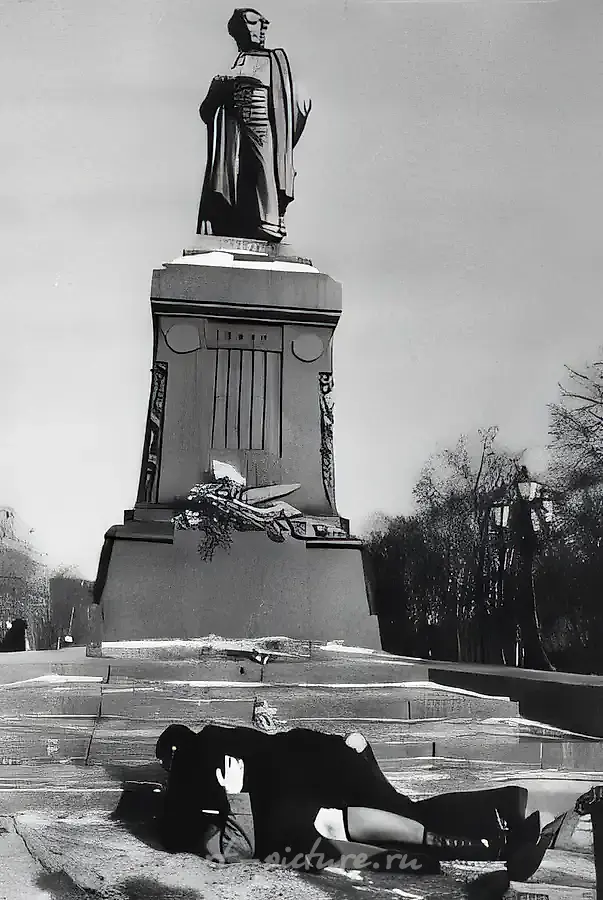
1994 'The Date'. Pushkin Square, Moscow
1994 'The Snows of Kilimanjaro'. Arbat Street, Moscow
1994 'Man in Soap'. CSI, Moscow
1994 'Self-portrait with Father'. Regina Gallery, Moscow
1994 'Last Ecstasy'. M. Gelman Gallery, Moscow
1995 Untitled. Action at Yelokhovsky Cathedral, Moscow
'Poetry and Prose' (with I. Yarkevich). CSI, Moscow
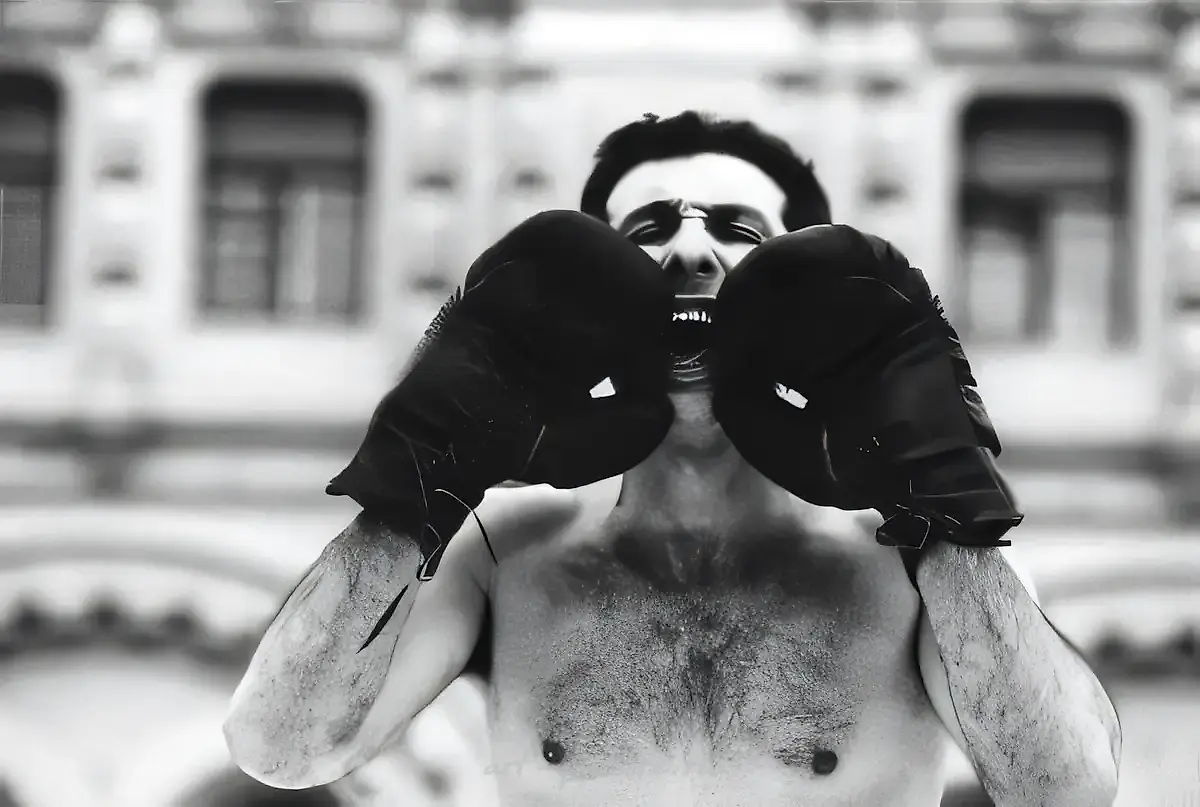
1995 'First Glove'. Red Square, Moscow
1995 'What David Didn’t Finish'. Lubyanka Square, Moscow
1995 'Architecture' (with 'Studio of Truly Good Works'). Ministry of Defense building, Moscow
1995 'It Burns!'. House of the Artist, Arbat (at D. A. Prigov’s event)
1995 'Quiet! My Mother Wants to Sleep!'. Performance at Yevgeny Yevtushenko’s event. Polytechnic Museum, Moscow
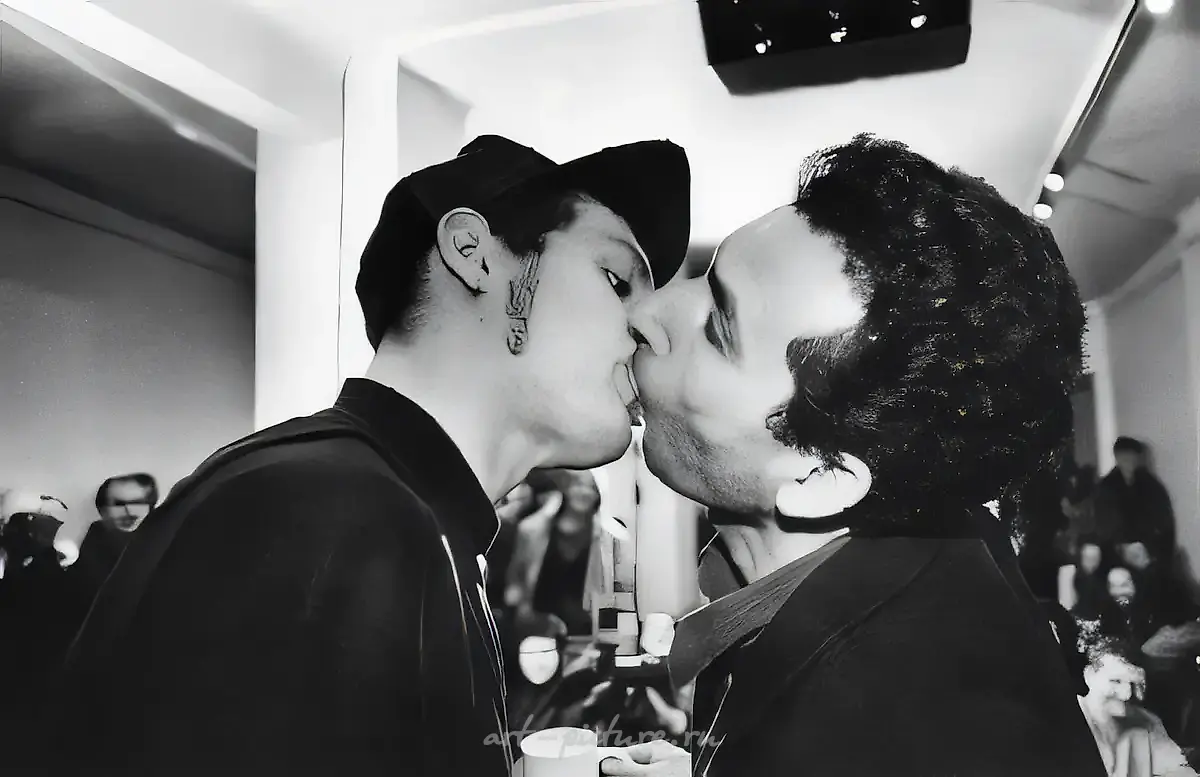
1995 'They Think That We Will Kill Each Other' (with Y. Mogutin). CSI, Moscow
1995 'Antiheroes' (with L. Lunina). Central House of Artists, Moscow
1995 'Throwing Raw Eggs at Nobodies' (as part of 'Turnkey Party' project). M. Gelman Gallery, Polytechnic Museum, Moscow
1995 Action at M. Rykhlin’s seminar in memory of M. Mamardashvili (A. Brener, A. Ilyevsky, A. Litvin). CSI, Moscow
1995 'Russia in the Gloom' (A. Brener, D. Gutov, A. Ilyevsky, A. Litvin, B. Mamonov). Artists' House at Kuznetsky Most, Moscow
1995 'Hello. I am your new commercial director.' Lubyanka Square, Moscow
1996 Untitled. Action at 'Interpol' exhibition, Stockholm, Sweden
1997 Untitled. Action at the Stedelijk Museum, Amsterdam, Netherlands
Critic
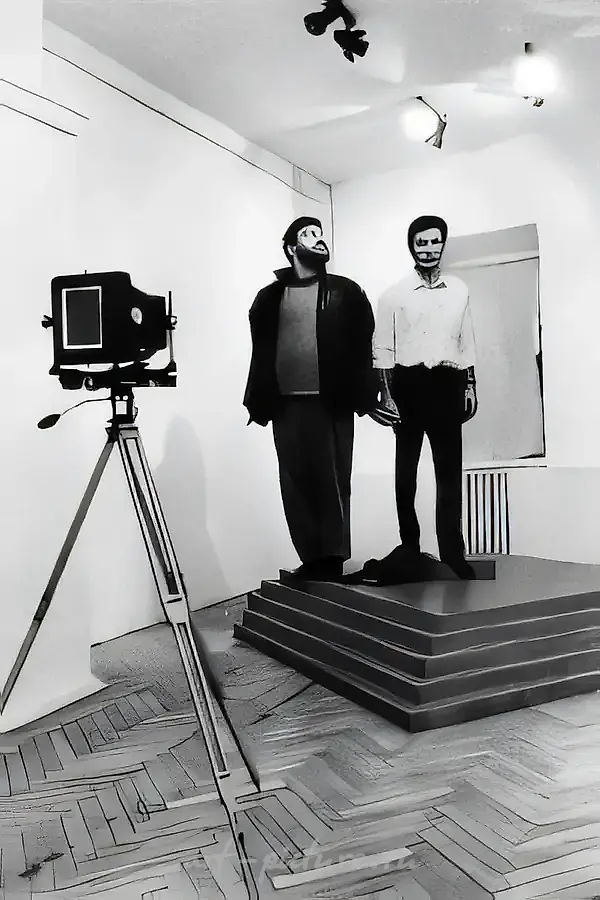
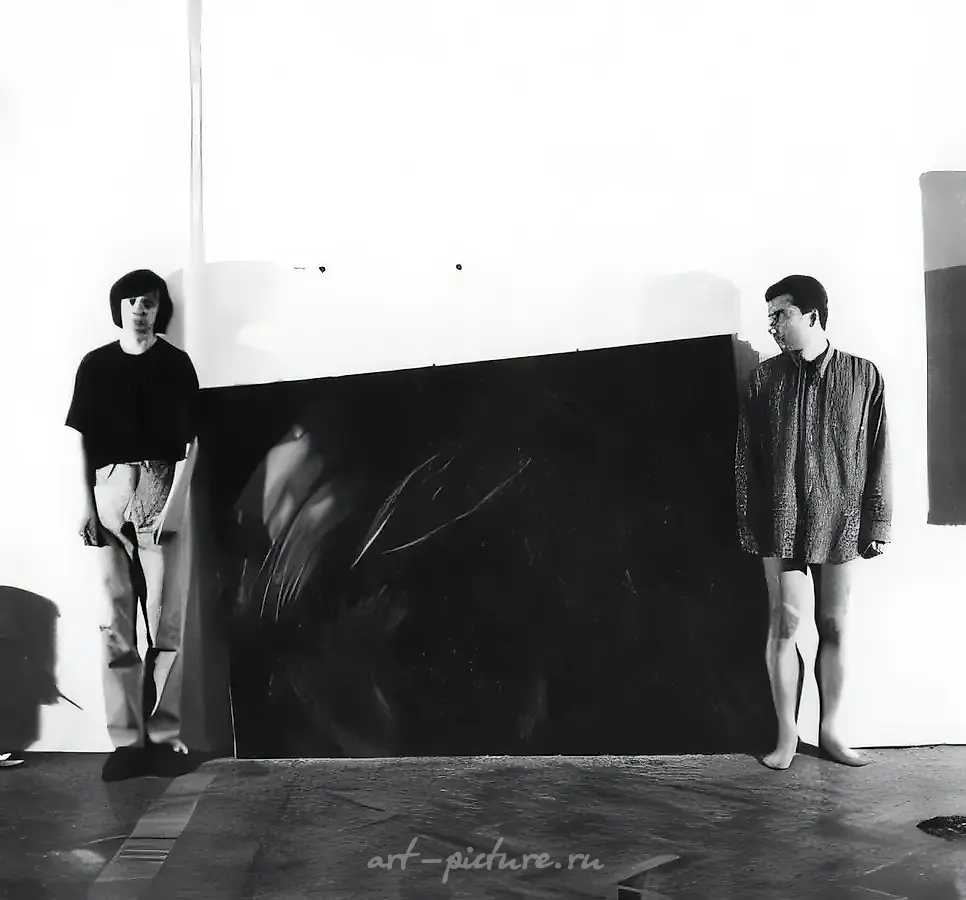
The pinnacle of Brener's meteoric career was marked by three criminal cases against him in Israel, Russia, and the Netherlands, and he had achieved fame as perhaps the most irritating and noticeable figure among Russian artists of the last decade. In 1994–95 in Moscow, no one was talked about more than Brener. Some found what he did totally unacceptable, others thought it the most interesting, whereas still others simply didn't know how to react. Yet until he left Moscow, Brener managed to keep the entire art community on edge.
His excessive ambition became apparent at once—they shocked. One of his first actions was staged at the Pushkin Museum of Fine Arts, where he knelt before a Van Gogh painting, shouting “Vincent! Vincent!”, and simulated an act of involuntary defecation. This public confession of powerlessness and insignificance before the Great was, however, far from mere humility.
Brener obsessively sought recognition, rightly believing he deserved more than to be just one of several Russian artists drifting around small galleries. Once, he put on a solo exhibition at the Moscow Center for Contemporary Art that claimed a scope of at least European celebrity (and, even more scandalously, fulfilled that claim). Naturally, this should be seen as a calculated artistic gesture—perhaps not lacking in irony, which, to some extent, is present even in Brener’s ambitions. In an action on Pushkin Square, where Brener attempted to have intercourse with his wife in public, he took on not just the role of an Artist who transgressed all boundaries, but played an even subtler game, exposing himself as a pitiable loser whose uncontrollable urge for public self-assertion ended in ignominious failure (“It’s not working!”—the key phrase of the action).
To what degree Brener breaks the conventions inherent to artistic acts is unanswerable; one can only keep asking it. It is evident that Brener's actions only appear improvisational—actually, they are results of preplanned scripts. But to perform them at all means overcoming at least a natural sense of shame and fear (and that, no script can provide).
Brener seeks sensations that do not come easily (and are therefore even more convincing); they are pointless to declare, only to be experienced or, more accurately, endured. Why be surprised, then, that his audiences at times felt acute embarrassment or sudden fear—natural reactions?
Brener is convinced that genuine art requires exhausting effort. At one exhibition, he tap-danced for hours, sweat pouring off him, thereby illustrating this simple truth. Such exhausted maximalism marks his approach to everything in the artistic life.
He is a fierce opponent to comfortable mediocrity, always opting for extremes and pushing them much further than most. This applies not only to his actions but to everything else: for example, his language, which combines high style (astonishing in its passionate intonation) with profanity, creating contrast, though not necessarily conflict; his combining the sublime with the openly obscene; and above all, the drama he stages of the insignificance and grandeur of Alexander Brener, the Artist.
Like many, Brener considers art a field of freedom, which is, in his mind, virtually its only distinction from life (one might also add an excess of emotion, tension, and risk compared to ordinary life). But what is freedom? For Brener, it means the ability to call things by their true names, bypassing propriety and pretense. Such conduct demands both courage and talent, and a total disregard for ordinary human ethics.
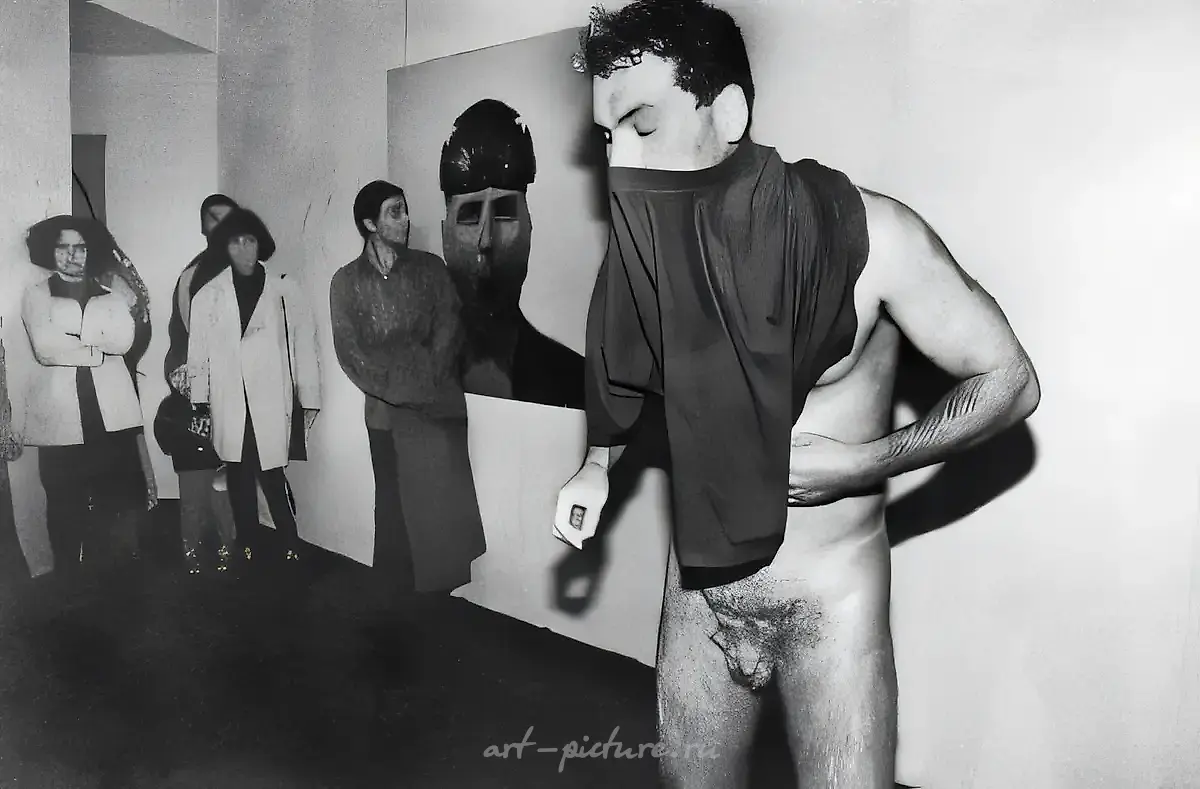
Going all the way in this, Brener burned all bridges in business and personal relations, becoming persona non grata in official art circles. On the other hand, this principle had another significant effect: in his works, Brener restored objects to their plain, literal meaning, which at that moment was a major achievement (after conceptual manipulation, things had lost not only self-referentiality but the very capacity to mean anything at all). Almost mocking all conceptual interpretations, wandering between signifier and signified, he presented himself—naked Alexander Brener—as the last authenticity in art.
In January 1997, at the Stedelijk Museum in Amsterdam, Brener spray-painted a green dollar sign on Malevich’s “White Square on a Gray Background” (insured for $10 million). Such a move was very much Brener's style and at first shocked everyone. The newspaper Kommersant-daily attributes the following explanation from Brener himself: in this way, he testified to the defeat and the conclusion crowned upon the artists' attempts to change the world. This comment implies only that Brener is more honest and precise in his actions than in his discussions (perhaps this version was meant for the judges). To explain this action is to chew over the obvious: in the West, Malevich singularly epitomizes all Russian art of the 20th century. This Raphael of the avant-garde has overshadowed all others, living and dead. Meanwhile, only changes in the number of zeros in the value of his works can shock anyone today regarding Malevich. Brener fights a ghost usurping the place of the living.
With this action, Brener put a full stop to the chapter of his biography that started four years ago in Moscow.
N. Tamruchi
Bibliography
Own works:
Nad stupnyami. Moscow, 1993
Grudi. Album Press, Moscow, 1993
Moe vlagalishche. M. Gelman Gallery, Moscow, 1993
Iskusstvo lyudey, Moscow, 1993
Khlamidioz, Moscow - Jerusalem, 1994
Alexander Brener is Tired. Nauka, Moscow, 1995
Joint works with R. Bayembaev:
BONANZA. Nenaebnaya Ptitsa Press, Tel Aviv, 1991
Secret Life of Buto. Nenaebnaya Ptitsa Press, Tel Aviv, 1992
Japanese God! Nenaebnaya Ptitsa Press, Tel Aviv, 1992
Manifesto. Nenaebnaya Ptitsa Press, Tel Aviv, 1992
SuperVasya. Nenaebnaya Ptitsa Press, Moscow, 1993
Nudist Cemetery. Nenaebnaya Ptitsa Press, Moscow, 1993
Works 6