Figurine "Lying Bear" Allach No. 8 Germany Porcelain figurine "Lying Bear" Allach, Germany, 1936-1944 Manufacturer's mark, sculptor's signature Sculptor - Teodor Kärner (1884-1966) Model number - 8, production began in 1936 Color figurines released in 1938 - 113 pieces, in 1939 - 14 pieces Height - 6 cm, length - 8 cm
Please check the payment methods with the seller when making a purchase
Delivery by agreement
Check the delivery methods with the seller when making a purchase
Approximate prices in Russia
от 180 ₽
от 180 ₽
от 180 ₽
The porzelan porzakin manufaktur
Description
Historical reference & nbsp; at the opening of the Allach factory in Berlin on Leipzigstrasse on April 13, 1, 1939, Professor & Nbsp; Carl Dibich & Nbsp; (Carl Diebitsch) words that later became prophetic: Factory of artistic porcelain Allach / Porzellan Manufaktur Allach - existed in Germany between 1935 and 1945.After the first year of the work, the company was under the jurisdiction of the SS using the forced labor of the prisoners of the Dachau concentration camp. “Not a single people live longer than the monuments of its culture.These words of the Fuhrer are a cultural motto for us.We well understand that everything that we do will be carefully investigated by those who come after us.And we do not want the subsequent generations to appreciate our work poorly. ” Master of ceramics Franz Nadi owned land in the suburbs of Munich - Allach, on which the Allach plant was created since 1925. In early 1935, he created a small porcelain factory. The official date of the base of Allach GmbH with the authorized capital of 45,000 Reichsmarks - January 3, 1936.The founders were Franz Nagy as the head of the enterprise, Theodor Kurner as a sculptor, Karl Dibich as a painter and Bruno Galke as a trading agent.The unofficial owner of the factory was Henry Himmler.First of all, the factory was focused on the production of decorative and artistic porcelain, including special orders from the Reichsfuhrer himself, who dreamed of “raising” and develop a new German artistic taste.The factory also carried out a more massive production of home ceramics and the organization of a special section of dishes. April 1, 1939 at the opening of the Allach factory in Berlin, on Leipzigstrasse 13, Professor Karl Dibich said words that later became prophetic: “People exists while people exists while aliveevidence of his culture.These words of the Fuhrer are a cultural motto for us.We well understand that everything that we do will be carefully investigated by those who come after us.And we do not want subsequent generations to appreciate our work poorly. ” The total turnover of the factory in 1941 was 560,000 Reichsmarks, & Nbsp;In 1942 - 850,000 Reichsmarks, and by 1943 it totaled 706 & nbsp; 000 Reichsmarks.More than half of the porcelain products of the highest quality and who were of the greatest value, was supplied to the personal department of the state of the SS Reichsführer, authorized to use them for propaganda, while others went on sale. & Nbsp; “Ideological porcelain” was addressed to high -ranking SS and police officials, as well as especially distinguished ordinary membersSS organizations.Selected works intended for the highest persons were approved personally by Himmler. & Nbsp; individual products existed in exclusive & nbsp;performance, & nbsp;as, for example, the prize plate of police competitions in 1937. & nbsp; Yolpestic plates (Yolfest & Nbsp; - the winter solstice that was supposed to replace Christmas), the candlestick & nbsp;and the so -called “luminaires of life.” & nbsp; And at the birth of the fourth and each subsequent child, the SS family was awarded the so -called & nbsp;The “Light of Life” with Facsimile Himmler and the signature: “In the endless chain you are one link.To you, your parents, your children, your family. ”The candlesticks were performed in the form of ceramic cones with runic ornaments. & Nbsp; The corporate sign of the manufactory was an image of two SS runes, one of which seemed to stand over the other. & Nbsp;
Additional articles
The figurine "Reclining Bear" Allach No. 8 Germany
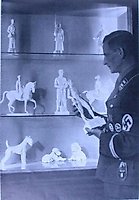
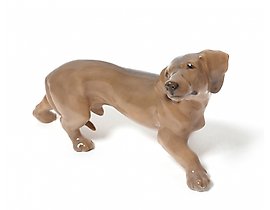
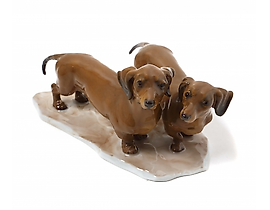
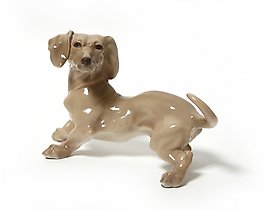
Porcelain Manufactory in AllachAfter coming to power in 1933, the National Socialists began to impose a new ideology in Germany. Strict regulation and rigid control of every sphere of life and activity led to the creation of an extraordinarily measured social structure, which was reflected not so much in monumental art, but rather in the art of small forms, in decorative works and household items.A distinctive feature of all totalitarian systems is the desire not only to create their own official art, but also to penetrate into every area of a person's life, including the private. For example, every newlywed couple was required, upon registering their marriage, to purchase "Mein Kampf," and hang a portrait of the Führer in their home.The everyday object also became an effective means of manipulating mass consciousness. Even household items were called upon to serve the ideological purposes of the new order. The choice of themes and forms, motifs and methods of decorating everyday objects—all these together were supposed to reflect the ideas of the greatness of the German people, the military and civil power of the young Nazi state, and its close ties to the empire of ancient Rome.The ideology of the new authorities was most clearly reflected in the developed system of symbols. The most common among them were the swastika (an ancient solar sign in ancient civilizations associated with the idea of infinite movement and, consequently, accumulating potential energy), the eagle (companion of the supreme god Zeus/Jupiter, an imperial symbol since antiquity), the cross (a symbol of the four cardinal directions, four elements, the tree of life, and all power), the wreath or oak leaves (the oak tree, representing vital force and immortality for Germans), swords (a symbol of military success), as well as recognizable emblems from various fields, such as a submarine, a torpedo boat, city coat-of-arms motifs, the head of the Greek goddess Athena, and others.The special features of porcelain items produced by the factories of the Third Reich included not only symbolic imagery. The selection of themes and motifs for small porcelain sculptures, votive plates and plaques, candlesticks, and tableware reflected both political ideas of the totalitarian regime and the character of private life and household arrangements of the era.Among numerous porcelain factories in Germany at the time, the undisputed ideological leader was the Allach-Munich manufactory, considered an "SS enterprise" (these also included the Apollinaris mineral water company, the Edel furniture factory, the Nordland publishing house, and a company making swords for SS needs).The manufactory, founded by personal order of H. Himmler and considered his "favorite child," officially started operation on January 3, 1936. However, it is known that as a private company, it had been functioning even before gaining the status of the country's main porcelain enterprise, as evidenced by samples from 1934 (notably, the "Standard-Bearer" figure) and invoice records from 1935. Among the founders were Himmler's personal friend, artist Karl Diebitsch, sculptor and modeler Theodor Kärner, and two businessmen, Bruno Galke and Franz Nagy.Until December 20, 1938, the factory was under the cultural department (managed by Diebitsch) of Himmler's personal staff, with Himmler himself listed as the art director of the manufactory. However, Himmler officially took over management in 1938, when it came under the SS Economic and Administrative Service (1939–1942, later called the SS Economic Administration Main Office until 1945). The manufactory primarily served the purposes of political propaganda, shaping the tastes and raising the cultural level of "true Aryans" (namely not ordinary citizens, but the chosen - SS members). Economic gain was not a key factor, although before the war the enterprise reportedly received profits as high as 100%.The factory's profitability declined significantly during the war, especially in the early 1940s, due to reduced funding and the mobilization of workers. At that time, the company began widely using forced labor from the nearby Dachau concentration camp. Some survivors recalled that this practice began in 1939; while only two or three prisoners worked at the factory in early 1941, by autumn there were 40–50, and by 1943, around 100. It was considered that one regular worker could be replaced by two or even three prisoner-laborers. Despite Himmler's dissatisfaction, many prisoners occupied significant roles and, in some instances, working at the factory saved their lives. For example, Karl Adolf Gross worked in the accounting department and recalled a Polish student, Josef Sobczak, who specialized in painting porcelain. Others worked in firing, casting, and polishing. Prisoner Hans Landauer was allowed to create even ideologically significant figures.Little is known about the last years of the manufactory. With the end of the war, as a Nazi enterprise, it ceased to exist.The history and nature of porcelain production are best told by the objects themselves. The most significant of them are now rare on the antique market, mainly due to limited runs of “elite” items (except for animal figurines produced for general sale), Munich's frequent bombings, and destruction at the end of the war. It is also known that so-called “political” porcelain figures began being destroyed even during the war. Not only the products themselves but almost the entire manufactory archive was lost in the flames. Some documents were destroyed by employees to hide financial wrongdoing.The only original surviving list of items is the 1936 catalogue listing 40 items. However, it is inaccessible to researchers: the catalogue was in Adolf Hitler’s personal collection, later was held by the US Library of Congress, and is still classified. The main information sources remain: testimonies of contemporaries, the repeatedly reprinted 1937 catalogue and its variants of 1938 and 1939 ("Porzellan-Manufaktur Allach-Munchen. Verzeichnis der Erzeugnisse. Liste 1938/39. Verlag ?"), and of course, the objects themselves, most of which are now in private collections.The most complete consolidated list of manufactory models over the years includes about 240 ceramic and porcelain items. Allach’s main direction was the production of small-form porcelain. Intended mostly as gifts for high officials, these items were to reflect the main ideas of the Nazi movement—figures of military men from various epochs and heroes of modernity, German peasants and craftsmen, bathers and dancers, ancient gods and heraldic figures of German cities, symbolic images, and a variety of animals. The "SS enterprise" was also tasked with creating important prize pieces—decorative plates and plaques with appropriate decor. While Allach porcelain sculpture is rare, these prize pieces are unique, often produced in single examples. More mass-produced were Allach’s lamps and vases, which also served ideological propaganda. Tableware was rare, only made to order for the SS chief or the Führer himself. All items (except the "Fencer" figure) were glazed, some painted, others kept white.The manufactory’s ceramic works are also rare today. In this technique, some of its most significant pieces were made: the imperial eagle, the head of Hitler, and the Julleuchter lamp, the latter becoming a symbol of the new social order and the manufactory’s most mass-produced item. Notably, they were left unglazed, imitating the technique of ancient Germanic tribal wares.The Glorious PastOne main topic of Allach’s porcelain and its pride were figures of soldiers, both prominent individuals from the past and archetypal representatives of different military branches. Within the new Nazi ideology, the theme of cultivating the perfect soldier based on honored examples became very popular from the early 1930s. Decorative soldier figures began to appear in the product ranges of numerous German manufactories (including Meissen, Nymphenburg, Älteste Porzellanmanufaktur, Hüttler, etc.), even in glass production (Rosenthal). Allach was no exception and devoted its best resources to "porcelain soldiers."Almost all soldiers were modeled after designs by lead master Theodor Kärner, or occasionally by his pupil Richard Förster. Kärner was responsible for riders; Förster for infantrymen. After 1942–1943, no further Kärner models are recorded, suggesting Förster created both rider and infantry figures thereafter. Three infantry figures (1943–1944) were designed by Adolf Röhrung, whose name appears in the 1938–1939 catalogue alongside a horse being saddled and bird figurines (thrush, greenfinch).The theme of the "equestrian monument"—prevalent in porcelain since the 18th century (Meissen, Nymphenburg)—took on a triumphant and heroic meaning in Nazi Germany. It was especially dear to Kärner. As stated in the introduction to the postwar catalogue of his works: “Depicting riders in costume of their time is particularly dear to the master.” Himmler also repeatedly underlined that cavalrymen were among the artist’s best works for his favorite manufactory. A painting by Kärner of a mounted messenger shown at the 1941 Great German Art Exhibition was acquired by the Reich Chancellery.Kärner, who had previously worked at Nymphenburg and Rosenthal, created Allach models of all hussars as well as a dragoon, cuirassier, pandur (Slovenian infantryman), and the famous “Old Fritz.”The main heroes of Kärner’s figures were Prussian King Frederick the Great and his best soldiers. The term “Old Fritz”—an affectionate nickname given to the king by his troops in his lifetime—became the name of Kärner’s porcelain statuette. In the "mythology" of the Third Reich, Frederick the Great embodied truly "German" ruler virtues: love for homeland, people, and culture. In 1932, Goebbels called him “the first Nazi.” Hitler identified himself with Frederick as his spiritual successor. It is known that in the new chancellery, a painting of Frederick the Great by A. Menzel hung in the Führer’s office, and a porcelain figure of him (from Älteste Porzellanmanufaktur, Volkstedt) stood in a glass case on his card table. Such parallels were strongly emphasized in mass culture, as seen in a surviving advertisement by Älteste Porzellanmanufaktur showing Frederick in the center, flanked by busts of himself and Hitler, the latter presented as the king’s follower; nearby stand portraits of other military leaders. Together, they expressed the continuity of German history and national greatness. Popularizing the image of Frederick began in the late 1920s: artistic and documentary films, engravings, and of course, porcelain statuettes were all produced by various manufactories, both new and based on 18th-century models. Copies of 18th-century models appeared at Meissen, Fürstenberg, Rosenthal (by Louis Tuaillon), and at lesser-known factories like Kochendorfer or Ackermann & Fritze. The Royal Porcelain Manufactory in Berlin even reproduced objects used by the king or created new ones following their design.The distinctive feature of Kärner’s model was that the rider is depicted not in the usual moving pose, but standing still, observing the battle calmly and determinedly—his composure only outward, emphasizing further the monarch’s military spirit. Only a few comparable examples of such iconography exist, such as a Chodowiecki engraving and an A. Menzel woodcut.Allach's Frederick figure enjoyed great success among top SS officials. In 1939, Kärner made 36 figures (32 white, 4 colored), and the next year Hitler ordered 100 unpainted figures for himself.Frederick's officers represent Prussian soldiers in general, with some modeled after specific historical individuals such as hussar officer von Zieten, Malachowski, and cuirassier officer von Seydlitz. The latter’s figure became one of the most popular, appearing on the cover of the 1937 catalogue and produced until 1945, despite being among the most expensive.Uniform samples from Frederick’s time were based on A. Menzel lithographs, used by Kärner as detailed guides, as seen in the hussar von Zieten.Alongside lithographs and engravings, Allach, like Nymphenburg (where Kärner formerly worked), also used models of the past, notably 18th-century works by porcelain artist F. A. Bustelli, whose horsemen enjoyed high acclaim among Third Reich leaders. The rococo style, particularly on the base decorated with rocaille curls, was evident, evoking the heyday of German porcelain.Förster’s infantry figures were to promote the virtues of German landsknechts, Prussian soldiers, Austrian warriors, etc., and remained the manufactory’s main products until 1941, when economic problems reduced production volumes.Some of these figures include "Knight Maximilian" (Emperor Maximilian I, considered the last nationalist ruler of the German Empire in Third Reich mythology), "Landsknecht," "Brandenburg Musketeer c. 1700" (in modern uniform), "Butler Dragoon of the Wallenstein Era" (a symbol of fearlessness and loyalty to the Kaiser), and others related to the wars of independence against Napoleon, as well as the "Great German Knight."Rare items include figures of famous German commander-knights commissioned by Himmler in 1944–1945, such as "Prince Eugene," "Frundsberg," "Götz von Berlichingen," "Knight Franz." Their names were also assigned to new SS divisions formed in 1943 to inspire spirit and faith in victory.This parade of troops today serves as a visual illustration of uniform development, itself a symbol of Hitler's Germany. Uniforms were worn by nearly everyone, a sign of social hierarchy and division into castes. Master craftspeople sought utmost authenticity in depicting uniform details in porcelain sculpture.Heroes of the PresentThe second major theme of Allach porcelain was the "images of the Nazi movement," including figures of contemporary military personnel.Among the most important items in this group was the "SS Standard-Bearer," directly alluding to the mythologized events of the Beer Hall Putsch of November 9, 1923. In Nazi ideology, the "Blood Flag" of the putsch was a revered relic, an "insignia" of new power. The porcelain figure, created by Kärner in 1934, had pseudo-religious status and was never sold—it could only be a gift to the SS. Store display of the figure was forbidden.Kärner's Standard-Bearer is shown in SS parade uniform, steel helmet, with a heraldic sign in the shape of a heart on his chest, holding the flagpole. The flag is only suggested. Unlike "historical figures," the Standard-Bearer has a strict rectangular base, without historical stylistic references, underscoring the image’s current relevance. Allusions to ancient and Renaissance sculpture are evident, emphasizing the military nature, gravity, and dignity of the figure.Another famous product was the "Cavalry Officer of the Third Reich," probably by Förster, continuing tradition. Other figures included a Luftwaffe officer, a pilot, a police officer, a worker, etc.The "Fencer" by O. Obermaier, also related to Nazi symbolism and ideology, is significant. Hitler paid great attention to physical development and youth sports training. Among Hitler’s stated "duties of the state" in "Mein Kampf" was to "promote sport among youth to unprecedented preparedness." State policy blurred lines between sport and military training. The ideal nation needed to be strong, sturdy, healthy, and athletic. Sport fostered discipline, collective feeling, solidarity, and will to win; SS careers required physical development.The choice of fencing as a subject is not accidental; Reinhard Heydrich, chief of the Reich Main Security Office, was a skilled fencer and popular in Nazi mass culture. Known is his portrait by Prague painter Josef Vitz, depicting a fencer figurine. The Allach "Fencer" is an idealized image, not a portrait of Heydrich—a model for the German youth. The athlete's body is relaxed, perhaps after competition, resembling antique Greek athletes. Notably, these sports figures were the only Allach items in biscuit technique, imitating marble; they were not for sale but were valuable competition prizes.The "Nazi movement" series also included images of various Third Reich employees (T. Kärner), as well as Hitler Youth and League of German Girls members (R. Förster). All, like the military, wear uniforms indicating their status and role. Even these figures were treated as national symbols, as pillars of a state destined for global rule. Such figurines were available for open sale and mass-produced, with colored versions less common and more costly.The Apology of Bourgeois Life, or Symbols and AllegoriesAlongside these clearly ideological products, Allach also produced decorative figurines of a more entertaining and less ideological nature: dancers, nudes, national types, etc.Of note are peasant figures with traditional "peasant" porcelain motifs; all dressed in national costumes, symbolizing the German nation and its ties to homeland and tradition. This series, modeled by Förster (who made similar ethnic types at Rosenthal in 1924), included Bückeburg, Upper Bavarian, Black Forest, Hessian, and Frisian pairs. More may have existed, but not documented.Unlike traditional colored peasant figures, Allach's were mostly white glazed porcelain. Despite the greater popularity of colored items, catalogues offered them in white to stress abstract ideas through material and minimalist design. Their serious, static appearance echoed political figures, reinforced by the geometric square bases. The Allach peasant represents not an “ideal peasant,” but a symbolic expression of national traits and roots.Allach produced both light-hearted nudes and more serious allegorical compositions with classical allusions, such as the “Four Seasons” series. Each of the elegant figures had a seasonal attribute, e.g., flute and bird for spring, straw hat and sickle for summer, dead hare and club for autumn, and a fire for winter. The "Four Seasons" were only made in white in 1937; the series was dropped from production, probably due to poor sales or weak ties to national art.Among Allach porcelain figures are Förster’s bathers. One depicts a girl emerging from water, towel behind her, openly displaying her nude body, an allusion to antique Venus figures, a popular motif in Nazi art. Notably, leading official Nazi artist F. Klimsch also designed nude models for porcelain, including sitting, lying, and naiad figures for Rosenthal.Another "Venus" of Allach is shown in the “modest Venus” pose, reminiscent of both ancient prototypes and 18th-century works such as Falconet's "Bathers."Mother and child groups, modeled by Diebitsch, were also popular and reflected Nazi demographic policies promoting “good blood.” Allach’s “maternal” figures ranged from classical Athena-like statues to genre scenes of a mother playing with a child. The former stress pride and national wealth, the latter, private lyricism.Athena, Greek goddess of war and wisdom, was adopted as a symbol of Germany’s martial nation, emphasizing links to Greek culture. Appropriately, the “Athena Pallas” figure was always left unpainted.Another classical theme was the Amazon—a nude woman with weapons, echoing the warrior nation idea. Allach Amazons, as with other exclusive gifts, were not for sale.The roots of the strong nation were illustrated by “Morris Dancers,” reduced copies of late Gothic statues by Erasmus Grasser for Munich’s town hall; six models were repeated by Förster, with only five put into production between 1939 and 1943, as prestigious gifts from the city. Their popularity led to a new "Jesters, or Tricksters" series inspired by Gothic art and carnival folklore characters, such as Till Eulenspiegel.“Chicken Thief,” a replica of H.I. Pagel’s Aachen fountain statue (1911-1913), was also produced, perhaps reflecting a wartime artistic shortage.Allach also produced souvenir figures such as the "Berlin Bear" and "Little Munich Monk," symbols of two key cities—Berlin and Munich. Produced in significant numbers, they were likely souvenirs or prizes, as noted on some bases. The “Little Munich Monk,” modeled by Kärner in medieval monastic habit from the city’s coat-of-arms, became one of the most popular—1802 were made in 1938 alone. Charming TrinketsAnother popular theme was animals. The idea was not new to porcelain art; animal figurines became highly popular in the Art Nouveau period, notably due to the Copenhagen porcelain factory and have been widely produced since, including at Nymphenburg, by many of the same artists who moved to Allach.Animal subjects were particularly beloved in the art of the Third Reich, as exemplified by major exhibitions dedicated to animal sculpture. State officials emphasized accurate representation and knowledge of animal anatomy and habits, criticizing the avant-garde for lacking this realism. The idea of closeness to nature was seen as a German trait, thus animal depictions had to be realistic, a principle embedded in law and official art policy. The symbolism of animals (otter—thief, bear—friend, beaver—builder, panther—energy and strength, etc.) was also codified at the state level.Allach’s animal figurines—realistic and recognizable—became the manufactory’s best-known and most loved products, bringing cosiness to carefully regulated German homes and paralleling Meissen’s famous pieces. Animals depicted included pets, wild and exotic species.Dogs of various breeds—sheepdog, fox terrier, dachshunds, terrier, bulldog, pinscher, and a mutt—were most popular, modeled by Kärner, Obermaier, and Nagy, and highly prized by pet owners and party leadership. Also present were cats and farm animals—sheep, rams, lambs, and kids—perhaps echoing the tradition of animal nativity figures.The “Jumping Horse,” modeled by Kärner, was also a highlight, appearing on the 1938–1939 catalogue cover.Wild animals—or “Beasts of the German Forest”—included foxes, deer, roe deer, mice, pheasants, squirrels, hares, and bear cubs, all executed with strict naturalism. Only the deer had a special mythological significance; the hare was a beloved folk motif and a popular symbol at Easter.Exotic animals were limited to elephants, popular due to their association with circus performances and tamed docility.Symbols of Power and Their HeroesThe theme of power symbols was not neglected; at least two models of the imperial eagle were made, one in grey-brown unglazed clay by W. Krieger, likely for state institutions, and a wood-derived version by Kärner, made for Himmler’s SS oath hall at Wewelsburg. The Eagle of Power, with a swastika and oak leaves, had its head turned left, like the party eagle.Portrait heads were also created, including a ceramic head of Hitler (by Obermaier, 1940), planned for serial production, though Goring's porcelain bust (by Förster, 1943) was a unique piece. Ceramics were considered a simple, accessible, but also a "primordial" material, hence seen as suitable for the most important, power-related works. The “Warrior in a Helmet” head by Kärner, in unglazed stoneware, was even more expensive and exclusive. Since the early 1930s, Hitler’s head became fashionable as a motif, but in 1933, government limited its production to approved enterprises, including Allach.The main range of Allach’s products was small-form sculpture, but other, less exclusive items were also produced, mainly decorated with Nazi symbolism and intended for mass production.Physical and Metaphysical LightAmong the most popular non-figurative items were candlesticks. Some were variations on ancient or early medieval models, others on 19th-century designs.The most famous was the special terracotta "Julleuchter" lamp, a gift for the pagan midwinter holiday "Julfest" (later overlaid with Christmas), instituted as a state holiday by Hitler on December 22, the winter solstice, symbolizing a revival of old pagan Germanic religion. The first lamp, modeled after ancient lamps excavated by archaeologists, was made as a gift for Himmler; subsequently, they became standard gifts for SS officers.The lamp is a truncated pyramid about 20 cm high, with heart- and wheel-shaped cutouts, relief edging, and two candle mounts: inside (symbolizing the ending year) and atop (the start of the new). Lighting the Christmas tree from the lamp’s "new year" candle was prescribed.A porcelain lamp for the summer solstice festival was also made, as this event symbolized marriage and new beginnings.Allach thus produced a multitude of candlesticks in various styles, techniques, and price ranges, making them accessible to all levels of society. Most were sculptural, pseudo-baroque in form, based on vegetal motifs, in line with the historicizing style popular in the Nazi era.A "Lamp of Life" with a frieze of children and volute feet was a special gift for SS officers’ families after the birth of their fourth child.Symbols and DistinctionsAnother product group was decorative plates and plaques, often one-of-a-kind, featuring a broad array of Nazi symbols and dedication inscriptions.For the main state holidays, special "Julteller" plates were created, mostly commissioned by Himmler and given as personal gifts; they typically featured white glazed porcelain with runic and organizational symbols. Others highlighted the "Honor Cross of the German Mother" or had floral paintings and poetic inscriptions.From the Table of the PowerfulAllach tableware is unique. Actual dishware production was rare, except by special order for the Führer or SS chief, typically as lavish wedding or birthday gifts. These sets had classical forms, often plain or with Reich or Führer eagles as their only decorations. Exceptions were the rococo-style service for Goring, with pastoral and hunting scenes.Products for the PeopleThe only everyday household item designed for mass production was vases, which came in classical or geometric forms, modestly decorated with simple stripes.Circulation and PricesIn conclusion, Allach production focused mainly on small-form sculpture, with little attention to tableware or other non-figurative items.Manufactory items are highly valued today by collectors and history enthusiasts, but are rare and not widely available. Unlike famous manufactories like Meissen or Nymphenburg, Allach existed for a short time, and many pieces were lost in bombings. They are more commonly found at major auction houses than on online auctions or in antique shops, and are virtually unknown at flea markets.The most available items are standard vases and candlesticks (notably the Julleuchter lamp) at 100–500 euros, depending on run and size. Animal figurines cost more due to their larger runs and lack of ideological content, at 1000–2000 euros (sometimes far more for rarer types such as the shepherd dog). "Little Munich Monk" souvenirs run 1000–1500 euros. Larger figures such as Amazons, bathers, mothers with children, trumpeters, and peasants range from 6500–8500 euros. Exclusive commissioned pieces, such as military figures or athletes, command prices in the tens of thousands of euros, depending on rarity and preservation—e.g., a preserved fencer with unbroken foil can be 15,000 euros. Unique commemorative plaques, bowls, and plates can be up to 20,000 euros; tableware from the Führer's set up to 1250–1500 dollars per plate or 9500 dollars per tea set for two. Formerly common but now exceedingly rare are Hitler busts, which can fetch up to 50,000 euros.Buyers must beware: many models developed for Allach were later produced at Nymphenburg or Rosenthal, often closely replicating Allach originals but not as rare or valuable, having no historical connection to Allach-Munich.Anastasia KorolevaIllustrations provided by the author.Magazine “Antiquariat, Art and Collecting,” No. 57 (May 2008), p. 4