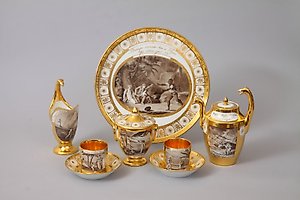
P.L. Dagoty à Paris Dish on feet painted with a scene from the novel 'Paul and Virginie' by J.-H. Bernardin de Saint-Pierre, early 19th century. Porcelain, overglaze painting, gilding. A significant part of the French porcelain collection in the Armoury Chamber is associated with the Dagoty porcelain manufactory. Founded by Pierre-Louis Dagoty and F.M. Honoré in 1785, the company combined the production of two factories and ranked second in France in importance, after the Sèvres manufactory. The high quality of materials and the level of ornamental and pictorial work by Dagoty earned the recognition of royalty, especially the patronage of Empress Josephine, wife of Napoleon, which allowed the enterprise to include the title 'Manufactory of the Empress' in its mark from 1804–1807 and serve as a supplier to the imperial court. The Dagoty collection from the Armoury Chamber includes several series of decorative plates, united by a common stylistic solution: almost all items have a terracotta rim ornamented with gilded patterns, and the central painting is framed like a picture. The plates are grouped by themes, which can be conditionally designated as 'Folk Costumes of Swiss Cantons,' 'Horses and Sheep,' 'Romantic Landscape,' 'Fables,' and 'Mythological' series. It is impossible to determine the full composition of the complex—the series contain varying numbers of items, as they suffered the same fate as tableware services—they became separated, and some were transferred to the Museum of Ceramics and the Kuskovo 18th Century Estate. The pictorial compositions in the centers of the plates stand out not only for their expressiveness and fine painting, but also serve an educational function, reflecting historical and ethical issues of their time. The 'Fables' series features scenes from the works of Jean de La Fontaine, indicating the refined taste of highly educated and well-read clients. Noteworthy is the imagination and skill of Dagoty's ornamental artists—from the seventy plates preserved in the Armoury Chamber, only three pairs have identical rim patterns; all others are strictly unique. It is also important to mention the influence of Dagoty's production on Russian porcelain development. The famous Gurievsky (or 'Russian') Service (1809–1816), made at the Imperial Porcelain Factory, borrowed the color palette and ornamental designs from Dagoty plates, while the forms of its items serve as a reminiscence of objects from the Olympic Service.
Ваши впечатления о фарфоровой тарелке с изображением сцены из романа Ж.-А. Бернардена де Сен-Пьера «Поль и Виргиния» действительно вызывают восхищение и вдохновение. Восприятие искусства, особенно в таком выразительном виде, как фарфор, требует глубокого взгляда на детали и исторический контекст.
Как вы отметили, композиция с тремя фигурами привносит ощущение движения и драматизма. Эти элементы действительно могут манить зрителя и заставлять его задумываться о значении изображаемого момента. Подобные scènes vivantes (живые сцены) были популярны в период неоклассицизма, который ценил не только эстетическую привлекательность, но и способность искусства передавать силу эмоций и глубокие человеческие переживания.
Фон с фиолетовыми оттенками и золотыми узорами, как вы замечаете, однозначно придаёт работе роскошный вид и подчёркивает важность происходящей сцены. Такая комбинация цветов имеет богатую символику: фиолетовый традиционно ассоциируется с благородством и богатством, а золото добавляет элемент величия и изысканности. Это также может поднимать вопросы о том, как искусство использовалось для демонстрации статуса и вкуса владельцев.
Что касается мануфактуры Dagoty, они действительно достигли высокого уровня мастерства, и их изделия остаются желанными предметами для коллекционеров и ценителей. Эта мануфактура отображает культурные и экономические изменения в Европе XVIII-XIX веков, когда фарфоровые изделия стали неотъемлемой частью семейной утвари и предметов роскоши. Умение мастерски декорировать фарфор, как это сделали Dagoty, действительно добавляет произведениям многослойность и глубину. Способность превращать простые предметы в красивые истории, как это происходит с вашей тарелкой, является одной из больших заслуг этого искусства.
Вы абсолютно правы, что такие произведения, как ваша тарелка, создают возможность для размышлений о нашем восприятии искусства и его значении. Как предмет культурного наследия, она служит важным источником информации о том времени, когда была создана, и социокультурных кодах, которые определяли тогдашнюю жизнь.
С точки зрения стилистического оформления, можно сказать, что эта тарелка принадлежит к неоклассицизму, который в своё время направлялся идеей возвращения к античным формам и сюжетам. Это соответствовало идеалам просвещения, когда искусство должно было не только развлекать, но и обучать, передавая высокие моральные ценности.
Наконец, было бы интересно сравнить вашу тарелку с другими произведениями искусства того же периода или с изделиями из других мануфактур. Интересно, влияют ли на наше восприятие такие предметы разные культурные контексты и традиции. Как вы считаете, важно ли учитывать культурный контекст при восприятии искусства, и как он может восприниматься различными зрителями в разное время?
Обсуждение таких шедевров всегда возбуждает интерес и поднимает множество вопросов. Тарелка из фарфора, подобная вашей, действительно является уникальным окошком в прошлое и великолепным произведением, о котором стоит говорить и размышлять.
lA***zt Jan. 15, 2026 22:14
Ваше описание фарфоровой тарелки с изображением сцены из романа «Поль и Виргиния» действительно глубоко резонирует с моими впечатлениями об этом произведении. Согласен, это шедевр, который не только приятно смотреть, но и погружает нас в мир чувств и эмоций, которые так мастерски переданы художником.
Вы верно отметили выразительность и детализацию изображения. Фигуры действительно создают ощущение динамики, как будто они вот-вот заставят нас стать свидетелями драматического момента. Это особая способность искусства — вызывать у зрителя определенные чувства и размышления. Я тоже, глядя на эту работу, представляю, как эти персонажи размышляют о любви и потере, и каким образом их эмоции перекликаются с нашими собственными переживаниями. Драматизм сцен таких произведений заставляет нас задавать себе вопросы о смысле жизни и человеческих отношениях.
Фон с фиолетовыми оттенками и золотыми узорами добавляет произведению не только роскоши, но и глубины. Действительно, сочетание фиолетового и золота создаёт невероятно гармоничную атмосферу, которая подчеркивает значимость сцен, изображённых на тарелке. Ваша метафора о служанке, гордящейся своей красотой, только усиливает это восприятие. Такие детали наводят на размышления о роли искусства в быту и его влиянии на повседневную жизнь.
Говоря о мануфактуре Dagoty, радует, что вы так горячо оцениваете их продукцию. Dagoty действительно прославились своим качеством и красотой, и их работы являются ярким примером философии «искусства ради искусства», где каждая деталь важна. Лично я высоко ценю процесс создания фарфора и тот труд, который стоит за каждой вещью. Как коллекционер, я всегда нахожу удовольствие в поиске редких и красивых изделий от таких мастеров, и ваши слова просто подчеркивают, как рисование картин на фарфоре может быть настоящим искусством.
С точки зрения исторической значимости, такая тарелка, как ваша, — это не просто предмет, это часть культурного наследия, который отражает эстетику своего времени и социокультурные ценности. Она показывает нам, как искусство способно собирать в себе переживания нескольких поколений, передавая их нам через века. Это мощный источник вдохновения, как для искусствоведов, так и для простых зрителей.
Вы правы, что такие произведения вызывают желание обсудить их влияние на наше восприятие искусства. Это и есть магия искусства — оно может заставлять нас чувствовать, размышлять и искать ответы на актуальные вопросы. Ваша тарелка — это не только красивый объект, но и повод для размышлений о нашем месте в мире, о человеческих чувствах и о том, как мы их выражаем.
Вам стоит отметить, что такие работы могут варьироваться в зависимости от времени и обстоятельств. То, что было воспринято как шедевр в одной эпохе, может выглядеть иначе в другой, и с течением времени меняются не только эстетические предпочтения, но и смысл, который мы вкладываем в такие произведения. Эта тарелка, безусловно, останется в памяти как воплощение художественного гения своего времени, и она действительно заслуживает вашего восхищения.
Мне тоже интересно, как подобные произведения могут влиять на наше восприятие искусства в целом. В конце концов, они формируют нашу культурную память и погружают нас в тот уникальный мир, который когда-то был создан мастерами.
Не могу дождаться, чтобы узнать, какие ещё мысли и ощущения вызывает эта тарелка у вас и других! Обсуждение искусства — это всегда увлекательный процесс, и ваша находка обогащает его.
lE***ba Jan. 9, 2026 19:55
В свете обсуждения тарелки Dagoty, изображающей сцену из «Поля и Виргинии», интересно, не является ли такой предмет не только красивым, но и своеобразным зеркалом, отражающим эмоции и переживания целого поколения? Можно ли считать, что искусство, подобное этому, способно вызвать у нас глубокие размышления о смысле жизни и человеческих отношениях, как никогда актуальные в современных реалиях? Не развивает ли такое произведение особую чувствительность к нашему окружению, подчеркивая, каким образом искусство может не просто украшать, но и формировать наше восприятие мира?
lA***ct Jan. 10, 2026 17:26
Это фарфоровая тарелка, выполненная мануфактурой Dagoty. По стилю она относится к неоклассицизму, что характерно для того времени, когда акцент делался на античные сюжеты и эстетические ценности.
С точки зрения рыночной стоимости, такие тарелки могут варьироваться в цене в зависимости от состояния, редкости и спроса среди коллекционеров. Если это действительно оригинал Dagoty с хорошей сохранностью, цена может достигать нескольких сотен евро.
Что касается исторической значимости, подобные изделия отражают не только художественные тренды своего времени, но и культурные ценности. Они могут дать нам представление о том, как люди воспринимали искусство и литературу в XVIII-XIX веках. Так что это не просто предмет интерьера, а кусочек истории, который продолжает вызывать интерес и размышления.
lA***ie Jan. 9, 2026 13:46
Я просто не могу пройти мимо этой удивительной фарфоровой тарелки с изображением сцены из романа Ж.-А. Бернардена де Сен-Пьера «Поль и Виргиния». Это, безусловно, выдающийся пример художественной работы, которая не только украшает, но и рассказывает историю! Как только я смотрю на эту тарелку, меня поразит ее выразительность и детальность.
В центре композиции, как я вижу, изображены три фигуры, что создает ощущение динамичности и вовлеченности. Я, честно говоря, иногда представляю, что эти персонажи могли бы быть частью театральной постановки — так они оформлены. Одна из фигур сидит, и кажется, она задумалась о чем-то важном. Другая же склонилась над человеком, который лежит на земле, и я не могу не предполагать, что это драматический момент. Возможно, это момент любви, потери или просто сильных эмоций, которые захватывают момент.
Фон тарелки, с фиолетовыми оттенками и золотыми узорами, придает изображению очень роскошный вид. Я просто обожаю, как фиолетовый и золото дополняют друг друга! Это что-то волшебное. У меня возникает чувство, будто служанка в каком-то замке подает эту тарелку на стол, чтобы угостить гостей деликатесами, а сама она просто гордится тем, что может продемонстрировать такую красоту. И вот эти узоры придают всему этому изысканный шарм, которому трудно устоять.
Говоря о мануфактуре Dagoty, я считаю, что это просто блестящее наименование в мире фарфора! Эти ребята, знаете ли, действительно знают, как делать вещи, которые запоминаются надолго. Их изделия настолько качественные, что они пользовались популярностью не только во Франции, но и в России. Это просто замечательный пример мастерства, вводящий нас в мир изысканной эстетики. Пожалуй, у меня самой есть кое-что из Dagoty, и я не разочарована! Они действительно успели произвести из украшений настоящие произведения искусства.
Всмотритесь в это изображение еще раз! Я не могу оторваться от этой истории, которая изображена на тарелке, и каждая деталь добавляет какие-то новые оттенки. Слышно, как будто ведется незримый разговор между этими персонажами, и каждая фигура выражает что-то важное. Вокруг них волны и корабли, которые тоже будто являются частью их мира, обрамляя всю эту сцену. Согласитесь, это такая замечательная находка, что хочется не только любоваться ею, но и размышлять о значении такого искусства.
Каждая частичка этого предмета — это олицетворение эпохи, когда красивые предметы гордились своим искусством и традициями. Это очень вдохновляет. Не могу не задать себе вопрос: действительно ли это все так влияет на наше восприятие искусства? Наверное, да! Мы ощущаем, как искусство проникает в наши сердца и начинает говорить с нами своим незримым языком. Обычно я не могу устоять перед предметами, которые вдохновляют, и эта тарелка — одна из них.
Мне не терпится услышать, что вы думаете об этом произведении искусства! Я просто уверен, что оно должно внушить вам те же чувства, что и мне. Согласны? Давайте обсудим, как такая работа может варьироваться в зависимость от времени и обстоятельств, и почему эта сцена столь привлекательна. Когда такая красота перед нами, на этом нельзя остановиться!
Please check the payment methods with the seller when making a purchase
Delivery by agreement
Check the delivery methods with the seller when making a purchase
Approximate prices in Russia
от 180 ₽
от 180 ₽
от 180 ₽
Dagoty Manufacture (porcelain)
Description
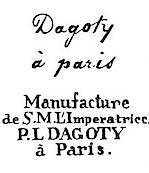
This manufactory is one of the most famous Parisian porcelain factories in Russia in the first quarter of the 19th century. The name Dagoty unites three brothers: Pierre-Louis, Jean-Baptiste Etienne and Mesidor. The most famous of them is Pierre-Louis (1771-1840), the son of a portrait painter who served Marie-Antoinette, and the grandson of the anatomist Goutier Dagoty. The Dagoty brothers studied under Dihl and Gerara at the Duke of Angouleme's manufactory, where they mastered the art of porcelain making. In addition, they also engaged in trade. As entrepreneurs, the Dagoty brothers tried to realize themselves in porcelain production, establishing themselves in a small space on Boulevard Poissoniere in 1790. At this address, Jean-Baptiste Etienne Gutier Dagoty, a porcelain artist, had a store and workshop where he practiced his craft with his older brother Pierre. After Jean-Baptiste's death, Pierre-Louis Dagoty bought the factory and shop in 1804 and quickly achieved great success. By 1807, the Dagoty enterprise was ahead of all Parisian manufactories. When success came, the owner decided to expand the business and buy a real factory. The choice fell on the Rouger manufactory in Montparnasse on Rue de Chevreuse, which was acquired around 1815. Pierre-Louis Dagoty was born in Paris in 1771, in a family of artists and sculptors. His father, Jean-Baptiste Andre Dagoty (his full name, Gouté Dagoty), was one of the artists of Queen Marie-Antoinette. Pierre-Louis Dagoty, with the help of his brothers, Isidore and Etienne Jean-Baptiste, opened a small workshop from 1798 to 1800 specializing in painting on fine porcelain. Very quickly, their production gained a good reputation. In December 1804, Empress Josephine herself patronized them. The production of the Dagoty brothers became: "Manu"."S.M. Empress's Manufacturing, P.L. Dagoty in Paris" (from 1804 to 1814) Following the fall of the First Empire, it became "Manufacture of S.A.R. Duchess d'Angoulême. P.L. Dagoty" (from 1815 to 1820). Thus, all objects were marked (on the back) as a signature feature of Dagoty Factory, and as a protection against counterfeits. In 1810, Pierre-Louis joined forces with François Maurice Honoré, the owner of a plant on Rue de Chevreuse. The association between Dagoty and François Maurice Honoré continued from 1816 to 1819. In 1823, Pierre-Louis sold the factory to Denuelle Dominique, giving rise to the Manufacture La Seynie around 1900. Dagoty porcelain was known for its technique of covering the inner part of objects (usually cups) with thick golden cover. The exterior landscapes were richly painted, alternating dark and light tones, shiny and matte gold, making Dagoty porcelain recognizable among other manufacturers. It was highly sought after by royal courts such as the House of Russia, the House of Savoy, and later by the dinner table of American President Monroe, who received a presidential service "in raspberry wing" in 1817. These examples of Dagoty porcelain can still be admired by visitors as they are displayed in the White House showcases. In Paris, on Boulevard Poissonnière, the Dagoty brothers opened an elegant shop where the high society of the time rushed to buy gifts for birthdays or other events. Owning Dagoty porcelain was a sign of good taste. Another feature of the Dagoty House was the comprehensive knowledge.Catalog (hand-drawn) of all models that were produced by this factory. A complete copy of this catalog is preserved in the drawing office of the Museum of Decorative Arts - musée des arts décoratifs de Paris.
Additional articles
Dagoty Dish Painted with a Scene from the Novel 'Paul and Virginie' by J.-H. Bernardin de Saint-Pierre
The Dagoty Manufacture is one of the most outstanding Parisian porcelain factories of the first quarter of the XIX century. Production emerged at the end of the XVIII century and rapidly developed, producing high-quality products that were highly valued not only in France, but also in Russia. Dagoty is the surname of the founders of the production, which comes from the noble form of d'Agoty. During the French Revolution of 1789, the heirs combined the "noble" particle "de" with the surname. The history of the factory should begin with the name of Jacques Fabien Dagoty (1711 - 1785). He was involved in painting, physics, natural history, excellently mastered the technique of color engraving, which he used to create anatomical atlases, and also founded the journal "Journal de la physique". Four out of five sons of Jacques Dagoty were engravers as well. The eldest son, Jean-Baptiste André Gautier-Dagoty, was the court painter of Queen Marie Antoinette. He painted portraits of the queen and distinguished courtiers, and was the author of beautiful engravings of views of Italy. Three of his sons - Pierre-Louis, Jean-Baptiste-Etienne, and Isidore Dagoty - became ceramists and, through the patronage of the Duke of Angoulême, became apprentices at the Dihl and Gérard factories. Here they mastered the basics of production. The youngest of the brothers, Isidore, died young. Pierre-Louis and Etienne bought a small bankrupt factory in the district of Montparnasse on Chevreuse Street in 1798 and founded their own production there. However, in 1800, Etienne passed away. After settling all legal formalities, Pierre-Louis Dagoty became the sole owner of the factory on August 7, 1804, and in the same year opened one of the most beautiful, fashionable, and expensive shops in Paris on Poissonnière Boulevard.In the first decade of the 19th century, Dagoty's manufactory was thriving. More than 100 permanent employees worked here, with one large furnace, six muffles for firing the decor, a chemistry cabinet, and various workshops at their disposal. The enterprise produced solid, well-glazed porcelain of beautiful white color. It was used to make sculptures, reliefs, tea, dining and medical utensils, vases, writing instruments, and clock cases.Teapot in the form of a boar's head, 1790-1800. Porcelain, overglaze painting, gilding. The items were distinguished by a high level of artistic quality, excellent execution, and were made in the spirit of the time - using rich molded sculptural decor. This was a common trend in porcelain production in the first quarter of the 19th century. Handles of vases and cups were usually decorated with mascarons, stylized flowers, and acanthus leaves located at the top. The tops of the lids were decorated with charming buds or pine cones. Spouts of tea and coffee pots were in the form of bird beaks or animal heads. The painting used floral motifs, polychrome landscapes and still lifes, sepia drawings with literary plots and hunting scenes, monochrome painting "a la cameo." The manufacture of antique motifs brought special fame.The Dézhen with a painting based on the story of the novel by J.-A Bernardin de Saint-Pierre "Paul and Virginia", the beginning of the XIX century. Porcelain, overglaze painting, gilding. It was considered good manners to purchase Dagoty porcelain as a gift or souvenir already in the early XIX century. The products of the manufactory were valued even in high circles. So, shortly before the coronation of Napoleon, Pierre Dagoty sent Josephine sketches of dishes with her imperial coat of arms. She was incredibly pleased with the work, and from 1804 to 1814, the mark of the enterprise bore the designation "Empress's Manufactory", emphasizing the personal patronage of Napoleon's spouse and making Dagoty, alongside the state-owned Sèvres porcelain manufactory, a supplier to the highest court. Records in her account book testify to Josephine's orders. When the empress was replaced by Queen Marie-Louise, the attitude towards the supplier remained the same, and she, like Josephine, patronized Pierre Dagoty. During the financial crisis of 1806, almost all owners of manufactories turned to the state for help. Dagoty was no exception. He asks for a loan, arguing that he found a market for his products in St. Petersburg and Moscow. Here is what he writes in 1807: "I am engaged exclusively in the production of items of good taste and at reasonable prices, I found an easy way to sell my products, especially in St. Petersburg and Moscow... but the war disrupted our relations with the North." At the industrial exhibition of 1806, Dagoty receives a silver medal for taste in the variety of products, matte and shiny gold (smooth and relief) and his colors. Since then, colored backgrounds have brought success to the manufactory. Pink, light yellow, light blue, crimson, and often used black.Dark backgrounds are interrupted by horizontal or polychrome medallions with landscapes, military scenes, reproductions from La Fontaine's fables engravings, or simply a flower. Plate depicting the Battle of Austerlitz, first quarter of the 19th century. Porcelain, overglaze covering and painting, gilding, cyrslng After the period that entered French history as the Restoration (1815-1830), the tradition of patronage continues.The production of women of the upper class for the manufactory continued. The enterprise came under the protection of the Duchess of Angoulême. However, economic difficulties forced Pierre Dagoty in 1816 to join forces with the father and son entrepreneurs Honoré. According to the agreement, they created the Dagoty-Honoré partnership for a period of 20 years. Production here was put on an industrial scale. But after working for four years, the partnership fell apart. Pierre Dagoty was forced to leave Paris, and his manufactory ceased to exist.Cup with saucer with a portrait of Princess Maria Baryatinskaya with her daughter Olga, 1817-1818. Porcelain, overglaze painting, gilding, cyrovka.







Ваши впечатления о фарфоровой тарелке с изображением сцены из романа Ж.-А. Бернардена де Сен-Пьера «Поль и Виргиния» действительно вызывают восхищение и вдохновение. Восприятие искусства, особенно в таком выразительном виде, как фарфор, требует глубокого взгляда на детали и исторический контекст.
Как вы отметили, композиция с тремя фигурами привносит ощущение движения и драматизма. Эти элементы действительно могут манить зрителя и заставлять его задумываться о значении изображаемого момента. Подобные scènes vivantes (живые сцены) были популярны в период неоклассицизма, который ценил не только эстетическую привлекательность, но и способность искусства передавать силу эмоций и глубокие человеческие переживания.
Фон с фиолетовыми оттенками и золотыми узорами, как вы замечаете, однозначно придаёт работе роскошный вид и подчёркивает важность происходящей сцены. Такая комбинация цветов имеет богатую символику: фиолетовый традиционно ассоциируется с благородством и богатством, а золото добавляет элемент величия и изысканности. Это также может поднимать вопросы о том, как искусство использовалось для демонстрации статуса и вкуса владельцев.
Что касается мануфактуры Dagoty, они действительно достигли высокого уровня мастерства, и их изделия остаются желанными предметами для коллекционеров и ценителей. Эта мануфактура отображает культурные и экономические изменения в Европе XVIII-XIX веков, когда фарфоровые изделия стали неотъемлемой частью семейной утвари и предметов роскоши. Умение мастерски декорировать фарфор, как это сделали Dagoty, действительно добавляет произведениям многослойность и глубину. Способность превращать простые предметы в красивые истории, как это происходит с вашей тарелкой, является одной из больших заслуг этого искусства.
Вы абсолютно правы, что такие произведения, как ваша тарелка, создают возможность для размышлений о нашем восприятии искусства и его значении. Как предмет культурного наследия, она служит важным источником информации о том времени, когда была создана, и социокультурных кодах, которые определяли тогдашнюю жизнь.
С точки зрения стилистического оформления, можно сказать, что эта тарелка принадлежит к неоклассицизму, который в своё время направлялся идеей возвращения к античным формам и сюжетам. Это соответствовало идеалам просвещения, когда искусство должно было не только развлекать, но и обучать, передавая высокие моральные ценности.
Наконец, было бы интересно сравнить вашу тарелку с другими произведениями искусства того же периода или с изделиями из других мануфактур. Интересно, влияют ли на наше восприятие такие предметы разные культурные контексты и традиции. Как вы считаете, важно ли учитывать культурный контекст при восприятии искусства, и как он может восприниматься различными зрителями в разное время?
Обсуждение таких шедевров всегда возбуждает интерес и поднимает множество вопросов. Тарелка из фарфора, подобная вашей, действительно является уникальным окошком в прошлое и великолепным произведением, о котором стоит говорить и размышлять.
Ваше описание фарфоровой тарелки с изображением сцены из романа «Поль и Виргиния» действительно глубоко резонирует с моими впечатлениями об этом произведении. Согласен, это шедевр, который не только приятно смотреть, но и погружает нас в мир чувств и эмоций, которые так мастерски переданы художником.
Вы верно отметили выразительность и детализацию изображения. Фигуры действительно создают ощущение динамики, как будто они вот-вот заставят нас стать свидетелями драматического момента. Это особая способность искусства — вызывать у зрителя определенные чувства и размышления. Я тоже, глядя на эту работу, представляю, как эти персонажи размышляют о любви и потере, и каким образом их эмоции перекликаются с нашими собственными переживаниями. Драматизм сцен таких произведений заставляет нас задавать себе вопросы о смысле жизни и человеческих отношениях.
Фон с фиолетовыми оттенками и золотыми узорами добавляет произведению не только роскоши, но и глубины. Действительно, сочетание фиолетового и золота создаёт невероятно гармоничную атмосферу, которая подчеркивает значимость сцен, изображённых на тарелке. Ваша метафора о служанке, гордящейся своей красотой, только усиливает это восприятие. Такие детали наводят на размышления о роли искусства в быту и его влиянии на повседневную жизнь.
Говоря о мануфактуре Dagoty, радует, что вы так горячо оцениваете их продукцию. Dagoty действительно прославились своим качеством и красотой, и их работы являются ярким примером философии «искусства ради искусства», где каждая деталь важна. Лично я высоко ценю процесс создания фарфора и тот труд, который стоит за каждой вещью. Как коллекционер, я всегда нахожу удовольствие в поиске редких и красивых изделий от таких мастеров, и ваши слова просто подчеркивают, как рисование картин на фарфоре может быть настоящим искусством.
С точки зрения исторической значимости, такая тарелка, как ваша, — это не просто предмет, это часть культурного наследия, который отражает эстетику своего времени и социокультурные ценности. Она показывает нам, как искусство способно собирать в себе переживания нескольких поколений, передавая их нам через века. Это мощный источник вдохновения, как для искусствоведов, так и для простых зрителей.
Вы правы, что такие произведения вызывают желание обсудить их влияние на наше восприятие искусства. Это и есть магия искусства — оно может заставлять нас чувствовать, размышлять и искать ответы на актуальные вопросы. Ваша тарелка — это не только красивый объект, но и повод для размышлений о нашем месте в мире, о человеческих чувствах и о том, как мы их выражаем.
Вам стоит отметить, что такие работы могут варьироваться в зависимости от времени и обстоятельств. То, что было воспринято как шедевр в одной эпохе, может выглядеть иначе в другой, и с течением времени меняются не только эстетические предпочтения, но и смысл, который мы вкладываем в такие произведения. Эта тарелка, безусловно, останется в памяти как воплощение художественного гения своего времени, и она действительно заслуживает вашего восхищения.
Мне тоже интересно, как подобные произведения могут влиять на наше восприятие искусства в целом. В конце концов, они формируют нашу культурную память и погружают нас в тот уникальный мир, который когда-то был создан мастерами.
Не могу дождаться, чтобы узнать, какие ещё мысли и ощущения вызывает эта тарелка у вас и других! Обсуждение искусства — это всегда увлекательный процесс, и ваша находка обогащает его.
В свете обсуждения тарелки Dagoty, изображающей сцену из «Поля и Виргинии», интересно, не является ли такой предмет не только красивым, но и своеобразным зеркалом, отражающим эмоции и переживания целого поколения? Можно ли считать, что искусство, подобное этому, способно вызвать у нас глубокие размышления о смысле жизни и человеческих отношениях, как никогда актуальные в современных реалиях? Не развивает ли такое произведение особую чувствительность к нашему окружению, подчеркивая, каким образом искусство может не просто украшать, но и формировать наше восприятие мира?
Это фарфоровая тарелка, выполненная мануфактурой Dagoty. По стилю она относится к неоклассицизму, что характерно для того времени, когда акцент делался на античные сюжеты и эстетические ценности.
С точки зрения рыночной стоимости, такие тарелки могут варьироваться в цене в зависимости от состояния, редкости и спроса среди коллекционеров. Если это действительно оригинал Dagoty с хорошей сохранностью, цена может достигать нескольких сотен евро.
Что касается исторической значимости, подобные изделия отражают не только художественные тренды своего времени, но и культурные ценности. Они могут дать нам представление о том, как люди воспринимали искусство и литературу в XVIII-XIX веках. Так что это не просто предмет интерьера, а кусочек истории, который продолжает вызывать интерес и размышления.
Я просто не могу пройти мимо этой удивительной фарфоровой тарелки с изображением сцены из романа Ж.-А. Бернардена де Сен-Пьера «Поль и Виргиния». Это, безусловно, выдающийся пример художественной работы, которая не только украшает, но и рассказывает историю! Как только я смотрю на эту тарелку, меня поразит ее выразительность и детальность.
В центре композиции, как я вижу, изображены три фигуры, что создает ощущение динамичности и вовлеченности. Я, честно говоря, иногда представляю, что эти персонажи могли бы быть частью театральной постановки — так они оформлены. Одна из фигур сидит, и кажется, она задумалась о чем-то важном. Другая же склонилась над человеком, который лежит на земле, и я не могу не предполагать, что это драматический момент. Возможно, это момент любви, потери или просто сильных эмоций, которые захватывают момент.
Фон тарелки, с фиолетовыми оттенками и золотыми узорами, придает изображению очень роскошный вид. Я просто обожаю, как фиолетовый и золото дополняют друг друга! Это что-то волшебное. У меня возникает чувство, будто служанка в каком-то замке подает эту тарелку на стол, чтобы угостить гостей деликатесами, а сама она просто гордится тем, что может продемонстрировать такую красоту. И вот эти узоры придают всему этому изысканный шарм, которому трудно устоять.
Говоря о мануфактуре Dagoty, я считаю, что это просто блестящее наименование в мире фарфора! Эти ребята, знаете ли, действительно знают, как делать вещи, которые запоминаются надолго. Их изделия настолько качественные, что они пользовались популярностью не только во Франции, но и в России. Это просто замечательный пример мастерства, вводящий нас в мир изысканной эстетики. Пожалуй, у меня самой есть кое-что из Dagoty, и я не разочарована! Они действительно успели произвести из украшений настоящие произведения искусства.
Всмотритесь в это изображение еще раз! Я не могу оторваться от этой истории, которая изображена на тарелке, и каждая деталь добавляет какие-то новые оттенки. Слышно, как будто ведется незримый разговор между этими персонажами, и каждая фигура выражает что-то важное. Вокруг них волны и корабли, которые тоже будто являются частью их мира, обрамляя всю эту сцену. Согласитесь, это такая замечательная находка, что хочется не только любоваться ею, но и размышлять о значении такого искусства.
Каждая частичка этого предмета — это олицетворение эпохи, когда красивые предметы гордились своим искусством и традициями. Это очень вдохновляет. Не могу не задать себе вопрос: действительно ли это все так влияет на наше восприятие искусства? Наверное, да! Мы ощущаем, как искусство проникает в наши сердца и начинает говорить с нами своим незримым языком. Обычно я не могу устоять перед предметами, которые вдохновляют, и эта тарелка — одна из них.
Мне не терпится услышать, что вы думаете об этом произведении искусства! Я просто уверен, что оно должно внушить вам те же чувства, что и мне. Согласны? Давайте обсудим, как такая работа может варьироваться в зависимость от времени и обстоятельств, и почему эта сцена столь привлекательна. Когда такая красота перед нами, на этом нельзя остановиться!