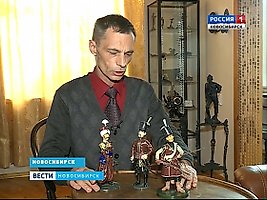
Blocked Sculpture, Figure of a Non-Commissioned Officer of the Kiev Grenadier Regiment
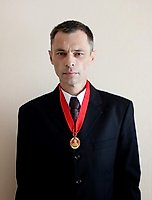
The translation of "Мертвецов Дмитрий Николаевич" into English is "Dmitry Nikolayevich Mertvetsov."
Description
Figure of a non-commissioned officer of the Kiev Grenadier Regiment, Schöngrabern, November 4, 1805. Polychromatic blocked sculpture, whitening and oxidizing of silver, hand engraving and soldering. Green jade – uniform, base; white jade – pants, gloves, plume; serpentinite – plume, shako, cartridge pouch, tie, knapsack, boots; jasper – epaulets, skirt turnbacks; rhodochrosite – plume, cockade, collar, cuffs; Chukotka chalcedony – face; jet – hair, mustache, sideburns, eyes; gold 585, silver 925, enamel, wood. Scale 1:10 Green and white varieties of Siberian jade, serpentinite, rhodonite, Ural jasper, Chukotka chalcedony, jet, gold, silver, enamel, wood. Final creation date: 25.12.2003. Near the Austrian village of Schöngrabern, the Russian rearguard under General P. I. Bagration blocked the path of Napoleon's Marshal Murat, giving the main forces of M. I. Kutuzov time and the opportunity to withdraw unhindered and join reserves and allied troops. All day and all night on November 4 fierce fighting raged. The 5,000-strong Russian detachment stood to the death, holding back the onslaught of a 30,000-strong enemy corps. The Kiev Grenadier and Pavlograd Hussar Regiments especially distinguished themselves at Schöngrabern. Having accomplished their task, Bagration's detachment managed to escape pursuit and join the main Russian forces. Bagration, in the battle of Schöngrabern, showed the French what he, a Russian general, and his soldiers were capable of. From the chaos of the battle, the prince brought out only a few wounded, bloodied men, and Kutuzov, who had expected the entire detachment to be lost, said to him: “I will not ask about losses: you are alive, and thank God!” Non-commissioned officer of the Kiev Grenadier Regiment. The grenadier non-commissioned officer is dressed in a short coat of tailcoat-type cut made of dark green cloth, introduced in 1802. The skirt turnbacks and epaulets are red, the cut standing collar is pink. On the chest, opposite the ends of the collar, six copper buttons are sewn. The cuffs on the coat are round, made of facing cloth, with a narrow flap of dark green color and three buttons. Epaulets, buttoned, are required on both shoulders. The coat skirts overlap; at the bottom of each, at the place joining the cloth facing, a button is sewn. The tie—with a bib—is black cloth. Winter trousers are made of white cloth, boots are black, blunt-toed, with a notch at the back of the tops. From 1805, instead of grenadier and fusilier hats, black cloth caps 20 cm high with a visor and black lacquered chin strap were introduced. Above the visor are affixed a copper grenade and button, as well as a black cockade with an orange border. At the top edge of the cap is a black horsehair plume 49.5 cm high. Along the top edge of the cap is a gold braid, and the upper part of the plume is white with a red stripe. The lower and side edges of the NCO's collar, as well as the upper cuffs, are trimmed with gold braid. Instead of a cartridge box on the belt, a cartridge pouch is attached. In addition, a non-commissioned officer is entrusted with suede gloves and a reed cane. The knapsack is round-shaped, made of black leather, fastened by three buckles. It is worn over the left shoulder, with its left side up. A canteen is attached to the center of the knapsack. Weapons: a sword with a broadsword blade and a non-commissioned officer’s rifled musket model 1798 with a triangular bayonet. In 1801, soldiers' ringlets were clipped and the braids shortened, and from 1802, the front and temples were cut into a comb style, while the back hair was tied into a flat braid reaching the middle of the collar. Powder was used only during parades.
Lot No. 5432
Characteristics
CountryRussia
Year2003

Category The translation of "Мертвецов Дмитрий Николаевич" into English is "Dmitry Nikolayevich Mertvetsov."
Lot location Moscow ( 77 )
Send a message Login
A comment
Opportunities for everyone Login
Payment by agreement
Please check the payment methods with the seller when making a purchase
Delivery by agreement
Check the delivery methods with the seller when making a purchase
Approximate prices in Russia

от 180 ₽

от 180 ₽

от 180 ₽
The translation of "Мертвецов Дмитрий Николаевич" into English is "Dmitry Nikolayevich Mertvetsov."
Description
Additional articles
Blocked Sculpture, Figure of a Non-Commissioned Officer of the Kiev Grenadier Regiment
open a page
"Military-Historical Stone-Cutting Miniatures by Dmitry Mertvetsov"
"Military-Historical Stone Carving Miniatures by Dmitry Mertvetzov"