Figure of a private from the fusilier company of the Moscow Dragoon Regiment. Poltava, June 27, 1709. Blocked polychrome sculpture, bleaching and oxidizing of silver, manual engraving, and soldering. Black jade - hat, tie, shoulder strap, boots; light jade - caftan, gloves, trousers, stand, hair; Ural jasper - collar, epaulettes, cuffs, flaps; Mongolian turquoise - sleeve cuffs, gold lace; chalcedony - face, hand; gold 585, silver 925, enamel, wood. Scale 1:10 Black, green, and light-colored varieties of Siberian jade, nephrite, Ural jasper, kahanol, chrysoprase, gold, silver. Final completion date: January 29, 2005. The Battle of Poltava was the climax of the confrontation between Russia and Sweden during the Great Northern War from 1700 to 1721. What all Russians had been waiting for since the times of Ivan the Terrible was fulfilled - the Swedes suffered a crushing defeat. The might of Charles XII's army was undermined. Private of the fusilier company of the Moscow Dragoon Regiment. The dragoon is dressed in the regulated uniform of the 1700 model. The caftan is grayish-white, made of uncolored wool, knee-length, and has no collar. The sleeves do not reach the wrists, and the shirt gathers are visible from underneath. The cuffs are made of blue wool and have slits. Three loops are cut along the upper edge, fastened with copper buttons. There are slits on the back and sides, from the waist to the hem. The spinal slit is decorated with shoulder straps. There are pockets below the waist cut in the front, with five-pointed toothy flaps fastened with four buttons. Along the edge are sewn copper puffed buttons, with their number varying from 12 to 16 depending on the height of the soldier. A blue cord on the left shoulder, a prototype of the epaulet, serves to secure the sling. The lining of the caftan and the edges of the loops are blue. A blue waistcoat is worn under the caftan; it has the same cut but is shorter and narrower, without cuffs. The trousers are knee-length and made of goat leather. In mounted formations, dragoons were required to wear knee-high boots—blunt-toed smooth boots with flaps and iron spurs. On their hands, they wear gloves made from elk leather with large cuffs. The hat is black, woolen, with a round crown. The brim of the hat is edged with gold lace and curled upward, forming a tricorn. A waistcoat button is sewn on the left side. The tie is made of black fabric. The hair is long, shoulder-length, parted straight down the middle. The soldier's armament consists of a dragoon fuzil with a hook and a sabre. In mounted formations, the fuzil is carried on a sling—an elk leather strap with a hook. A shoulder strap is slung over the right shoulder, also on an elk leather strap. Black and various light-colored varieties of Siberian jade, Mongolian turquoise, Belorechensk quartzite, metal, wood. Sergeant of the Nizhny Novgorod Infantry Regiment. The non-commissioned officer is dressed in the regulated uniform for foot formations of the 1700 model. He is outwardly distinguished from the private soldiers by gold lace on the details of the caftan and on the hat, as well as a pole weapon—an halberd.
If you need any further assistance, feel free to ask!
Please check the payment methods with the seller when making a purchase
Delivery by agreement
Check the delivery methods with the seller when making a purchase
Approximate prices in Russia
от 180 ₽
от 180 ₽
от 180 ₽
The translation of "Мертвецов Дмитрий Николаевич" into English is "Dmitry Nikolayevich Mertvetsov."
Description
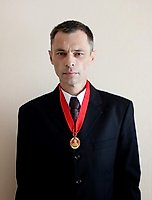
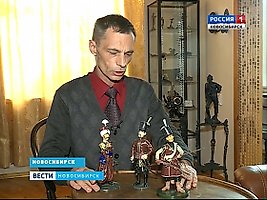
Dmitry Nikolaevich Mertvetsov Artist – stone carver. Born in 1964 in Novosibirsk, into a family of a scientist and a doctor. His grandparents on his father's side were geologists, and as a child, he often went on geological expeditions with his grandfather during the holidays. His grandfather, Pavel Efimovich, was passionate about working with stones. As a child, Dmitry spent a lot of time sculpting with plasticine. He enrolled in the geology-geophysics faculty at Novosibirsk University. After graduating, he was assigned to the Institute of Geology and Geophysics in Novosibirsk Academgorodok, where he spent many years on expeditions. In every spare moment, he eagerly carved and polished ornamental stones. In Irkutsk, he worked in a stone carving workshop, became fascinated by plastics, and was particularly drawn to polychrome mosaics. He created a variety of works from semi-precious stones, including figures of birds, animals, people, fish, and more. He produced the famous series "Dinosaurs," which gave its name to an entire direction in stone carving – "Paleoanimale." Not every artist has the fortune to become the founder of a movement. He takes on many commissions across various genres. He considers the theme of military-historical miniatures in the technique of blocked sculpture from natural semi-precious stones to be his true direction. The figures are created at a uniform scale of 1:10 from colored stones, wood, and metal, which requires him to deeply delve into the field of historical science known as "Uniformology." Today in Russia, in addition to two recognized schools of stone carving – the St. Petersburg and Ural schools, one can speak of the emergence of a new, third – Siberian school of stone carving skills, and Dmitry Mertvetsov becomes its worthy representative.From the book "The Knights of the Perkhina Order" Published by: The Memorial Fund of Karl Fabergé. St. Petersburg. 2011.
Additional articles
Blocked sculpture. Figure of a private from the fusilier company of the Moscow Dragoon Regiment.
"Military-Historical Stone-Cutting Miniatures by Dmitry Mertvetsov"
"Military-Historical Stone Carving Miniatures by Dmitry Mertvetzov"
On May 5, 2012, during a significant year in Russian history, an exhibition titled "RUSSIA. TIME OF GLORY AND DELIGHT" was opened at the Novosibirsk State Art Museum. The art museum showcased a unique collection of military-historical stone-carved miniatures created by Novosibirsk master Dmitry Mertvetsev. The works presented at the exhibition are united by a single theme—the reconstruction of Russian military costumes, uniforms, and armaments of participants in renowned battles from the early 17th to the mid-20th centuries. The retrospective provides a broad historical panorama, ranging from the Battle of Poltava to the campaigns led by A.V. Suvorov, M.I. Kutuzov, and other commanders. Fusiliers, dragoons, musketeers, grenadiers, rotmistras, and lieutenants clad in breastplates, helmets, grenadier caps, gaiters, overcoats, and waistcoats, armed with sabers, swords, muskets, fusils, bayonets, spears, and pikes, are crafted on a scale of 1:10 from jasper, lapis lazuli, jade, and other stones. The gold and silver of galloons, epaulettes, cockades, and heraldic emblems shine on the stone of the waistcoats, helmets, and grenadier caps. The figurines of warriors from long-ago battles are plastic, expressive, and splendidly detailed. The exhibition featured 14 works, 11 of which were by the author, while three were generously provided by private collector Grigory Gaponov. The opening of the exhibition was attended by the governor of the Novosibirsk region, Vasily Yurchenko. The exhibition was inaugurated by the Minister of Culture of the Novosibirsk region, Natalia Yaroslavtseva, and the Director of the Novosibirsk State Art Museum, Sergey Dubrovsky. In their speeches, they highly praised the collection presented for its significance to the city and the country as a whole, and expressed the common sentiment among museum professionals and officials that this collection should become the property of the museum. The exhibition was very successful, gathering a large audience.The number of enthusiastic reviews in the circles of cultural and political figures, as well as among the general public, was significant. In light of this public resonance and the high evaluation from museum specialists, the Novosibirsk region made the decision to purchase eleven pieces from this collection. The remaining three figures were not for sale by the private collector. The Novosibirsk State Art Museum received ten pieces for its permanent exhibition. It was decided to present one piece as a personal gift to the President of the Russian Federation, V.V. Putin, from the Novosibirsk region in honor of the celebrations of the events of 1812. In 2012, the stone-carved miniature "Küstrin, August 17, 1813" was gifted to V.V. Putin by the Governor of the Novosibirsk region, V.A. Yurchenko. Moscow. The Kremlin. 2012. V. Putin and V. Yurchenko. A total of 20 figures were made in this series. According to Dmitry, he has completed this series and does not intend to return to it. The crafting of the figures in this series took the master 11 years. Currently, five unique works are for sale, three of which were featured in the aforementioned exhibition. According to experts, these are among the best works in the series in terms of quality and significance. For example, the figure "Schöngraben, November 4, 1805. Unter-officer of the Kiev Grenadier Regiment" is the first work in this series created by the master. It has won numerous awards at regional and all-Russian exhibitions. The works "Leipzig, October 4, 1813" and "Preussisch-Eylau, February 8, 1807" are the last pieces where the master applied all his accumulated experience and skill over the years. These five figures represent a complete collection that provides a full understanding of the master's creativity. It should also be noted that the figures not included in the catalog are held in private collections that are not publicly accessible and belong to representatives of the business and political elite of Russia. One of these figures was gifted to V.V. Putin on October 8, 2014, on the occasion of his birthday by the Governor of the Novosibirsk region, Vladimir Gorodetsky. Here is this figure:The text translates to: "Collection of V.V. Putin"


 # tags