Here's the translation of the text into English:
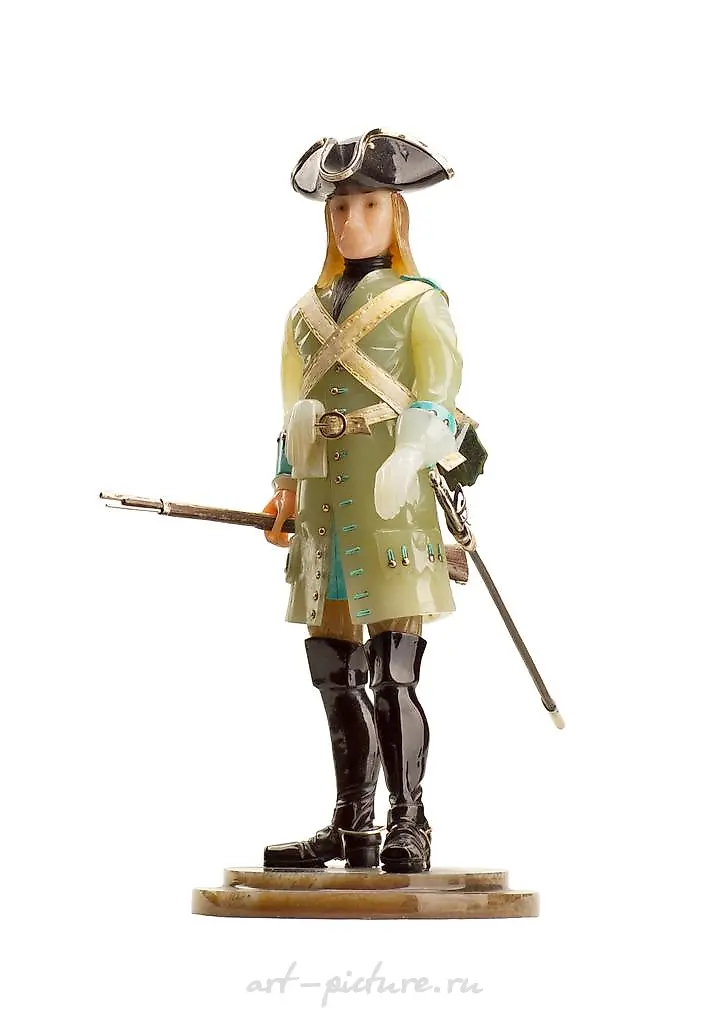
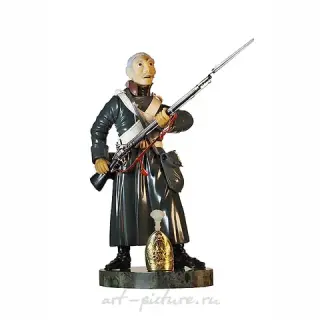
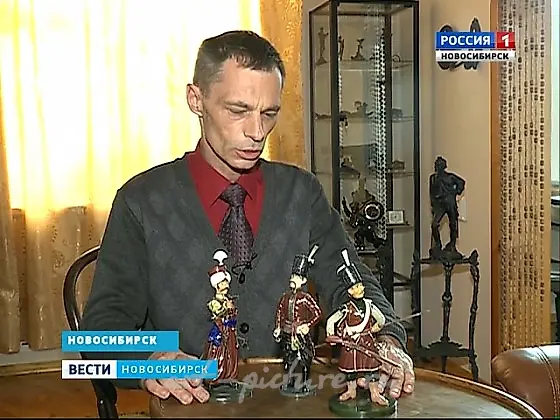
Figure of a private from the fusilier company of the Moscow Dragoon Regiment. Poltava, June 27, 1709.
Blocked polychrome sculpture, bleaching and oxidizing of silver, manual engraving, and soldering.
Black jade - hat, tie, shoulder strap, boots;
light jade - caftan, gloves, trousers, stand, hair;
Ural jasper - collar, epaulettes, cuffs, flaps;
Mongolian turquoise - sleeve cuffs, gold lace;
chalcedony - face, hand;
gold 585, silver 925, enamel, wood.
Scale 1:10
Black, green, and light-colored varieties of Siberian jade, nephrite, Ural jasper, kahanol, chrysoprase, gold, silver.
Final completion date: January 29, 2005.
The Battle of Poltava was the climax of the confrontation between Russia and Sweden during the Great Northern War from 1700 to 1721. What all Russians had been waiting for since the times of Ivan the Terrible was fulfilled - the Swedes suffered a crushing defeat. The might of Charles XII's army was undermined.
Private of the fusilier company of the Moscow Dragoon Regiment.
The dragoon is dressed in the regulated uniform of the 1700 model. The caftan is grayish-white, made of uncolored wool, knee-length, and has no collar. The sleeves do not reach the wrists, and the shirt gathers are visible from underneath. The cuffs are made of blue wool and have slits. Three loops are cut along the upper edge, fastened with copper buttons. There are slits on the back and sides, from the waist to the hem. The spinal slit is decorated with shoulder straps. There are pockets below the waist cut in the front, with five-pointed toothy flaps fastened with four buttons. Along the edge are sewn copper puffed buttons, with their number varying from 12 to 16 depending on the height of the soldier. A blue cord on the left shoulder, a prototype of the epaulet, serves to secure the sling. The lining of the caftan and the edges of the loops are blue.
A blue waistcoat is worn under the caftan; it has the same cut but is shorter and narrower, without cuffs. The trousers are knee-length and made of goat leather. In mounted formations, dragoons were required to wear knee-high boots—blunt-toed smooth boots with flaps and iron spurs. On their hands, they wear gloves made from elk leather with large cuffs.
The hat is black, woolen, with a round crown. The brim of the hat is edged with gold lace and curled upward, forming a tricorn. A waistcoat button is sewn on the left side. The tie is made of black fabric.
The hair is long, shoulder-length, parted straight down the middle.
The soldier's armament consists of a dragoon fuzil with a hook and a sabre. In mounted formations, the fuzil is carried on a sling—an elk leather strap with a hook. A shoulder strap is slung over the right shoulder, also on an elk leather strap.
Black and various light-colored varieties of Siberian jade, Mongolian turquoise, Belorechensk quartzite, metal, wood.
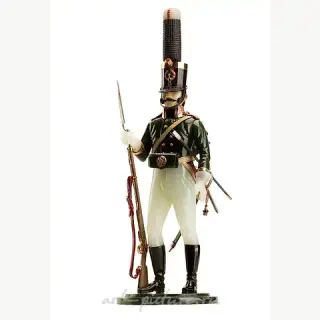
Sergeant of the Nizhny Novgorod Infantry Regiment.
The non-commissioned officer is dressed in the regulated uniform for foot formations of the 1700 model. He is outwardly distinguished from the private soldiers by gold lace on the details of the caftan and on the hat, as well as a pole weapon—an halberd.
If you need any further assistance, feel free to ask!