Sergey Alexandrovich Alferov. A large collection of Alferov's works is available for sale; prices and photos of the works are available upon request.
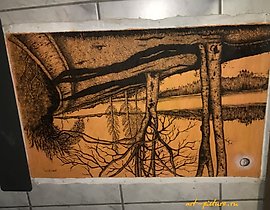
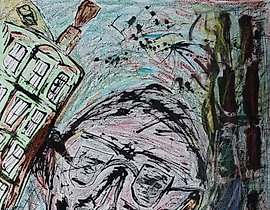
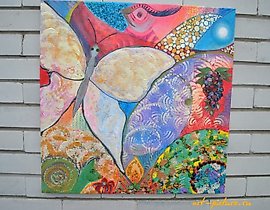
His art intricately fuses high aesthetics and folkloric sources, the ornate quality of modernism and the quivering sensitivity of Dadaism, the fathomless depth of symbolism and the tangible physicality of Russian lubok, painterly refinement and 'raw' graphic concreteness. Yet, all this together is not the amateurism of a seeking neophyte, nor is it eclecticism, but a transfer of powerful spiritual experience, a gateway into the intimate, the secret, an approach to the origins of all beginnings.
Sergey Alferov is one of those about whom it is said that they are not quite of this world. His way of life is uncomfortable and irrational. He has renounced household comforts and has settled in one of the artist communes on the outskirts of Moscow among wandering philosophers, hippies, tramps, and eccentric painting fanatics. His bed is a sleeping bag. His table is a crate from glass containers. Yet he is open to all cosmic energies, absorbing them eagerly and passionately, rushing to capture and record the revelations he receives.
However, Sergey Alferov is not merely a medium, coldly and dispassionately recording the directions of astral winds. His gaze is first and foremost turned to the most ancient recesses of consciousness. From vanished centuries and civilizations, he draws what is most relevant today. The signs of the perished and non-existent must be deciphered, if only for a timid attempt at personal salvation—perhaps, even unconsciously and fragmentarily reproducing these incomprehensible symbols, the artist manages to make contact with higher forces. At the same time, he leads us, the viewers, along. The level of our 'intellectualism' does not matter here—in the end, prayers are uttered even by those who do not understand the meaning of their words.
Magic, in principle, is accessible to everyone. The difference is that we draw 'circles,' 'crosses,' and 'triangles' without ever thinking of the consequences (it just doesn’t come to our minds). The initiated approach the matter professionally. Hence, why an encounter with their art makes the heart ache so sweetly. Only by superhumanly loving this world can one learn to transform simple, unpretentious things into vast, generalized categories. For the care-burdened philistine, the whale, the elephant, or the turtle are merely zoological specimens. And, alas, few are left of the madmen who, without the slightest doubt, consider them the sacred foundation of the earth.
Fortunately, Seryozha Alferov is one of these 'deluded ones' (he draws turtles encompassing all existence at once). His 'inner,' subjective is so fused with the 'outer,' objective that one involuntarily recalls the fundamental dialectical postulate: nature created man to know itself. It is not the artist’s fault that the reality he reveals does not coincide with generally accepted notions.
How national is Sergey Alferov’s art? On one hand, it is convenient to answer this by referring to the cosmic nature of the Russian soul (after all, his work has absorbed and reflected the scents of many 'distant, wondrous lands'). On the other hand, he is so dissolved in primeval esoteric traditions, so spiritually assimilated that, at first glance, he has become ethnically atrophied beyond recovery. Nevertheless, his departure into 'inner emigration' did not entail a break with the 'Russian quintessence'—and you need to understand at least a little about the nuances of the Eastern, kaif-like worldview to glimpse, amid the shimmering outlines of Andersen’s spires and attics, the romance of other geographic spaces, to sense the pungent smell of wild Polovtsian steppes, to hear the soft neighing of mares grazing at night. Truly, the more fantastic and unreachable the goal set by Russian artists, the farther their rebellious spirit strives from native soil, the more at ease they feel, the more intricate, fathomless, and original their legend becomes, the greater their contribution to the treasure trove of world culture.
Sergey Alferov, that lonely Russian semi-Taoist, semi-Sufi, wandering with a tattered umbrella through centuries and legends, presents us with his gentle, touching revelations—and beckons us into boundless, unknown distances.
Please check the payment methods with the seller when making a purchase
Delivery by agreement
Check the delivery methods with the seller when making a purchase
Approximate prices in Russia
от 180 ₽
от 180 ₽
от 180 ₽
ALFEROV SERGEI ALEKSANDROVICH
Description
Sergei Aleksandrovich Alferov (1951-2004) studied at the Tashkent Art School named after P.P. Benkov. From 1969 to 1971 he worked as a decorator in the Uzbek Drama Theater named after Hamza and as an artist in pioneer camps in the Tashkent region. In 1972 he moved to Moscow. From 1972 he was a member of the Moscow City Committee of Graphic Artists at Malaya Gruzinskaya. From 1987 to 1991 he worked in the creative workshop of the exhibition hall "Dom-100" in Belyaevo. He was friends with A. Zverev, who painted many portraits of S. Alferov and his wife. Participant of the 2nd outdoor exhibition in the Izmailovo forest park in 1974, participant of the Bulldozer exhibition, as well as shows on M. Gruzinskaya. Since the early 1970s, he actively participated in various exhibitions, worked in Germany and England. Sergei Alferov's works are kept in the collections of the Moscow Museum of Modern Art, the Museum of the Underground in the USA, as well as in private collections abroad and in Russia.• 1987, Moscow: Exhibition-auction of the Soviet Cultural Foundation "New Chamber Art". Exhibition hall of the Soviet Cultural Foundation - "Artblia". Central House of Architects - First exhibition of ironic art. Exhibition hall "Sevastopolsky" - Annual closed exhibition "Autumn 87". Exhibition hall of SOYUZVNESHTANS - "Aniline Wind". Exhibition hall "Sevastopolsky" • 1988, Moscow: First exhibition of free youth artistic associations "Labyrinth". Moscow Youth Palace - "Paper Clocks". Exhibition hall "October" • 1990 - Creative trip to London to participate in the exhibition "Moscow in Cambridge" under contract with the magazine "Ogonyok", which exhibited Sergey Alfyorov's work in the UK for a year. • 1994-1995 - By invitation of German businessman and patron Eckehard Streletzki, for six months participated in the design of the Estrel Rezidence Congress Hotel in Berlin. All works created during this period are in the permanent exhibition of the hotel. Personal exhibitions • 1997 - Gallery "Gallery on Solyanka", Moscow • 1989 - "War of 1812". Exhibition hall of the Cheremushkinsky district, Moscow • 2000 - "Center Periphery". Exhibition hall "Na Kashirke", Moscow • 2010 - Gallery "Cinema", Moscow Works are stored in the collection of the Moscow Museum of Modern Art, the Museum of underground (USA) Monograph "Preface to the inevitable", dedicated to the life and creative work of the artist Sergey Alferov (1951-2004). The presentation is dedicated to the opening of an exhibition of graphic and painting works, which introduce practically all stages of the master's creative path, his searches and discoveries, immersing in the circleHis artistic preferences. The book consists of 140 color reproductions and photographs from the master's archive, as well as Valery Turchin's art historical research, memories of contemporaries and like-minded individuals, "peers" of Sergey Alferov - Igor Dudinsky, Artem Kirakosov, Sergey Bordachev, Igor Kislytsyn, Vladimir Tryamkin, Andrey Basanz, Alexander Lisovsky, Yuri Pliss, Kati Medvedeva, Ivan Akhmetiev, Larisa Pyatnitskaya, Boris Bich, Nina Shcherbakova, Dmitry Ionov, Vladimir Dzha Guzman, Alexander Kedrin, daughters of Anastasia Alferova and wife Olga Burakova. Sergey Alferov's first solo exhibitions date back to 1980-1990 - however, his name became known in the Moscow art community from the mid-70s. The artist was born in 1951 in Tashkent, in a Russian family. He entered the local art school, where aesthetic disagreements with teachers immediately began; therefore, Alferov moved to Moscow in 1973, where he immediately joined the circle of non-conformist artists. His works began to be actively acquired by Soviet and foreign collectors of contemporary art. S.A. Alferov also participated in open-air vernissage in Izmailovo, as well as exhibitions at Malaya Gruzinskaya, 28, and many other shows of alternative art. It is no coincidence that V. Turchin titled his article "Sergey Alferov's Different Experience", drawing parallels between the artistic searches of the artist and a number of other non-conformists - representatives of the so-called Other Art. Almost all of the masters of this community were united by a spirit of experimentation, a free approach to a wide range of styles and traditions, the presence of, alongside individual mythology, a clearly pronounced stylistic and imagery commonality. His friendship with the brightest representative of unofficial art of those years - Anatoly Zverev - played a significant role in shaping Sergei Alferov, both as a person and as an artist. Both artists often lived by fate.And under one roof they worked side by side, exchanging creative ideas. Sergey Alferov seriously studied world, primarily Eastern philosophy and metaphysics, which could not but affect his creativity. The artist's main interest was in the traditions of Eastern art, the sharp expressiveness and expression of African masks, the classics of European art of the early 20th century - especially in Dadaism with its immediacy and orientation towards "childhood". The artist's life was tragically cut short in 2004, when interest in his work reached its peak. At the age of 53, he tragically died on the street under "unexplained circumstances". The project "Preface to the Inevitable" was prepared by curators Lusine Petrosyan and Anna Moreva, who put a lot of effort into preserving and popularizing the creative legacy of Sergey Alferov. The exhibition features works from private collections. Some of them are offered for sale. Major group exhibitions: 1974 - Moscow park "Izmailovo". Second autumn exhibition of paintings outdoors. 1977 - Painting exhibition. Moscow United Committee of Artists-Designers (Mala Gruzinskaya, 28). 1984, January - Exhibition of painting, sculpture and graphics. Institute of Electronic Control Machines (INEUM). Moscow. 1984, December - Galerie with J. Kiblitzky's support. Dusseldorf, FRG. 1986 - Exhibition of the "ARBATR" association. Exhibition hall "Kievsky". Moscow. 1987 - Exhibition-auction of the Soviet Cultural Fund "New Chamber Art". Exhibition hall of the Soviet Cultural Fund. Moscow. - Exhibition of the association "ARTBLYA". Central house of the architect. Moscow. - First exhibition of ironic art. Exhibition hall "Sevastopolsky". Moscow. - Annual closed exhibition "Autumn-87". Exhibition hall of AO "SOYUZVNESHTRANS". Moscow. - Exhibition "Aniline Wind". Exhibition hall "Sevastopolsky". Moscow. 1988 - First exhibition of free young artistx unions "Labyrinth". MDM. Moscow. - Exhibition "Paper Clocks". Exhibition Hall "Oktyabrsky". Moscow. 1990 - a creative trip to London to participate in the exhibition "Moscow in Cambridge" under a contract with the magazine "Ogonyok", which for a year exhibited the works of Sergey Alferov throughout Great Britain. 1994-1995 - at the invitation of German businessman and patron Ekkerhada Streletsky, for six months participated in the design of the interior of the newly built Estrel Residence & Congress Hotel (Berlin). All works created during this period are in the permanent exhibition of the Hotel. Personal exhibitions 1989 - "War of 1812". Exhibition hall of the Cheremushki district. Moscow. 1997 - Exhibition hall "Gallery on Solyanka". Moscow. 2000 - "Center & Periphery". Exhibition hall "On Kashirke". Moscow. Sergey Alferov's works are in the MMAM (Moscow Museum of Modern Art), the Museum of the American Underground, as well as in other domestic and foreign museums, galleries, private and corporate collections. Sergey Alferov "IsoMythology". "IsoMythology" is the first museum retrospective exhibition of Sergey Alferov (1951-2004). The exhibition will provide an opportunity to familiarize yourself with all stages of the artist's work, who was an idol for his generation of connoisseurs and enthusiasts of contemporary art. About 200 works of the master will be presented at the exhibition - painting, graphics, and artistic photographs. The extensive retrospective project will allow you to trace the formation of the artist from his first artistic experiments to his works in the last years of his life, his circle of artistic interests and preferences, to see in the aggregate all the searches and discoveries of the master who made a significant contribution to the history of contemporary culture. The entire creative path of Sergey Alferov represents a whimsical intertwining of different mythologies - in painting, everyday lifeThe artist was born and raised in Tashkent, in a Russian family of hereditary intelligentsia, and throughout his subsequent life, he remained faithful to Eastern traditions with their fairy-tale decorative basis. Being already a mature master, Alferov would leave for the mountains at the first opportunity to gain spiritual experience. He traversed the entire Pamirs, visited local sages, lived in communes - among those like him, seekers of mystical revelations. As Alferov became acquainted with various aspects of world philosophy, he immediately reflected them in his works. Africa, the shamanic North, the East, Asia, Native America - all of this found its reflection in the artist's works. One mythology organically flows into another, symbolism is layered upon each other, inviting the viewer on a fascinating journey through civilizations that have passed and survived to our days. From the very beginning of his artistic career, Alferov's "non-canonical" style, from the point of view of socialist realism, irritated the officials of the Tashkent art community. After several unsuccessful attempts to exhibit his work, the young artist decided to move to Moscow in the early 1970s, where many famous non-conformist artists worked. In the capital, Sergei initially lived wherever he could, wandered through the apartments of acquaintances and the studios of his colleagues. For a time, he had access to a basement, where he hung his works to dry on ropes like laundry. Alferov's art quickly gained popularity among contemporary art connoisseurs. Sergey's participation in the so-called "bulldozer" exhibition on September 15, 1974, played a significant role in his recognition. As a result, Alferov's works attracted the attention of art critics. Sergey became a trendy and sought-after author. In the fall of 1975, he participated in another large-scale historical exhibition of non-conformists at the "Culture" pavilion at VDNKh among 150 artists. There, for the first time, one could see the works of all the leading figures of the domestic avant-garde art scene.In the 1970s, Alferov joined a prominent group of artists such as Tselkova, Rabina, Nemukhin, Vechtomova, Zverev, Plavinsky, Kharitonov, and Yakovlev. Alferov took a worthy place among the masters. In 1975, Sergey Alferov became one of the founders of the so-called "painting section" at the Moscow City Trade Union Committee of Artists-Graphic Designers, which allowed many previously unrecognized authors to obtain the status of "official" artist and stop hiding from the militia hunting down "idle persons." A significant role in the formation of Sergey Alferov - as a person and as an artist - was played by his friendship with another prominent representative of unofficial art of those years - Anatoly Zverev. Communication with a real living genius liberated Alferov in a creative sense and finally convinced him that he was on the right path. By the end of the 1970s, Alferov entered the circle of the founding fathers of Soviet nonconformism and became a full participant in the most vibrant exhibitions and auctions. His works were actively acquired by Soviet and foreign collectors of contemporary art. He created his mythology from the primeval chaos of color. Would work for several days at a time. Sitting in the middle of the room on linoleum, squatted absorbed in himself half-crazy half-hippie - always wearing headphones, meditating to Eastern music or jazz. Surrounding him were dances of unfinished sheets. Flowers, birds, butterflies, fish, turtles, architectural structures. They all patiently awaited the master's final touches - passionate, temperamental, impulsive. The entire room was cluttered with jars, bubbles, and tubes of gouache, watercolor, ink, tempera, printing ink. Brushes, markers, and chalk were scattered at his feet. Alferov believed that paper itself provokes the artist to create. Sergei Alferov's life tragically ended in 2004, when interest in his works was exceptionally high. At the age of 53, the artist tragically died in the street "under unexplained circumstances."