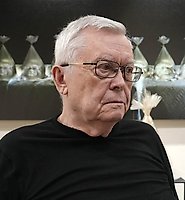
Шаров Сергей Александрович (род. 1945) «Матросская тишина». 1979. Бумага, шелкография, 64,5×63,2 см. В правом нижнем углу шелкографированные авторские подпись и дата, а также подпись и нумерация фломастером: «28/250». oтличнoе коллекциoнное состояние.
Please check the payment methods with the seller when making a purchase
Delivery by agreement
Check the delivery methods with the seller when making a purchase
Approximate prices in Russia
от 180 ₽
от 180 ₽
от 180 ₽
The text "ШАРОВ" transliterates from Russian as "SHAROV." It is a surname and does not have a direct translation into English; it is simply rendered as "Sharov" in English contexts. The text "СЕРГЕЙ АЛЕКСАНДРОВИЧ" translates to **"Sergey Alexandrovich"** in English.
Description
Here is the English translation of your text: --- **Artist, architect.** Born on June 29, 1945, in Yekaterinburg. Lives and works in Moscow. Corresponding Member of the Russian Academy of Arts (Department of Architecture, 2009). **Education:** Moscow Architectural Institute (1969). **Professional Activities:** Architect at "Mosproject No.1" in Workshop No.12 (1969–1981); Chief artist at the Karl Marx and Engels Museum in Moscow (1971–1978); Artist-designer at the Decorative and Applied Arts Combine of the Moscow Artists Union (1978–1984); Co-founder of the first independent art association in Moscow, M’ars (1988). **Major Projects and Works:** As part of creative teams – exhibition design for Lenin museums in Kuibyshev, Kazan, and Frunze; project for the reconstruction of the Central Lenin Museum in Moscow; together with sculptor A.I. Rukavishnikov – monument to L. Yashin at the Dynamo Stadium (1996), sculptural relief for the monument to F.M. Dostoevsky in Moscow (1997), monument to A. Samaranch in Luzhniki (2001), monument to Tsar Alexander II (2005), monument dedicated to religious figures – victims of repression in Shuya (2006), monument to Dmitry Donskoy in Kolomna (2007), monument to the Tajik poet A. Rudaki in Dushanbe (2008), monument to the founder of the Imperial Orthodox Palestine Society V.N. Khitrovo in Moscow (2012), monument to S.V. Mikhalkov on Povarskaya Street (2014), 25-meter sculpture of a Gladiator near Spartak Stadium (2014). Participated in the creation of the memorial plaque for Borovik, the memorial plaque for writer L. Leonov, the monument to Army General Govorov, and the tombstones for Beskov and Gomelsky. Author of the painting series "Moscow Capriccios," as well as sculptures and installations. Engaged in magazine graphics, book illustration, industrial graphics, and graphic design. **His works are represented in** the collections of the State Tretyakov Gallery, the State Russian Museum, in the collections of the MARS Museum, and cor... --- Note: Your text is cut off at the end, so the last sentence is unfinished. If you provide the rest, I can translate that as well.Here is the translation of your text into English: --- ...in corporate and private collections in Russia, France, Sweden, Finland, Germany, Colombia, Austria, Bolivia, the USA, Japan, Czechoslovakia, Romania, England, and many other countries. A regular participant in exhibitions of the group "Twenty Moscow Artists" (since 1976) and the association "ARS". In 1989, a solo exhibition was held in London. Sergey Alexandrovich Sharov: The Light of Change Sergey Sharov is a talented Russian artist whose work marked a new era in art. His works are distinguished by a deep philosophical subtext and a unique visual style. Born into a humble family, Sergey displayed outstanding abilities in drawing since childhood. Even as a youth, his paintings amazed viewers with the boldness of their concepts and his masterful command of technique. After graduating from art school, Sharov moved to Moscow, where his rise to fame began. Early Work Sergey Sharov’s first works stood out for their subtle lyricism and philosophical reflections on the human soul. The artist created moving portraits, landscapes, and still lifes. His paintings from that period are imbued with sadness and hope at the same time. However, gradually, Sharov’s work acquired new features—complex metaphors, symbols, and allegories began to appear. The artist turned increasingly to the theme of humanity’s spiritual quest, the eternal struggle between good and evil. His works took on a mystical, enigmatic character. Mature Work Sergey Sharov achieved true recognition with the paintings of his "Moscow" period. Here, the artist developed his own recognizable style, combining realistic depiction with fantastic imagery. Mysterious characters, reminiscent of angels or demons, began to appear. Their figures float above everyday Moscow landscapes, creating a sense of unreality. Sharov explores the contrast between the spiritual and material worlds. Later Work In recent years, Sharov’s painting has acquired features of surrealism. The artist with...Here is your requested translation: --- He creates phantasmagoric canvases filled with mysterious symbols and archetypes. His works convey the sensation of a waking dream, where reality intertwines with the otherworldly. At the same time, Sharov does not lose touch with reality. In his paintings, features of contemporary Moscow can still be discerned, but in a whimsical, transformed manner. In this way, the artist expresses the idea of the eternal cycle of life. Significance of his creative work Over many years of work, Sergei Sharov has created a unique artistic world that continues to impress and move viewers. His art has influenced many contemporary painters, inspiring them to seek new forms and images. Sharov demonstrated that art is capable of conveying complex philosophical ideas by means of visual metaphors and symbols. Thanks to the depth of his thought and the originality of his style, his legacy has forever become a part of Russian cultural history. Evolution of style Throughout his creative journey, Sergei Sharov has repeatedly experimented with his painting style. While his early works stood out for their realism and attention to detail, over time his manner became increasingly abstract and symbolic. The evolution is especially noticeable in the depiction of human figures. Initially, the characters in Sharov's paintings were recognizable and individual. Later, their features become blurred, transforming into conventional outlines in which the human form can barely be discerned. Color palette The use of color plays an equally important role in Sharov’s works. At different stages of his creativity, the artist used completely different color combinations. His early period is characterized by muted brownish-gray tones that convey a melancholic mood. In his mature years, contrasting, bright colors appear, symbolizing the struggle of opposites. In his later works, fantastic shades predominate, creating an illusion of a dream. Influence on followers Many contemporary artists, to one degree or another, have experienced the influence of Sergei Sharov’s art. They are united by an interest in philosophical painting, the combination of... --- Let me know if you need the translation of the last incomplete sentence or the rest of the text!Here is the English translation of your text: --- realism with mysticism, the use of metaphors and symbols. At the same time, Sharov’s followers interpret his ideas in a new light, adding elements of their own vision. Thus, the legacy of the master continues to live and develop in the works of his students. **The Artist’s Legacy** Over decades of creative activity, Sergey Sharov has created a vast artistic legacy. His works are found in many museum and private collections not only in Russia, but also abroad. Solo and group exhibitions of Sharov’s works are held regularly. Albums and monographs devoted to his life and art are published. The artist’s name is firmly inscribed in the history of 20th-century Russian art. **Contribution to Culture** The contribution of Sergey Sharov to national culture is hard to overestimate. His paintings reflected the spiritual quests of his era, and humanity’s striving for the comprehension of the deeper meaning of existence. Thanks to vivid imagery and philosophical depth, Sharov’s works popularized complex ideas, making them accessible to a wide audience. The artist made an invaluable contribution to the development of the audience’s aesthetic perception.