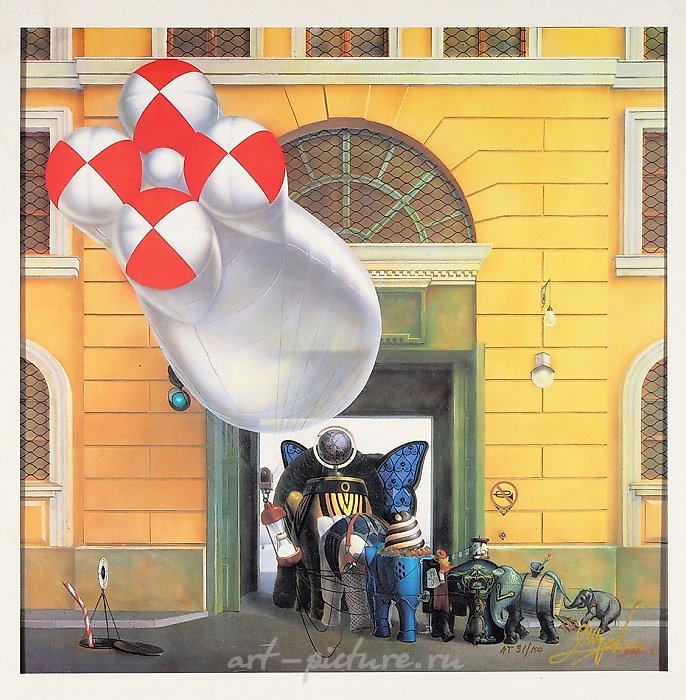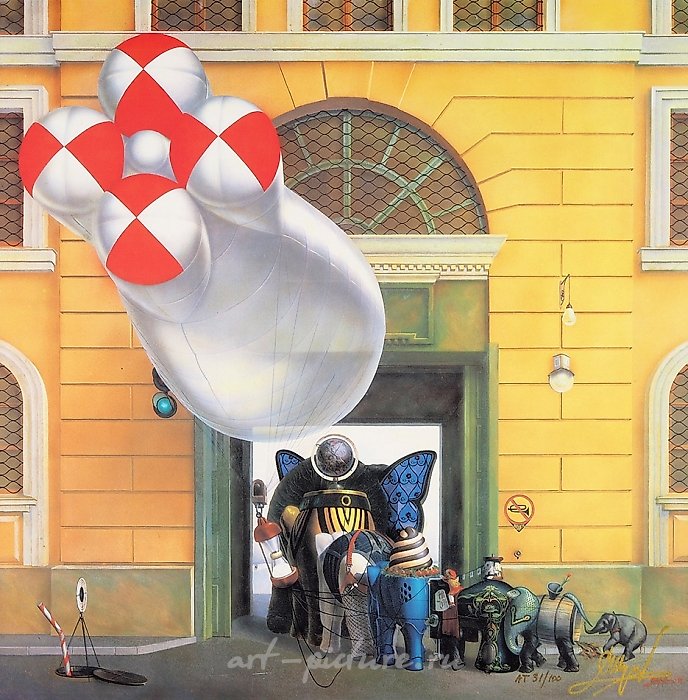
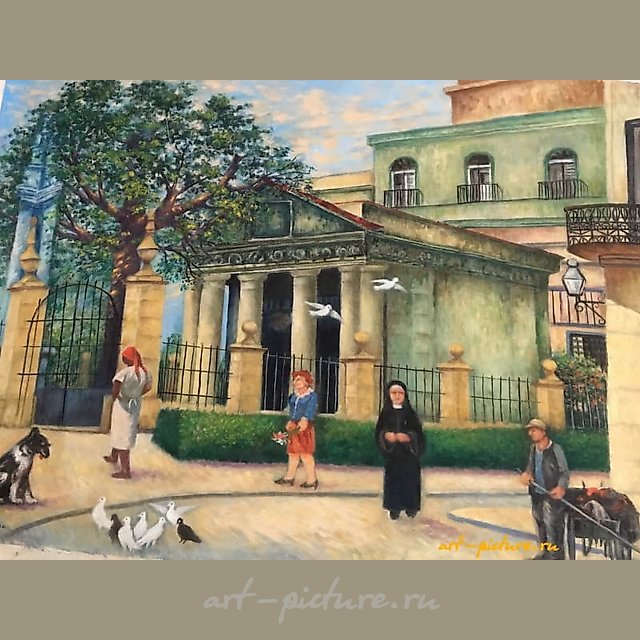
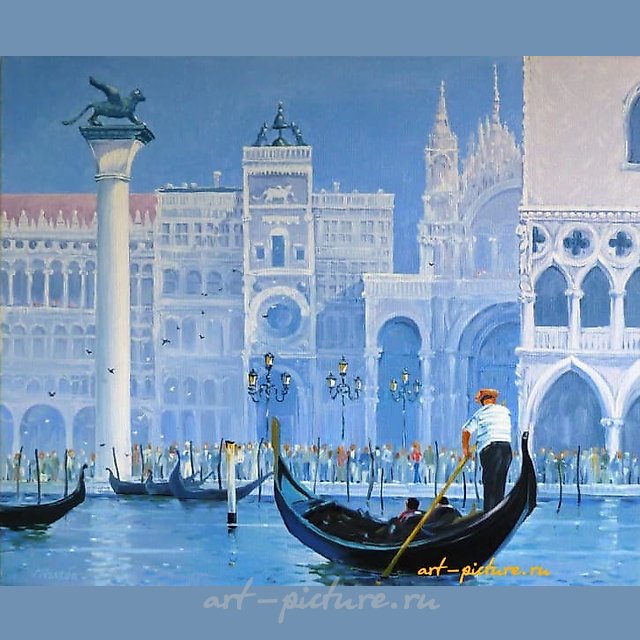
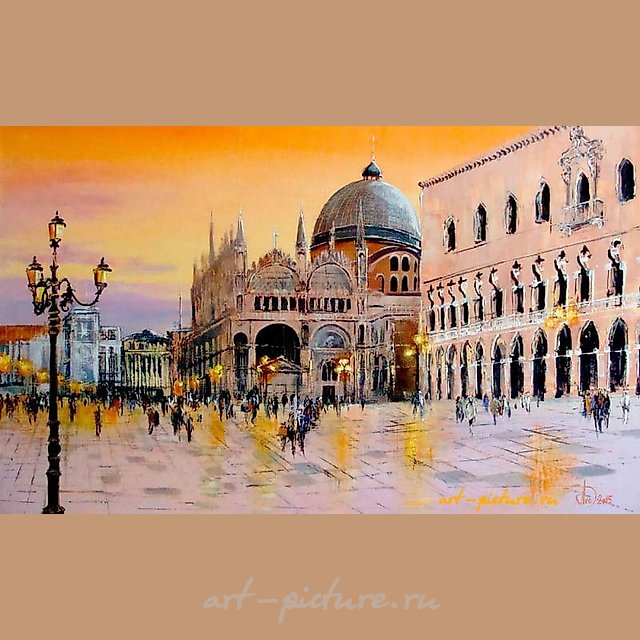
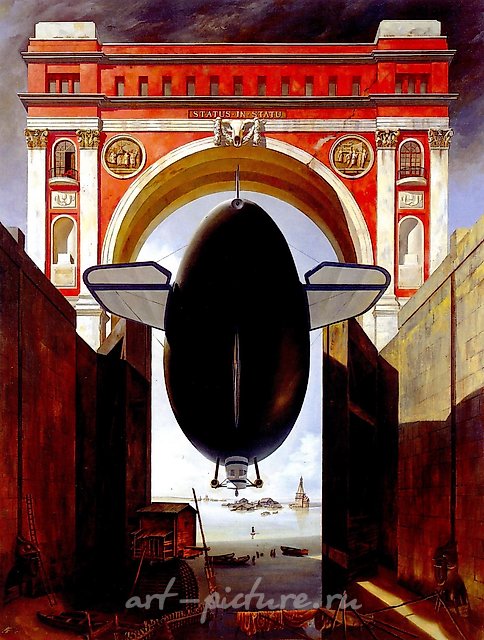
Sergey Alexandrovich Sharov (born 1945), "Matrosskaya Tishina". 1979. Paper, silkscreen, 64.5×63.2 cm. In the lower right corner, the author's silkscreened signature and date, as well as a marker inscription with signature and numbering: "28/250". In excellent collectible condition.
Please check the payment methods with the seller when making a purchase
Delivery by agreement
Check the delivery methods with the seller when making a purchase
Approximate prices in Russia
от 180 ₽
от 180 ₽
от 180 ₽
The text "ШАРОВ" transliterates from Russian as "SHAROV." It is a surname and does not have a direct translation into English; it is simply rendered as "Sharov" in English contexts. The text "СЕРГЕЙ АЛЕКСАНДРОВИЧ" translates to **"Sergey Alexandrovich"** in English.
Description
Here is the English translation of your text: --- **Artist, architect.** Born on June 29, 1945, in Yekaterinburg. Lives and works in Moscow. Corresponding Member of the Russian Academy of Arts (Department of Architecture, 2009). **Education:** Moscow Architectural Institute (1969). **Professional Activities:** Architect at "Mosproject No.1" in Workshop No.12 (1969–1981); Chief artist at the Karl Marx and Engels Museum in Moscow (1971–1978); Artist-designer at the Decorative and Applied Arts Combine of the Moscow Artists Union (1978–1984); Co-founder of the first independent art association in Moscow, M’ars (1988). **Major Projects and Works:** As part of creative teams – exhibition design for Lenin museums in Kuibyshev, Kazan, and Frunze; project for the reconstruction of the Central Lenin Museum in Moscow; together with sculptor A.I. Rukavishnikov – monument to L. Yashin at the Dynamo Stadium (1996), sculptural relief for the monument to F.M. Dostoevsky in Moscow (1997), monument to A. Samaranch in Luzhniki (2001), monument to Tsar Alexander II (2005), monument dedicated to religious figures – victims of repression in Shuya (2006), monument to Dmitry Donskoy in Kolomna (2007), monument to the Tajik poet A. Rudaki in Dushanbe (2008), monument to the founder of the Imperial Orthodox Palestine Society V.N. Khitrovo in Moscow (2012), monument to S.V. Mikhalkov on Povarskaya Street (2014), 25-meter sculpture of a Gladiator near Spartak Stadium (2014). Participated in the creation of the memorial plaque for Borovik, the memorial plaque for writer L. Leonov, the monument to Army General Govorov, and the tombstones for Beskov and Gomelsky. Author of the painting series "Moscow Capriccios," as well as sculptures and installations. Engaged in magazine graphics, book illustration, industrial graphics, and graphic design. **His works are represented in** the collections of the State Tretyakov Gallery, the State Russian Museum, in the collections of the MARS Museum, and cor... --- Note: Your text is cut off at the end, so the last sentence is unfinished. If you provide the rest, I can translate that as well.Here is the translation of your text into English: --- ...in corporate and private collections in Russia, France, Sweden, Finland, Germany, Colombia, Austria, Bolivia, the USA, Japan, Czechoslovakia, Romania, England, and many other countries. A regular participant in exhibitions of the group "Twenty Moscow Artists" (since 1976) and the association "ARS". In 1989, a solo exhibition was held in London. Sergey Alexandrovich Sharov: The Light of Change Sergey Sharov is a talented Russian artist whose work marked a new era in art. His works are distinguished by a deep philosophical subtext and a unique visual style. Born into a humble family, Sergey displayed outstanding abilities in drawing since childhood. Even as a youth, his paintings amazed viewers with the boldness of their concepts and his masterful command of technique. After graduating from art school, Sharov moved to Moscow, where his rise to fame began. Early Work Sergey Sharov’s first works stood out for their subtle lyricism and philosophical reflections on the human soul. The artist created moving portraits, landscapes, and still lifes. His paintings from that period are imbued with sadness and hope at the same time. However, gradually, Sharov’s work acquired new features—complex metaphors, symbols, and allegories began to appear. The artist turned increasingly to the theme of humanity’s spiritual quest, the eternal struggle between good and evil. His works took on a mystical, enigmatic character. Mature Work Sergey Sharov achieved true recognition with the paintings of his "Moscow" period. Here, the artist developed his own recognizable style, combining realistic depiction with fantastic imagery. Mysterious characters, reminiscent of angels or demons, began to appear. Their figures float above everyday Moscow landscapes, creating a sense of unreality. Sharov explores the contrast between the spiritual and material worlds. Later Work In recent years, Sharov’s painting has acquired features of surrealism. The artist with...Here is your requested translation: --- He creates phantasmagoric canvases filled with mysterious symbols and archetypes. His works convey the sensation of a waking dream, where reality intertwines with the otherworldly. At the same time, Sharov does not lose touch with reality. In his paintings, features of contemporary Moscow can still be discerned, but in a whimsical, transformed manner. In this way, the artist expresses the idea of the eternal cycle of life. Significance of his creative work Over many years of work, Sergei Sharov has created a unique artistic world that continues to impress and move viewers. His art has influenced many contemporary painters, inspiring them to seek new forms and images. Sharov demonstrated that art is capable of conveying complex philosophical ideas by means of visual metaphors and symbols. Thanks to the depth of his thought and the originality of his style, his legacy has forever become a part of Russian cultural history. Evolution of style Throughout his creative journey, Sergei Sharov has repeatedly experimented with his painting style. While his early works stood out for their realism and attention to detail, over time his manner became increasingly abstract and symbolic. The evolution is especially noticeable in the depiction of human figures. Initially, the characters in Sharov's paintings were recognizable and individual. Later, their features become blurred, transforming into conventional outlines in which the human form can barely be discerned. Color palette The use of color plays an equally important role in Sharov’s works. At different stages of his creativity, the artist used completely different color combinations. His early period is characterized by muted brownish-gray tones that convey a melancholic mood. In his mature years, contrasting, bright colors appear, symbolizing the struggle of opposites. In his later works, fantastic shades predominate, creating an illusion of a dream. Influence on followers Many contemporary artists, to one degree or another, have experienced the influence of Sergei Sharov’s art. They are united by an interest in philosophical painting, the combination of... --- Let me know if you need the translation of the last incomplete sentence or the rest of the text!Here is the English translation of your text: --- realism with mysticism, the use of metaphors and symbols. At the same time, Sharov’s followers interpret his ideas in a new light, adding elements of their own vision. Thus, the legacy of the master continues to live and develop in the works of his students. **The Artist’s Legacy** Over decades of creative activity, Sergey Sharov has created a vast artistic legacy. His works are found in many museum and private collections not only in Russia, but also abroad. Solo and group exhibitions of Sharov’s works are held regularly. Albums and monographs devoted to his life and art are published. The artist’s name is firmly inscribed in the history of 20th-century Russian art. **Contribution to Culture** The contribution of Sergey Sharov to national culture is hard to overestimate. His paintings reflected the spiritual quests of his era, and humanity’s striving for the comprehension of the deeper meaning of existence. Thanks to vivid imagery and philosophical depth, Sharov’s works popularized complex ideas, making them accessible to a wide audience. The artist made an invaluable contribution to the development of the audience’s aesthetic perception.
Additional articles
"Matrosskaya Tishina" by Sergey Alexandrovich Sharov. Paper, Silkscreen
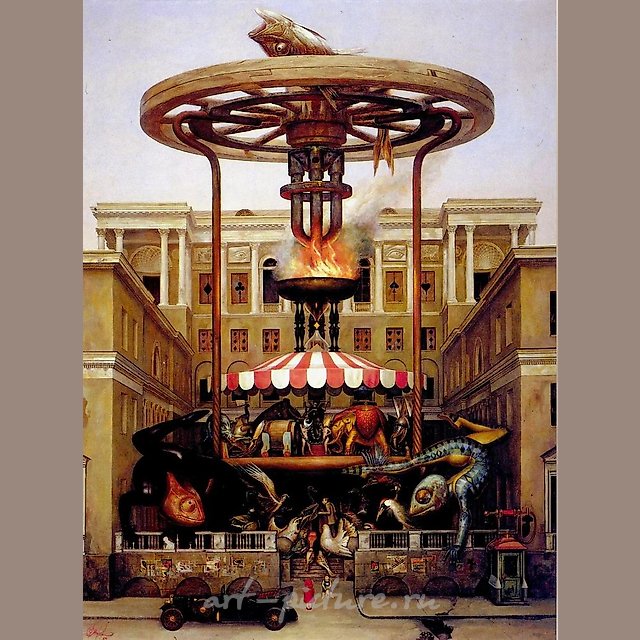
Sergey Alexandrovich Sharov Born in 1945 in Sverdlovsk. In 1969, he graduated from the Moscow Architectural Institute. He has been engaged in painting since 1965. Member of the Moscow branch of the Union of Artists since 1985. Participant of the art exhibition "Twenty Moscow Artists" (1978-87) and exhibitions ARS-1 and ARS-2 in Moscow, 1988. Solo exhibition in London, 1989. His works are owned by private collectors from Russia, USA, Japan, Sweden, Germany and other countries. The first thought that comes to mind when you see Sergey Sharov's works is that he is a born artist. In this era of rampant dilettantism, marked by an inability to ground a canvas or draw a human figure, he remains true to aesthetic principles inherited from the old masters and skillfully masters the art of painting. He can convey the firmness of stone, the softness of down, the texture of silk and human flesh, the transparency of air and the flow of water. This is not illusory kitsch, but rather solid and serene mastery of a master. Sergey Sharov is one of the founders of the M'ARS gallery, the first independent contemporary art gallery in Russia. In this gallery, technical mastery is highly valued. Paradoxically, the tastefully and lovingly depicted world he creates on canvas is actually just an illusion, something between dream and reality, a phantasmagorical vision reminiscent of Bergman's "Wild Strawberries". If you think about it, dreams can become reality more than life itself. It is enough to study the art of different epochs and peoples, this accurate chronicle of human history, to see that all this forms a chain of the wildest, most unreal sagas, starting from primitive man and ending with our days. What makes Sergey Sharov's work special, in his own words, is that he sets himself the goal of reconciling the irreconcilable - "to create a union of dialectics and metaphysics", resolving their conflict in the painted image.It is not surprising that he succeeds in this. A specialist in medieval demonology, he whimsically combines it with the early European avant-garde of de Chirico and Magritte. His works are filled with literary and artistic reminiscences; he is not ashamed of them and does not hide them. They are part of the natural language of art, the language through which the artist reveals his complex allegorical thoughts to the initiated; as for the uninitiated, those people who love simplistic art, he is not willing to stoop to their level or make any effort to make his work more accessible to them. In the history of art, there are great subjects that have been taken up in every era and will never be exhausted. One of these subjects, passed down to us from the Middle Ages, is "The Temptation of St. Anthony". The struggle between Good and Evil, Light and Darkness, symbolized by the opposition of the Saint and raging demons, has always attracted artists over the centuries, each of whom has brought their own special meaning to this theme. Sergei Sharov also paid tribute to this theme. In the collection of the M'ARS gallery, there is an amazing panel, drawn by him in pencil, depicting the struggle of the saint with demons. This complex composition of dozens of whimsical figures, in which the artist manifests himself like his favorite Bosch. Among these figures, we also find those that were unknown in the Middle Ages - for example, a combination of human and machine forms - a cybernetic nightmare of the 20th century. Undoubtedly, this is every step of our historical progress. They hide in the cast iron structures of the GUM building in "Early Morning", emerge in the foreground of the "Mansion", frolic on a fire extinguisher in "Emergence". We also often encounter ichthys, the fish - an early Christian symbol of Christ or the human soul... But relevance, even in a historical context, is just one of the meanings, one of the finest layers of Sharov's creativity. Like the masters of the Renaissance, he creates his paintings...According to the principle of multi-layering, similar to a Russian matryoshka doll: behind each layer hides another, deeper idea. The aesthetics of the Renaissance demanded that a true work of art not be one-dimensional, but have several layers of meaning: factual (historical), allegorical, morally instructive, and finally religious, spiritual. Sharov's works are closely related to this pattern and can be interpreted in all four of the above-mentioned categories. As an example, let's look at "The Mansion," which is clearly a key painting in the "Moscow Capriccio" series (which includes "Early Morning / The Mansion / Bathhouse / Fire Station / Moscow Courtyard / Emergence / The Last Castle"). This painting depicts the bright and noisy atmosphere of the NEP era in the 1920s, but on the other hand, it is full of allegorical statements. The fish is not only a symbol of Christ or the human soul, but also a symbol of metal (silver), the moon, a cold melancholic temperament (bourgeois). The primus is not only an attribute of the disorganization of life in the post-revolutionary period, so praised by Zoshenko, but also a symbol of the fire of worldly passions that consumes the human soul. The unusual "bestiary" on the second-floor balcony personifies the seven deadly sins, leading a dance to the sounds of Death's violin. Opposite Death, a flock of birds (symbolizing purity, soaring upwards) listen to Velimir Khlebnikov, a poet-prophet, an eccentric and unassuming man, reading his poems (by the way, he has a poem about birds). This painting has another meaning - deep, naturally philosophical (Nikolai Zabolotsky, the artist's favorite poet). The four elements are depicted from top to bottom: air - water - fire - earth, but in this realm of absurdity, their natural hierarchy is disrupted, so fire passes through the hourglass (time) to become earth, dust, dissipating into nothingness... We could continue our interpretations and guesses, as the artist provides us with a lot of material to do so.Bots, but we have shown enough to demonstrate the intention and depth of his concepts. Another aspect of his creativity, which often goes unnoticed, is humor, which largely softens the tense atmosphere of his works. Here the artist also follows in the footsteps of the old masters: when they grew tired of serious themes, they painted demons surrounding Saint Anthony, which were more humorous than frightening. In conclusion, let's discuss the architectural structures that form the basis of all of Sergey Sharov's works. Educated as an architect, he meticulously selects proportions, using the "Golden Mean" principle in the best traditions of architecture, carefully depicting every detail of the molding, every crack in the wall. According to him, each of his paintings starts with the idea of a building. Moreover, every building he draws actually exists. The remarkable Price Shcherbatov House in the painting "Manor" (the artist lived there in a communal apartment with his family after the war) still stands on the corner of the Garden Ring and New Arbat. The "Moscow Courtyard" is actually the gates on Solyanka Street; once there was a basement there, where prisoners were distributed to prisons. This underground was known to locals as "Under the Angel." The "Bath Palace" is a swimming pool at the Likhachev Plant, and the fire tower still stands next to the Sokolniki metro station. Who knows, maybe one day, the guides of the Mars Museum of Contemporary Art will offer visitors a special tour of "Sharov's Moscow."