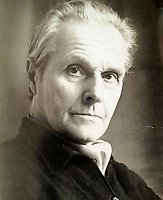
Osenev Nikolai Ivanovich (1909-1983) Honored Art Worker of the RSFSR. Honored Cultural Worker of the Polish People's Republic. Landscape artist. Genre painter. Author of works on historical and revolutionary themes. Born in 1909 in Moscow. Studied in 1938-1949 at the Moscow State Art Institute named after V. I. Surikov under S. V. Gerasimov, I. E. Grabar, A. A. Deineka. Participant in art exhibitions since 1949. Early 1950s—active work en plein air. By the mid-1950s—renowned master of compositional landscape painting. In the 1960s traveled abroad (England, Italy, France, Sweden, Iraq, etc.) and created a series of works inspired by these trips (mainly, architectural and scenic motifs). Major works: "Komsomol Members Building Defensive Lines near Moscow" (1947, Tretyakov Gallery), "October in Smolny" (1949, Central V. I. Lenin Museum), "The First Word of Soviet Power" (1952, Lviv Picture Gallery), "Landscape in Tarusa" (1957, Arkhangelsk Regional Museum of Fine Arts), "On the Roads of War" (1958, Tretyakov Gallery), "New Landscape" (1960, Central V. I. Lenin Museum), "First Issue of the Pravda Newspaper" (1962, USSR Artists' Union), "Industrial Landscape" (1963, RSFSR Art Foundation), "Highways of Blue Fire" (1967, RSFSR Artists' Union), "The Sound of the Severe Bryansk Forest" (1967, USSR Artists' Union), "Winter in Moscow" (1968, USSR Artists' Union), "Moscow Ahead" (1970, USSR Artists' Union). Regarding Osenev N. I.'s exhibitions in cities of France. It is a good tradition to organize exhibitions dedicated to a single theme. They allow you to at least partially get acquainted with some corner of the world or recall what you've seen and experience it again. That is why I write this introduction with great pleasure, as if meeting the visitor at the entrance to the exhibition of Nikolai Ivanovich Osenev dedicated to France. Perhaps this is not simply an artistic report of the artist for some period, a display of works and the resolution of certain pictorial challenges. For me personally, his work combines two forms of perception of the world: sensual, emotional enjoyment of color, form, and rational—that is, thought, personal conclusions from what he saw, reflections on time, the movement of history, the national characteristics of the country and the life of the people. In N. Osenev's works, thought and feeling are inseparable. Nowadays, when it comes to classical examples in the visual arts (and especially in theater), there is a tendency to "see everything anew, in a contemporary way", to reconsider and renew everything. And this, I would say, "overturning" often leads to serious misconceptions. Because the old examples are to be abandoned, and the new ones are not yet created—they are in some abstraction, in search; and then our, mostly young, audience, who so needs to uncover the great mysteries of true art, faces the difficult problem of forming their own viewpoint, taste, and clear definition: what is progressive in art and what is backward, what is genuine and what is artificial, done for the sake of fashion, as a tribute to the times. And here, of course, a great role is played by the careful and serious attitude of art masters to life, to nature, to people and their characters, to their careful study. That is, that culture which forms the artist and gives him the right to converse with the viewer in the living and rich language of colors, lines, and forms. This is precisely the conversation one comes for with the artist N. Osenev, whose works this time are dedicated to Normandy, Vendée, Alsace, and mainly Paris. Paris is dazzling on N. Osenev's canvases even in gloomy and anxious weather. Dazzling not only in the solemnity of the ceremonial architecture of the Place de la Concorde, Notre-Dame Cathedral, the triumphal arches, but also in the massive gray walls of residential buildings, which, like the sharp noses of ships, cut into the green sea of boulevards, parks, and squares. I want to recall my favorite line by Louis Aragon from the poetry of Charles Cros, an 18th-century poet—a line which Aragon considered truly French: "You are dazzlingly dark." Perhaps, in Osenev's painting, this dazzling quality is aided by the modern style of clothing of the Paris crowd—almost luminescent colors of red, yellow, and blue spots against the gray stone houses and embankments. Besides the superb painting style of Nikolai Ivanovich, I want to note the street scenes he happened upon, so characteristic for Parisians, aptly chosen, the receding perspective of Montmartre streets, convincingly rendered in oil and graphics. Osenev did not overlook the new districts; La Défense attracted his attention with its architectural solutions, he found a vantage point along the Seine from which La Défense looks fantastically grand—but this is no longer Paris and the artist paints it in a different mood. Normandy. The port of Honfleur with the black walls of houses reflecting in the shimmering waters of the ocean bay, with the slender masts of small boats swaying before the windows, under a cool sky... Boldly and unexpectedly, in the landscapes of Saint-Malo, at low tide, petrified, salt-encrusted giant tree trunks suddenly emerge from the water. In two hours, the tide will cover them, leaving just small stumps by the pier, but the artist managed to depict them in their poignant, ugly immobility. There is also the significant corner on the Oise, the town of Auvers, where Van Gogh lived and died. The tavern, the miserable attic with an upper window, the easel in the corner, and the famous chair with the woven seat... The modest graves of the brothers Vincent and Theo, in the secluded stone cemetery of Auvers, with tragic, restless clouds above them. And who knows or remembers that the town of Amboise on the Loire was the last refuge of Leonardo da Vinci? Nikolai Ivanovich Osenev takes us to this crooked street, to the red-and-white house with open oak gates: once the exiled genius entered there. You see his chambers and his bed under a crimson canopy and believe in everything the artist so lovingly and inspiredly depicted. Graphics occupy a large place in Osenev's work. He starts all works in pencil, before painting in oils, and instead of a camera, he wanders through French cities with a sketchbook, searching for an interesting subject. The artist has many magnificent, bold, and spirited drawings that testify to his lively humor and powers of observation. These are scenes in cafes, on streets, in parks, museums, and each time everything is sharply captured and drawn with superb mastery. In my opinion, these drawings are as expressive as the pictorial canvases. I think that everyone who visits the exhibition of Nikolai Ivanovich Osenev will undoubtedly add new, rich impressions to their mind and heart. Natalia Konchalovskaya