RUSSIAN ARTISTS Stepanov Alexei Stepanovich (1858-1923)
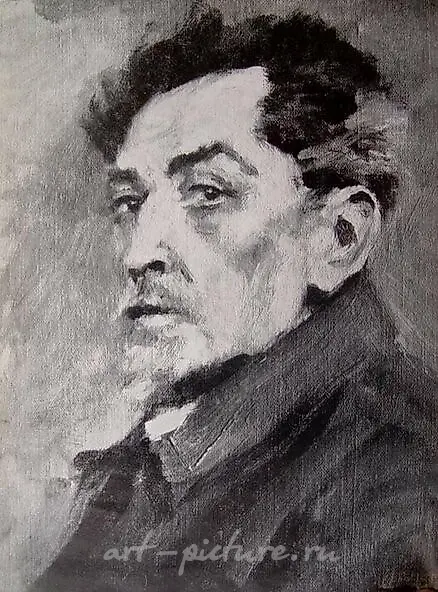
The modest, delicate, and kind A. S. Stepanov, "Stepochka," as everyone called him, was loved and appreciated by friends - S. V. Ivanov, N. P. Chekhov, brothers S. A. and K. A. Korovin, I. I. Levitan, M. V. Nesterov - and numerous students, including P. D. Korin, A. A. Plastov, L. V. Turzhansky, and others. After Stepanov's exhibition, Korin said: "It was as if I had read Pushkin's poetry. Just as simple, simple, yet high... What can I say about him? He was an artist. That says it all. Everything in him was simple, without effects. He had a soul, and that is the most important thing. But at the same time, he had high artistry and incomparable mastery. He was brilliant in his great simplicity."
Aleksey Stepanovich Stepanov

Stepanov lost his parents at a very young age. At the age of seven, he was raised by a guardian, who insisted that the young man graduate from the Land Management Institute in Moscow in 1879 and acquire a profession as a land surveyor.
However, he did not work in this field, and in 1880, he entered MUSHVZ (Moscow School of Painting, Sculpture, and Architecture). He studied in I. M. Pryanishnikov's class, was successful, and graduated from the school in 1884 with a large silver medal.
“Portrait of I.I. Levitan”
Paper, pencil. 21.5 x 13.4 cm
National Art Museum of the Republic of Belarus

In the second half of the 1880s, Stepanov worked for several summer seasons together with I. I. Levitan - first near Zvenigorod, then on the Volga. Alongside Levitan, he is considered one of the creators of the so-called mood landscape, when the artist...The text translates to: "In nature, it not only seeks a motif that corresponds to its inner state but also psychologically interprets the landscape, projecting its own thoughts and experiences onto it.
"Autumn"
Canvas, oil. 54 x 80 cm
Kirov Regional Art Museum named after V.M. and A.M. Vasnetsovs

Autumn. 1896

Lake Udomlya. 1912

"Winter. Hoarfrost"
1900-1910
Canvas, oil
Memorial Museum-Estate of the artist N.A. Yaroshenko

"Winter Landscape"
1910
Canvas, oil
Buryat Republican Art Museum named after Ts.S. Sampilov

[
/gusckovalida/view/5273390?p=3>)
“March”
Canvas, oil
Nizhny Novgorod State Art Museum
“Thaw”
1904
Canvas, oil. 58.3 x 79 cm
Khimki Picture Gallery

“Early Spring”
1900-1910
Canvas, oil
Volgograd Regional Museum of Fine Arts

“Sea”
1923
Canvas, oil
Pless State Historical, Architectural and Art Museum-Reserve

“Arbor Under Flowers”
Study
Canvas, oil
Pless State Historical, Architectural and Art Museum-Reserve

In 1905, Stepanov was awarded the title of academician of the Imperial Academy of Arts for the painting “Morning Greeting.”The painting was exhibited at the XXV exhibition of the Wanderers, the XXIV exhibition of the Imperial Academy of Arts, and at the World Exhibition in Paris in 1900.
“Morning Greeting”
1897
Canvas, oil 61 x 99
Pskov State United Historical, Architectural and Art Museum-Reserve

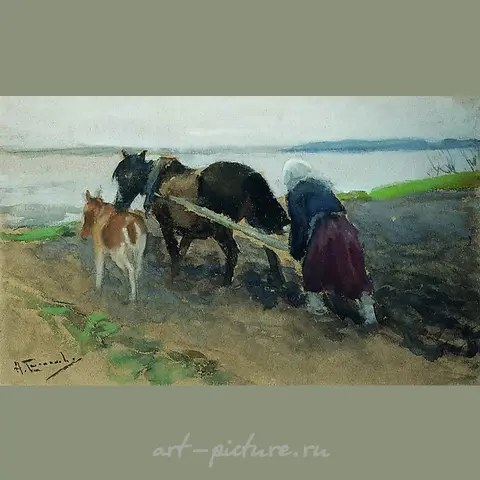
Stepanov's works are characterized by their plein air quality; they are painted broadly, sketched, with a thin transparent brushstroke, very softly, in a limited palette ("Fewer colors," he later advised his students). Stepanov loved to depict a rural road down which peasant horses pull sleds or carts ("Gusek," 1910-15; "On the Country Road in Winter," "By the Porch," both 1913-14; "Gone," 1914).
“On the Winter Path”
Cardboard, watercolor
State Central Museum of Musical Culture named after M.I. Glinka

“Winter Landscape”
1910
Canvas, oil
State Tretyakov Gallery

[](http://fotki.yandex.ru/users/gusckovalida/view/5273344?p=0)
"In a Row"
1911-17
"Deaf Province"
1900s
Canvas, oil. 62 x 97 cm
State Vladimir-Suzdal Historical-Architectural and Art Museum-Reserve

Every summer from 1906 to 1914, Stepanov lived in the estates of Lubenikino, Garusovo, and Berezhok in the Vyshnevolotsky district (now Udomelsky district) of Tver province. The house where Stepanov lived in Garusovo is depicted in the painting "Left"
"Left"
1914
Canvas, oil
State Tretyakov Gallery

"In Winter"
1900-1910
Canvas, oil
Alupkin State Palace and Park Museum-Reserve

On a Sledge

[](http://fotki.yandex.ru/users/gusckovalida/view/5273350?p=1)
“Riding on Maslenitsa”
1910
Cardboard, tempera. 49 x 68 cm
Stavropol Regional Museum of Fine Arts
“Inn”
1912
Canvas, oil
North Ossetian Republican Art Museum named after M.S. Tuganov

“Village in Winter”
1900-1910
Canvas, oil. 42 x 68 cm
Stavropol Regional Museum of Fine Arts

“At the Watering Place”
1916
Canvas, oil
Nizhny Novgorod Art Museum

He loved to depict peasant children observing the surrounding world - bare, poor, autumnal, but familiar and vast (“Cranes Are Flying,” 1891; “Children on the Brushwood,” 1899; “At the Outskirts,” 1915-16).
“Cranes Are Flying”
1891.
Canvas, oil 620 x 110
State Tretyakov Gallery
Moscow

[ ](<http:/
Note: The text appears to be part of a catalog or art showcase featuring several paintings and their details.Here is the translated text in English:
)
'Children on Firewood'
1899
Canvas, oil. 47.5 x 72 cm
Ulyanovsk Art Museum
'Evening Dawn'
Canvas, oil
Krasnoyarsk Art Museum named after V.I. Surikov

Near the Fence

'On the Terrace'
1900-1910
Canvas, oil
Nizhny Novgorod Art Museum

Conversation with the Godmother

'Chorovo' Please note that the links and images would not be functional in this format.Here is the translation of the provided text into English: --- Canvas, oil Buryat Republican Art Museum named after Ts.S. Sampilov 


"Wolves in the Winter Forest"
1900-1910
Canvas, oil
State Tretyakov Gallery


"She-Bear with Cubs"
Colored paper, gouache 23 x 33
Private collection

"She-Bear with Cubs"
1919
Canvas, oil
Nizhny Tagil Museum of Fine Arts

"Horse"
1911-1920
Canvas, oil
Nizhny Novgorod Art Museum

"Little Horse"
1900-1910
Canvas, oil
Nizhny Novgorod Art Museum

[ Paper, watercolor
Memorial Museum-Estate of the artist N.A. Yaroshenko](http://fotki.yandex.ru/users/gusckovalida/view/5273386?p=3)
On the field. 1919

"Outskirts"
1914
Canvas, oil
Sumy Art Museum

"Study with a Cow"
Study
Canvas, oil
Novokuznetsk Art Museum
The genre in which the artist preferred to work can be described as landscape-animalistic. M.V. Nesterov considered Stepanov to be the best animal painter after V.A. Serov. Serov also highly valued this gift of the artist and insisted on inviting Stepanov as a teacher at the MUJVAZ (Moscow State Academy of Arts and Industry). For about twenty years (1899-1918), Stepanov led the "animal class" there. Students adored him. Very little is known about the artist's personal life - shortly before his death, he destroyed his archive. However, he is fully present in his paintings.

"On the Volga"
1897
Canvas, oil. 55 x 133 cm
Samara Art Museum
--- Let me know if you need any more assistance!Here's the translated text into English: --- **Working. 1895**  --- **Woman on the Sofa. 1912**
 --- **"Peasant"** Around 1890 Canvas, oil Plesk State Historical and Architectural Museum-Reserve
 --- **"Lilac Alley"** 1900-1910 Canvas, oil State Literary Museum
 --- **Estate in Summer. 1882** "Estate in Summer" 1882 Canvas, oil State Tretyakov Gallery [
"Flowerbed in the Park"
Cardboard, oil. 23.3 x 33.7 cm
Khimki Art Gallery
"Arrival of the Teacher"
1889
Canvas, oil. 58.5 x 79 cm
Chuvash State Art Museum

"Portrait of S.P. Kuvshinnikova"
1888-1889
Canvas, oil
State Literary Museum
"Portrait of Medyntsev"
Canvas, oil
Tver Regional Art Gallery
Nikolai Vasilyevich Medyntsev — merchant, collector, father-in-law of the artist A.S. Stepanov (1902)

"Boulevard"
1919
Paper, watercolor
National Art Museum of the Republic of Belarus

[Here is the translation of the text into English:
x.net/get-snippets_images/1681814/rth8df7620cae0591f434f9c0146278cc60/414x310>)](http://fotki.yandex.ru/users/gusckovalida/view/5273360?p=1)
"Ferry"
1919
Canvas, oil
Rostov Regional Museum of Fine Arts
Ballet. 1908-1909

The gouache by Stepanov titled "Grand Opera" becomes particularly interesting, seemingly done in such a creatively interpreted manner of the Impressionists that it leads even major specialists in French art of the second half of the 19th century into attribution errors. In "Grand Opera" (c. 1922), with free brush strokes, indistinct yet deep colors—muted as they are—tender, unclear yet characterized silhouettes of figures in the dusky darkness of the auditorium and evaporating in the bright light of the stage, the airy white shadows of ballerinas easily glide across the stage. Stepanov's style is so close to Degas that it led many to attribute this small study not necessarily to Degas himself but at least to one of the artists from his circle. M.A. Dobrov testified to Stepanov's admiration for Degas’s work and his fascination with his masterful drawing. However, it would be incorrect to see in this study a blind imitation of French Impressionism. This is an inspired, excited, yet ultimately a practical exercise, driven by the artist's intrinsic desire to learn until the end of his days. Stepanov was genuinely moved only by the Russian theme.
Careful attention should be given to the statements of Stepanov's students denying the presence of Impressionism in his work (A.P. Panfilov, V.A. Filipov, B.N. Yakovlev, and others).
There exists a deep difference between the painting of the Impressionists and Stepanov's painting, rooted in the very principle...Here is the translation of the text into English: --- Their art. The Impressionist masterfully conveys the immediate impression. However, in the moment, his work loses something of the permanent essence that resides in every phenomenon, in every thing. Stepanov, on the other hand, aimed to capture the most essential, specifically that which gives tone and character to a phenomenon, discarding the unnecessary and looking deep into the heart of the object. Behind his light, quick, airy painting lies much skill but also a lot of hard work. "This is not Impressionism," says A.P. Panfilov. "He approached it gently, but with persistence." That is why in his animals, the "fur is always visible," even though it is hard to imagine anything more distant from naturalism than Stepanov's art. Years of diligent work, thousands of observational studies, meticulous study of animal anatomy, and along with all this, a comprehension of the artistic practice of all painting materials: paints, solvents, canvas, cardboard—all of this forms the foundation of Stepanov's method. This is why he did not allow his students to imitate him. He knew that such imitation could only be superficial and harmful. He taught them to see, to choose the main elements, to memorize; he taught them to train their eyes to distinguish the subtlest shades of tonality. **Self-Portrait. 1922** In 1920, Stepanov fell seriously ill but continued to work. One of Stepanov's last works, "The Swing" (1923), was acquired by the Carnegie Institute for its collection. Alexei Stepanovich Stepanov died in 1923 and was buried at Vagankovo Cemetery.