A Keyhole to Another World
Have you ever wondered about an object that was created to become fate itself?
About a trinket whose delicate beauty hides a backstage chess game of great powers, love and cold diplomacy, personal drama and mythological parable?
Those who see only rarity and luxury in porcelain dinner sets are sorely mistaken: behind the smoothness of saucers and the golden gleam of cups, passions unfold that would put the best novels to shame. One such story is the mystery of the "Olympian" dinner set from the Sèvres manufactory: created for one destiny, it ended up forging a completely different one.
We dive into the labyrinth of the Napoleonic era—emerging onto battlefields, royal weddings, and thunderous diplomatic talks. I promise: from now on, when you look at fine porcelain in a museum or a rare piece in an antique market, you won't say again: "Just a pretty trinket"…
Birth of Olympus from Porcelain: The Workshop Where Imperial Myths Come True
At the start of the 19th century, the Sèvres Manufactory was not a quiet workshop but a true alchemical crucible. Here, chemistry and art, politics and fashion merged: under its arches, not only artists inspiring trends throughout Europe worked, but also scientific inventors. Among sacks of kaolin, kilns and brushes, Sèvres didn't just give birth to dinner sets—an entire cultural era took shape here.
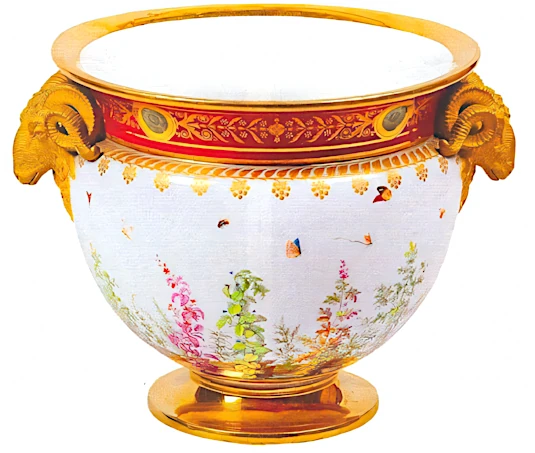
During the years when Napoleon's wars shook Europe, dinner sets became the secret language of political maneuver. The emperor himself saw in porcelain masterpieces the keys to hearts and power: for a lavish gift can unite more firmly than a military alliance. Thus, the idea of the "Olympian" set was born in Napoleon's mind: not simply a set of tableware, but a gem of artistic mastery, a symbol of allegorical alliances. It was crafted slowly and meticulously, as though constructing the architecture of a marriage—it was meant as a wedding gift for his brother Jérôme and the German princess Catharina of Württemberg, intended to be intertwined forever into the kinship network of Europe.
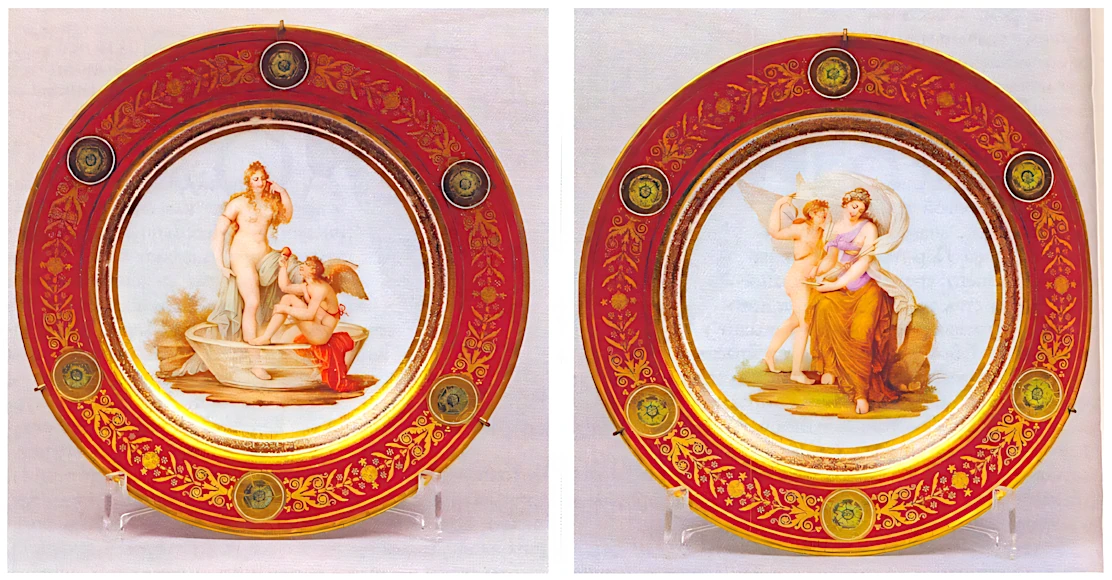
Dessert Plate "Erato Writes Inspired Poems to Cupid" Sèvres Manufactory, 1804-1807. Artist Adam.
Inspired by the spirits of antiquity, Alexandre Brongniart—the director and genius organizer of the manufactory—asked his son Théodore not simply to sketch, but to invent a new mythology for a new union. The workshop's walls filled with the whispers of myths, mingled with the scent of oil paints: they took the symbolism of the future family heirloom very seriously in Sèvres.
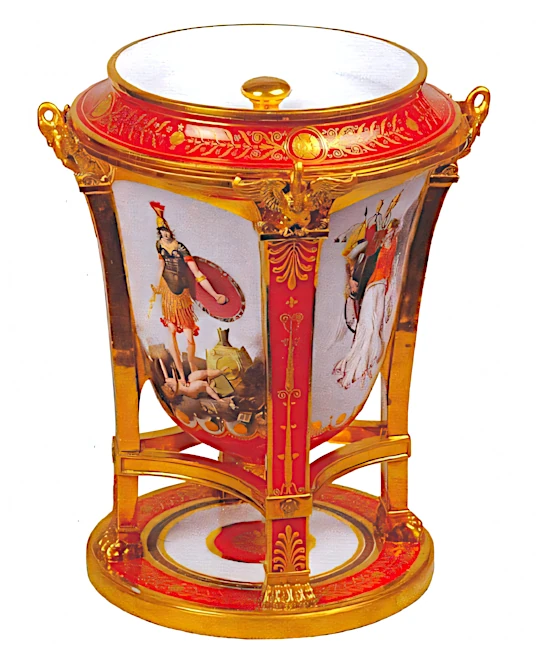
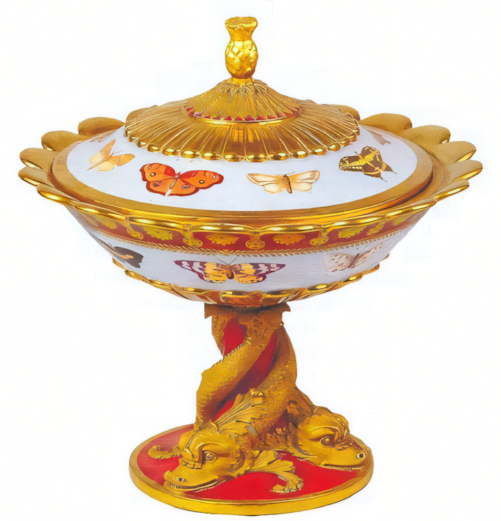
Théodore Brongniart was an architect, dreaming of leaving a mark on eternity. His hand confidently combined antique simplicity with Parisian sophistication: the shapes of the vessels recall ancient kraters and tripods; decorative details are inspired by sphinxes, dolphins, rams—zoomorphic symbols not merely for beauty, but as codes for future generations.
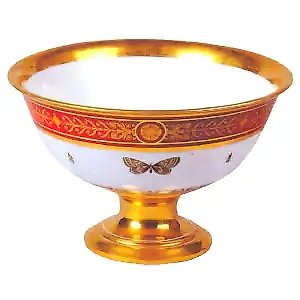
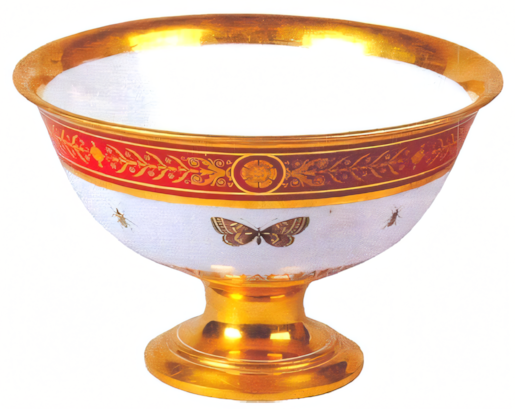
But the most striking thing—in this porcelain symphony, every item is not just functional, but tells a little myth about love, trust, motherhood, and trials. Plates, sugar bowls, ice cream cups—all seem like actors in a grand drama where gods and heroes are to play the wedding of the century. But is it really just a fairy tale? Or is a completely different outcome hinted at here?
The Language of Porcelain: Hidden Meanings Not Found in Textbooks
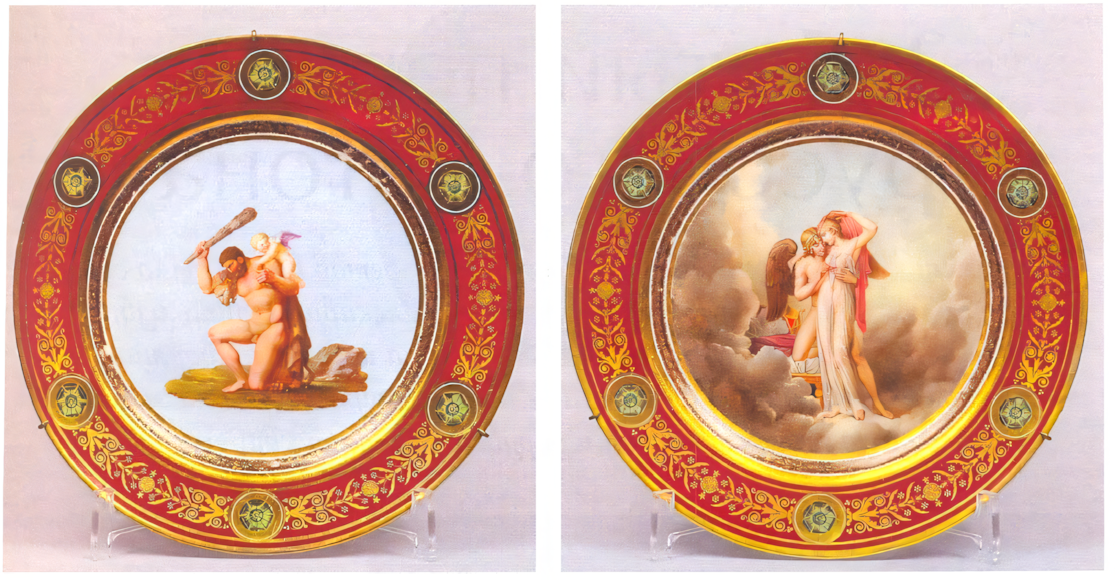
Studying the "Olympian" set is like reading a decrypted code—but to do so you need to know the keywords. At first glance—erotica and ancient mischief: Venus, Cupid's bathing, the games of the gods. But don't settle for a superficial smile: underneath the naked nymphs, Cupids, and Psyches, there is a moral lesson and a channel for passing on family values.
There is not a single aggressive or chthonic deity here, as if the porcelain itself is afraid of ominous omens. No Poseidon, no Hades, no Ares—they were banished from the porcelain fields so as not to disturb the peace of marriage. Even huntress goddesses like Diana appear only briefly, as a farewell gesture. It was both a warning and a guideline: if you want happiness, cast aside darkness, fears, rivalry, erase revenge.
The plates are divided into thematic cycles: Jupiter and Juno sanctify the union of true love and marriage, Venus and Cupid teach passion, Apollo with the muses—inspiration. The great Psyche, with her sacrificial yet triumphant tenderness, embodies the soul that endures trials for love. Hercules? From all his exploits, almost only those concerning protection of friends, family devotion, and readiness to overcome oneself for others are chosen.
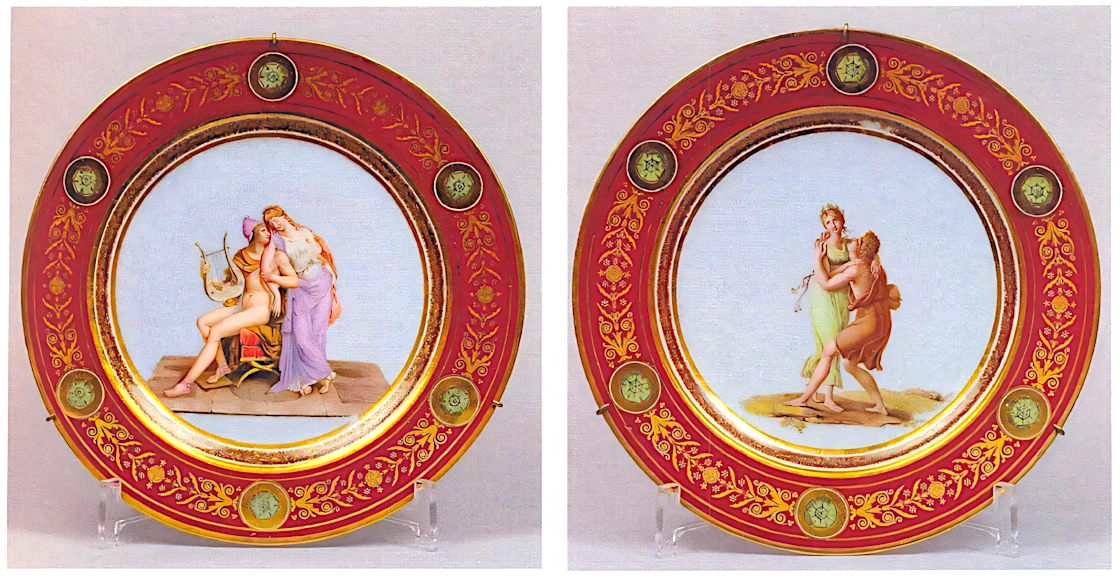
Dessert Plate "Daphnis and Chloe", Sèvres Manufactory, 1804-1807. Artist É.-Ch. Le Guay.
Even in scenes dedicated to tragedies (like the loss of Niobe's children), porcelain is a lesson. Love is the source of both greatness and catastrophe; everything depends on compassion, tenderness, and avoidance of destructive jealousy. Some plates are signed: "Adam composed and wrote"—these "composed" stories seem like a diary of real life, where every shade of feeling has a role.
There are also "trompe-l'oeil" plates: naturalistic butterflies, birds, flowers seem to have escaped from botanical atlases and scientific books—a touch of the Enlightenment era, when knowledge was in fashion. Ice cream cups evoke not only desserts, but even the change of seasons, day and night, peace and war.
So who was the true recipient of this message?
The young bride?
The family for whom the set would become a relic?
Or anyone who happens to be near a Russian museum and wonders: "What, in fact, does beauty teach us?"
Porcelain as a Political Message: Why the Set Ended Up in Russia and Became a Myth
But what was it all for?
Why was the centuries-old ritual—creating a wedding dinner set to strengthen dynastic unions—so spectacularly broken?
Napoleon, master of reversals, suddenly sends the majestic "Olympian" set not to his brother's new family, but… to Russia, to Tsar Alexander I.
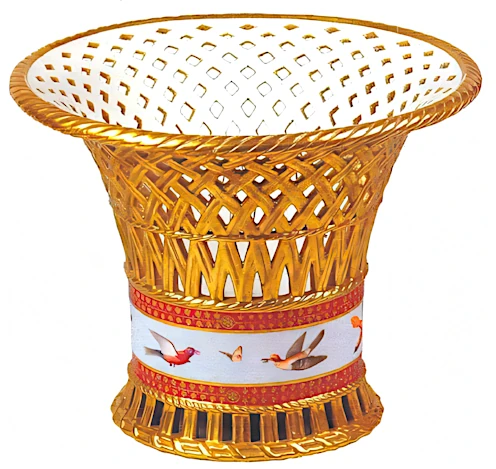
Together with it—the "Egyptian" set, botanical masterpieces and the most exquisite porcelains of France. The cautious Alexander accepted the gift with dignity but skepticism: he quoted Homer, "I fear the Greeks even when they bear gifts…", as if sensing a hidden motive in every saucer. For this gift was unique and unrepeatable—no copies, only the original. The myth of heroic France was now part of Russia's fate.
Leaving the aristocratic halls of Sèvres and after all the turmoils of Europe, the set didn't even spend a month in France before it embarked on a long journey overseas. Its fate was unusual: little more than two weeks of wedding splendor—and instead of becoming a family album, it turned into a stranger in the palaces of the Winter and Kremlin, and later—a wandering museum exhibit.
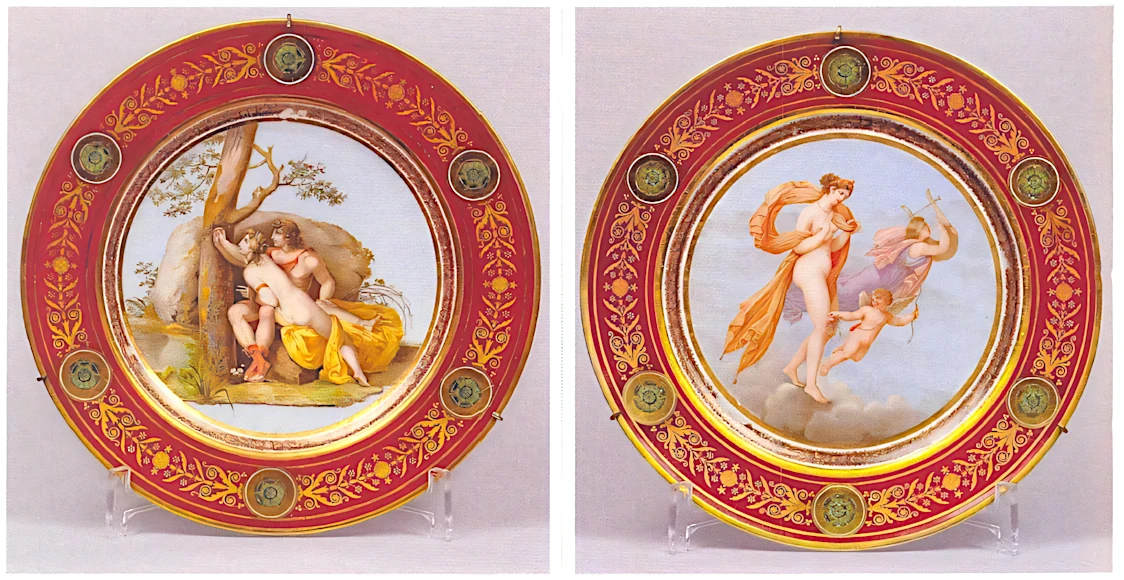
Dessert Plate "Daphnis and Chloe", Sèvres Manufactory, 1804-1807. Artist Adam.
What an irony: a set conceived as an amulet for the female branch of the new decade-long Bonaparte dynasty became a prophetic gift to a political rival. Napoleon's ideas of union through marriage were frozen in porcelain—and thus remained just ideas, not reality.
Since then, the "Olympian" set has been more than just a museum piece. It became a matryoshka of meanings: a palace toy, a political metaphor, a local myth that Russia dropped into its cultural memory from the hands of Europe's great adventurer. Where it should have become a family relic, it became a memory of an unrealized alliance between powers.
But isn't this the greatest irony of art, able to preserve and reveal symbols so subtly that answers to questions become entirely your own?
A Catalyst for New Questions
So what was the "Olympian" set—a porcelain teacher, an invisible tablet for a happy family, or a "Trojan horse" of grand diplomacy?
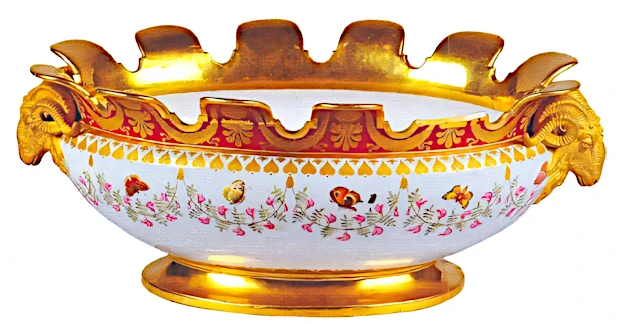
Perhaps it's not only about gilded plates. Once, finding yourself in the stillness of a museum, try to see it not as a dinner set, but as a novel embedded in porcelain—about love and courage, dignity and jealousy, grand politics and intimate feelings. Perhaps this is how art brings us back to a simple truth: life cannot be unpacked at a glance, and true dinner sets always keep a mystery…
And what work of art or object once changed your view of the world or became part of your family history?
Listen—sometimes an ordinary plate holds a story far more powerful than any book…