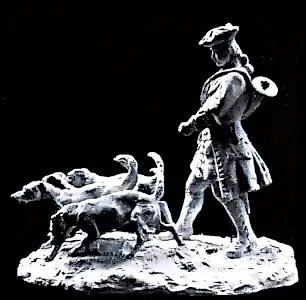
What can a porcelain rider tell us?
Have you ever paused to gaze at a porcelain figurine standing behind the glass of a museum case?
Not just at a pretty trinket, but at a sculpture—with delicate dynamism, with the history in the horse's gaze, with the tiniest details of a uniform reflecting an entire era. As if someone, knowing that times change, decided to preserve their breath in fired white clay.
Few people know that behind the scenes at the Imperial Porcelain Factory—famous worldwide for its splendor and precision—not only creative experiments, but also genuine dramas of psychology, statehood, and art played out. After this story, you will never look at a porcelain miniature the same way again. You will see not just a collectible "exhibit," but a key to a dialogue between past and future, between an artist’s dream and the ideology of Empire.
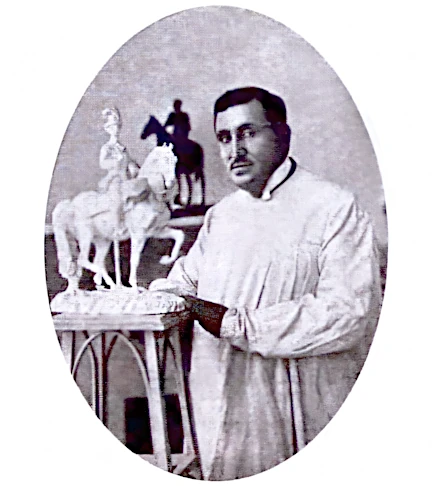
Act One — A Pearl on the Front Line: Baron Rausch von Traubenberg and the Play of Small Sculpture
Paris, 1907. A mysterious young man, tall, always polite, with delicate military mustache, exhibits his works for the first time at the Autumn Salon. This is Karl Karlovich Rausch von Traubenberg, a hereditary military man, a porcelain rebel, a dreamer, apprenticed to Ashbe and I. Grabar. He grows up in Bavaria, learns modeling to music in Hildebrand’s studio. Behind him—Europe with its bronzes, marbles, vitrines in cigarette smoke, great cities and their endless search for artistic identity.
But now it’s 1908, and Petersburg draws the baron into its cold northern whirl.
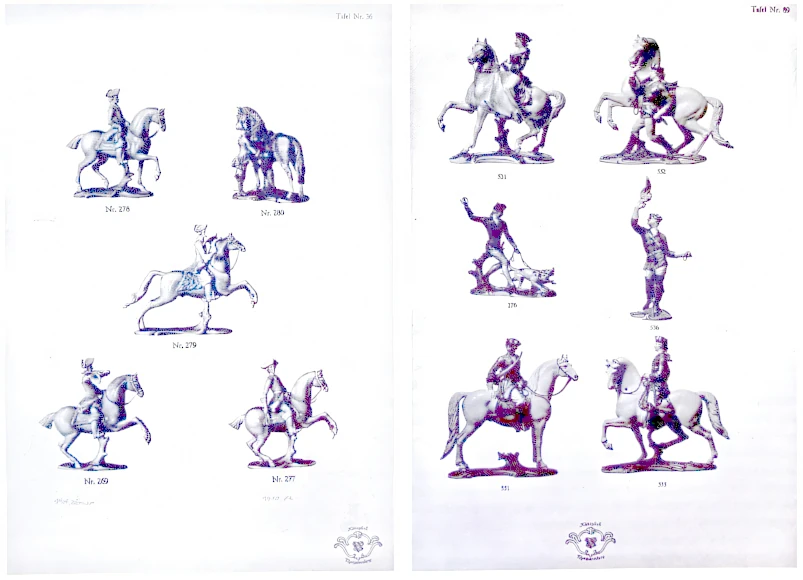
Sheet No. 89 from the 1912 Nymphenburg Porcelain Factory sales catalog.
Here, at the Imperial Porcelain Factory, doors open and... the pressure mounts. The factory is a world with two faces: one is the academic muse of native traditionalism, the other—a neighbor green with envy, watching as young artists try to breathe “new life” into porcelain. It was Rausch von Traubenberg who brought a European wind here, but his journey was never a quiet walk up a marble staircase.
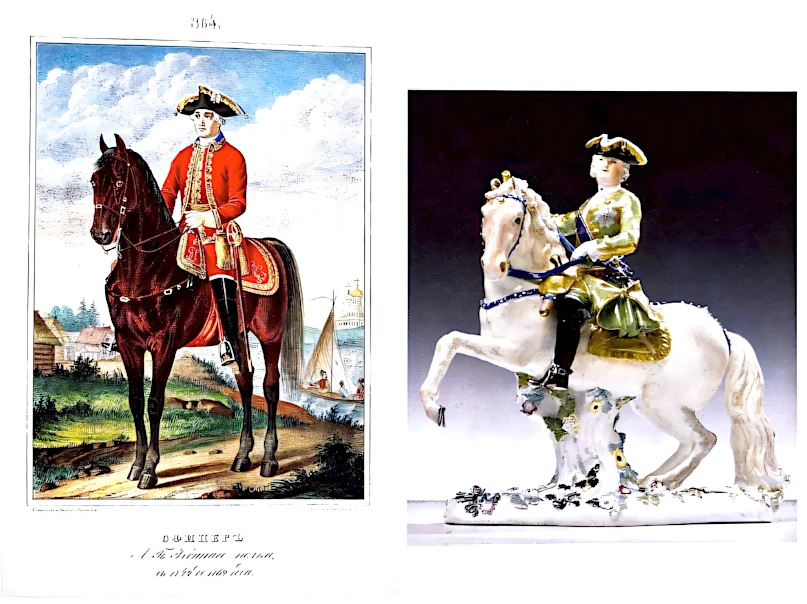
“Empress Elizabeth Petrovna on Horseback”. Model by J.J. Kaendler. 1743. Meissen Porcelain Manufactory. Unmarked. Height—23.5 cm. Dresden, Staatliche Kunstsammlungen, Porzellansammlungen.
The porcelain manufactory is a strict, official lady. Its range reflects the will of the imperial court; every work is tightly regulated, and a commissioner's pen order cuts off everything bold and too lively. Yet, gradually, new faces, ideas, and trends begin to appear in this royal utopia. Nicholas Roerich wrote bluntly about it, sighing in his notes: among the talented craftsmen there are no true porcelain poets—those who can turn a clay mass into the reflection of reality...
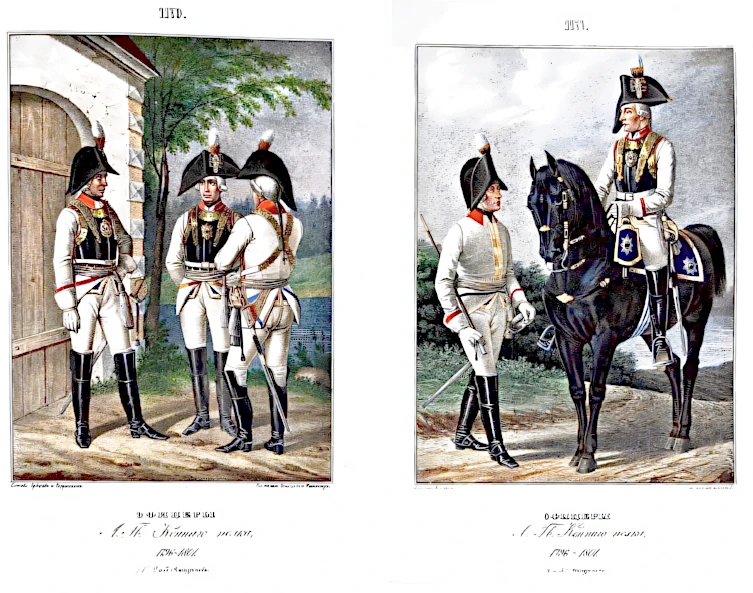
Officers of the Life Guards Horse Regiment 1796–1801, 4th and 5th squadrons
Just think: the Imperial Porcelain Factory was not just a giant industry—it created symbols, from national heroism to mundane napkins for empresses. And one of the first to reshape this system was Rausch von Traubenberg. For the factory, longing for propagandistic power and fresh artistic blood, the baron was an ideal compromise. On one hand, status, lineage, military spirit; on the other—a young European perspective, unspoiled boldness in composition and style.
However, any innovation is slow to take root in an environment where every brushstroke must receive the highest approval, and every shade of porcelain white must pass scrutiny no less strict than a new regiment before Peter III.
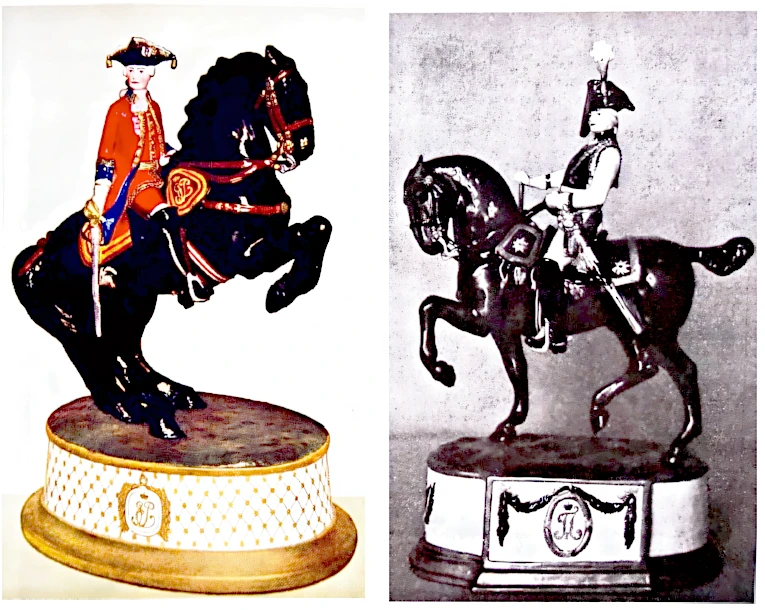
Separate print from Apollon, 1913
Sculpture “Officer of the Life Guards Horse Regiment during the reign of Emperor Paul I”
Separate print from Apollon. 1913, St. Petersburg.
Act Two — Riders on Something Greater: “The History of the Russian Guard” as the Mirror of a Nation
Before you is not just a rosy officer on an expensive horse. This is an ideologeme: the figure of a serviceman embodying the scale and splendor of the Empire. In the early 20th century, the Imperial Porcelain Factory, once the court’s favorite toy, finds itself at the epicenter of an ethical storm: on one side—a grand series “Nationalities of Russia” (almost a theater of national characters in miniature), on the other—pathetic battle scenes where whole epochs come to life like on film reels.
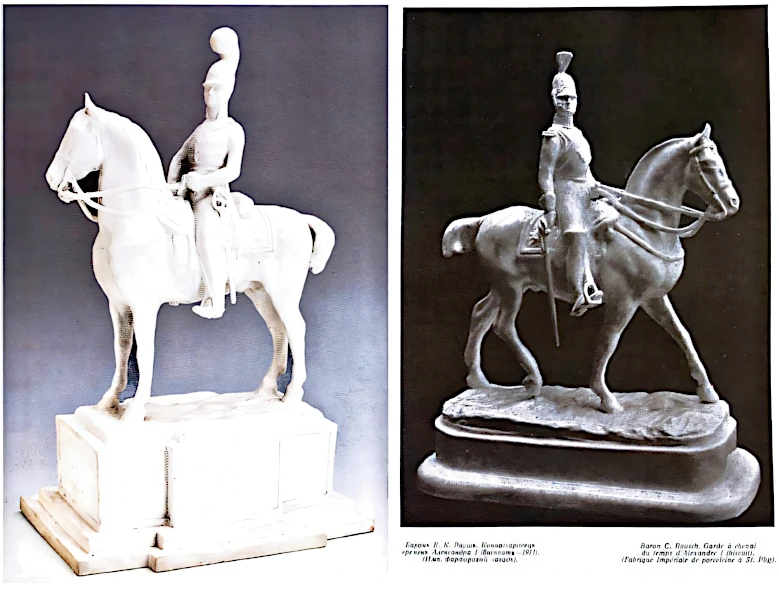
Sculpture “Horse Guard of the time of Emperor Alexander I”
And here comes Rausch von Traubenberg with his “History of the Russian Guard.” The Guard—elite, ostentation, system of values. The artist works on a whole series of miniatures with almost maniacal diligence: corresponding with military historians, flipping through multivolume uniform books, correcting sketches in antique albums, studying each horse’s breed to ensure it's not just a “stand,” but an independent character, an actor in a personal tragedy. Here, every fold of the uniform matters, glowing in the matte blue of porcelain; every movement—like a captured nerve of a bygone century.
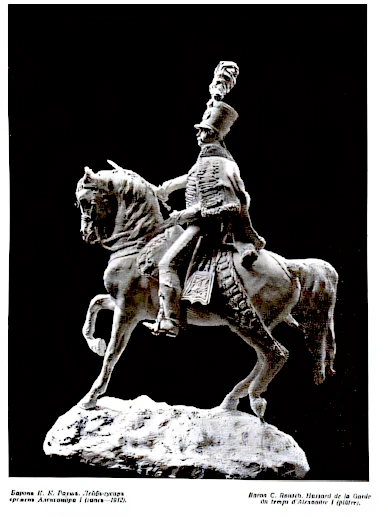
A special feature of these sculptures is the almost physical tangibility of the era through the material. If you listen closely, the porcelain officer of Elizabeth Petrovna’s time has a crystalline ring to his gauntlets, attracting the spirit of the 18th century, and the Andalusian horse is recreated with almost anatomical accuracy. The baron draws inspiration from Munich manufactory catalogs, military costume albums, and even personal family legends (his uncle translated “A History of Cavalry” into Russian). His work is not illustration, but a subtle psychological narrative: how society, the army, and even the image of the hero changed.
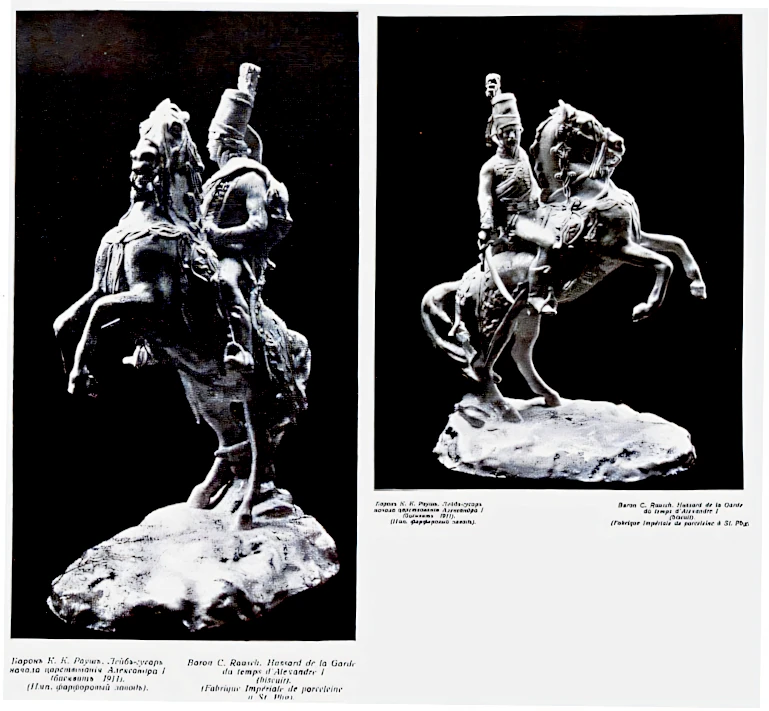
A parallel to the modern day: today, brands, pop-culture heroes, and even bloggers copy elite imagery, building entire businesses on the “symbolism of success.” Back then, this code was encoded in porcelain figurines; all of St. Petersburg’s elite wanted their own symbol, their own miniature of acquired eternity. Is it not similar to how we collect “stories” and push notifications?
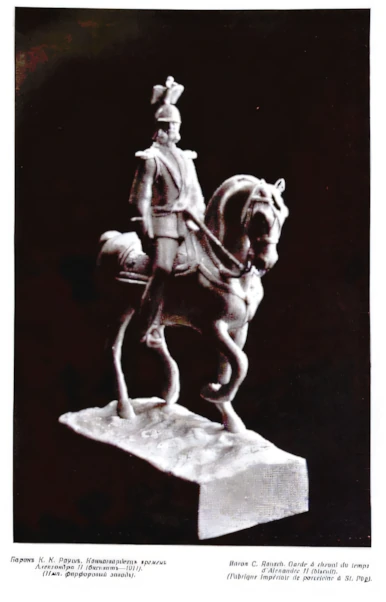
Act Three — For Whom the Porcelain Tolls? Hooves Resounding Through Time
Porcelain is a material you cannot help but feel, touch, or fall in love with completely. There is no place for half-measures: Rausch describes the Andalusian horse with the obsession of the best 19th-century animal artists, meticulously ensuring each rider is paired not just with a “prop,” but a unique equestrian portrait. The line between art and science disappears. Would you believe that in the baron’s workshop, there were serious debates about the shape of a hussar’s horse’s ears, or that each officer is depicted on a pure breed—since the imperial army would not allow a “foreign” color?
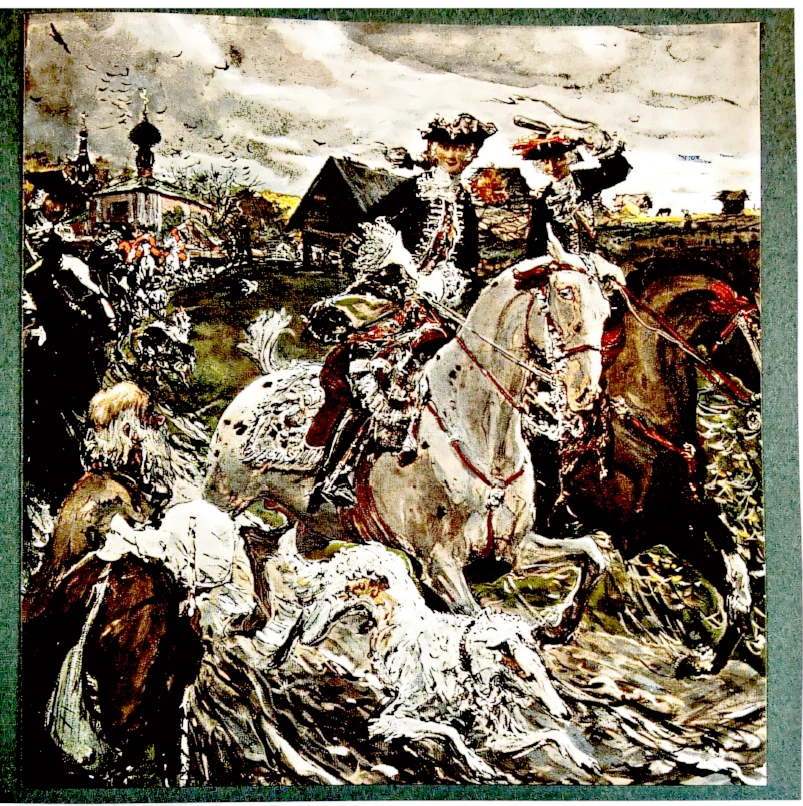
Critics later called his porcelain sculpture "alive"—vs. painted mannequins, colorful yet cold. In these figurines there is movement, tension, a hint of individual fate... This is not just “minor art,” the era says, because the line between “home statuette” and cultural code is gone. They were created as ideological comrades, but survived their era and did not become faceless artifacts. “One can rejoice at the appearance of an artist who so actively contributes to the revival here of that delightful branch of artistic production—artistic porcelain,” wrote art historian Rostislavov.
And yet, even today in major museums of the country one has to prove the value of these works; it's amazing—masterpieces made at the intersection of physics, psychology, and the will of the state often remain "second row." But isn't the same thing happening with the "small" in our culture? Try to remember how short the path from real passion to oblivion is, if not supported by a chronicle, a museum, or at least a good storyteller...
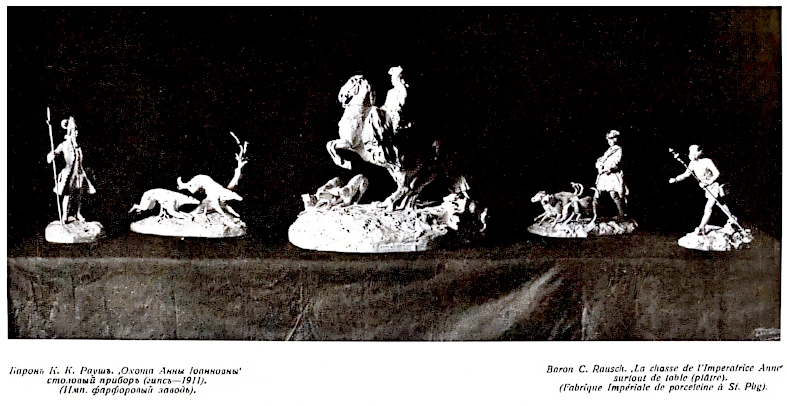
Act Four — The Secret of the Royal Hunt: Through the Porcelain Forest
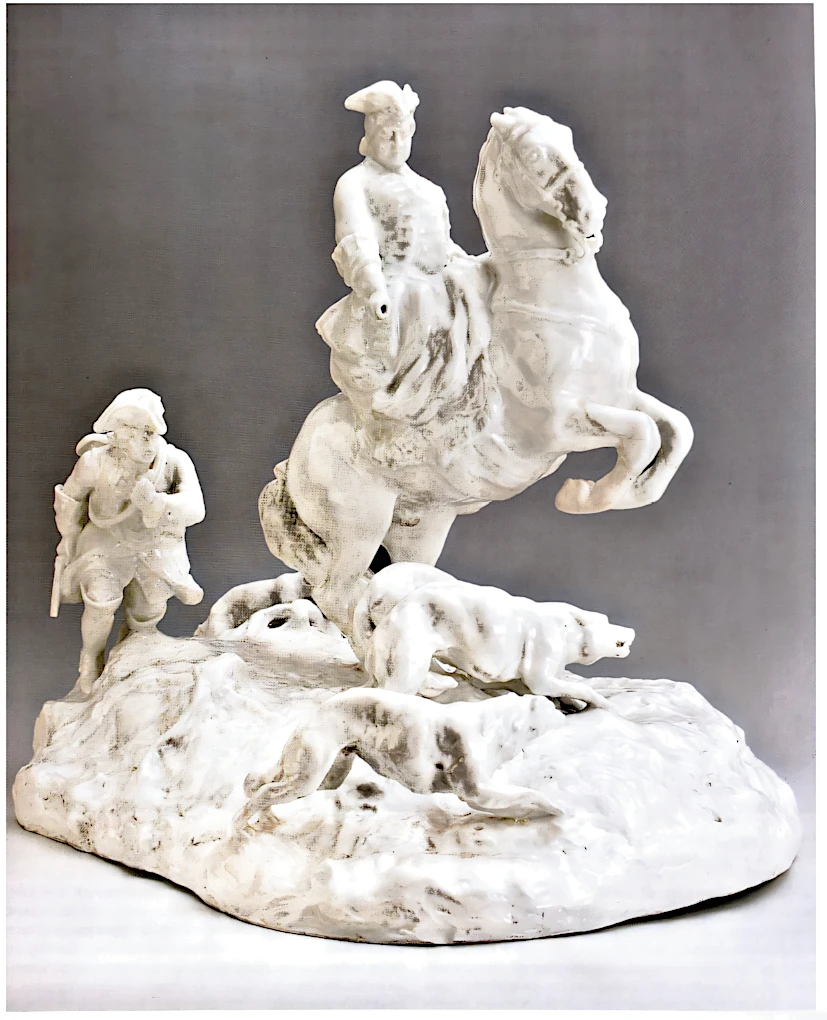
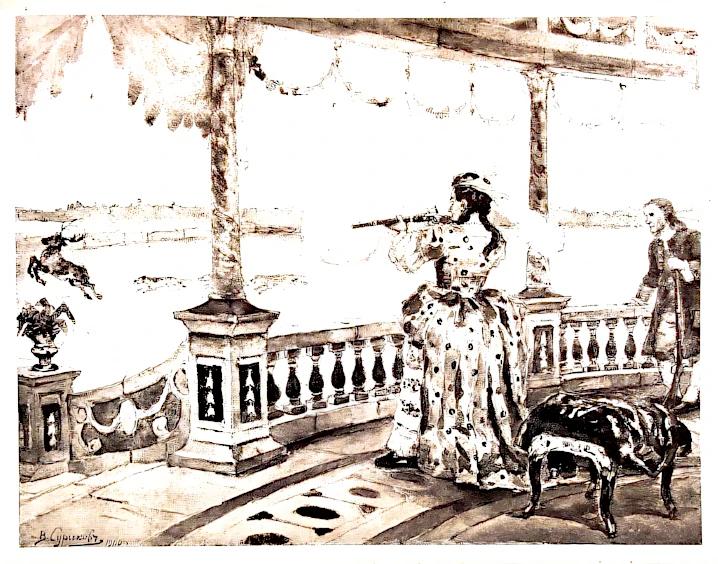
In the early 20th century, Russian archaism and retrospection become not just a fashion, but the language of new meanings. The porcelain “Royal Hunt” is not only a historical reconstruction: it is an art-historical flashback, an act of cultural shamanism. The baron becomes passionate about reconstructing 18th-century “hunting scenes,” inspired by Serov’s paintings, Wrangel’s hunting works, and Kutepov’s multivolumes. The figures in the centerpiece are not just miniatures: it is a scene frozen with excitement, luxury, tension of ceremonial life, and psychological play. Porcelain is restless—even the famous Anna Ioannovna on horseback is not just a copy of an old portrait, but the embodiment of an entire aesthetic in one pose.
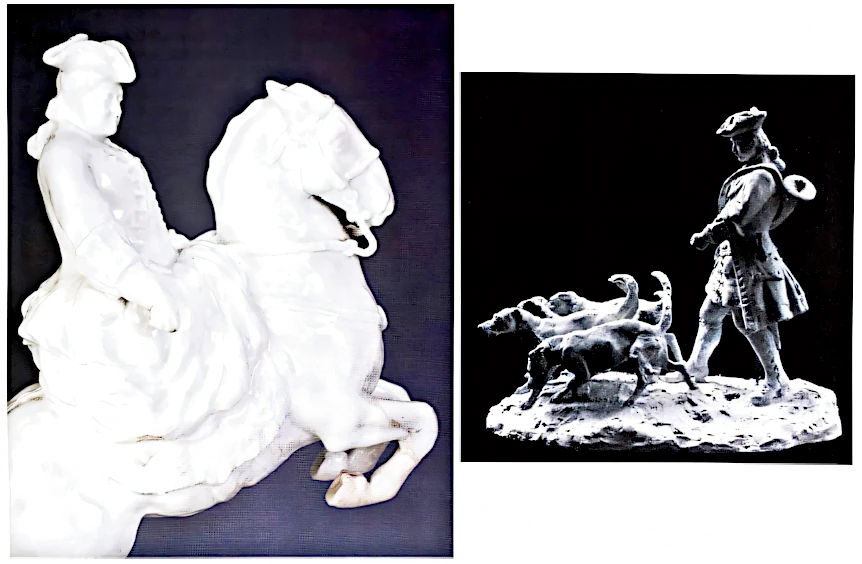
The composition is overtly theatrical: a wolf surrounded by borzois, a whipper-in with a hunting horn, a young African page in a fancy costume... Even the hunter with a spear sounds like a sharp “sting” of time. This is theater in porcelain, where each participant is a self-sufficient character. As we look at them, we find ourselves associating: contemporary pop-aesthetic, the desire to “cosplay” historicity, seeking one's own root amid fragments of memory.
Notice how the master reproduces animal plasticity: not just fur, teeth, or whiskers—but that special look that first appears "empty" and a minute later comes to life, as if an echo of a living beast. This is a special magic of the “sculptor impressionist”—Paolo Troubetzkoy, whom Rausch, like an entire generation, learned to see movement through material.
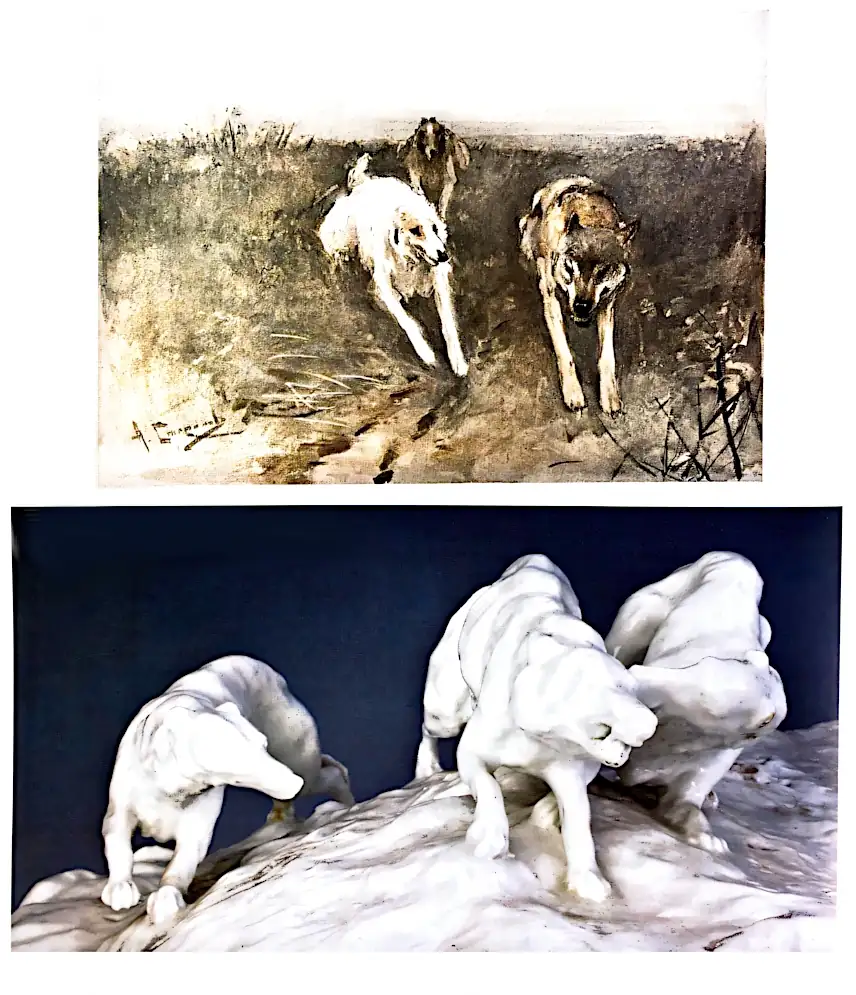
Fragment of a sculptural composition: wolf hunt
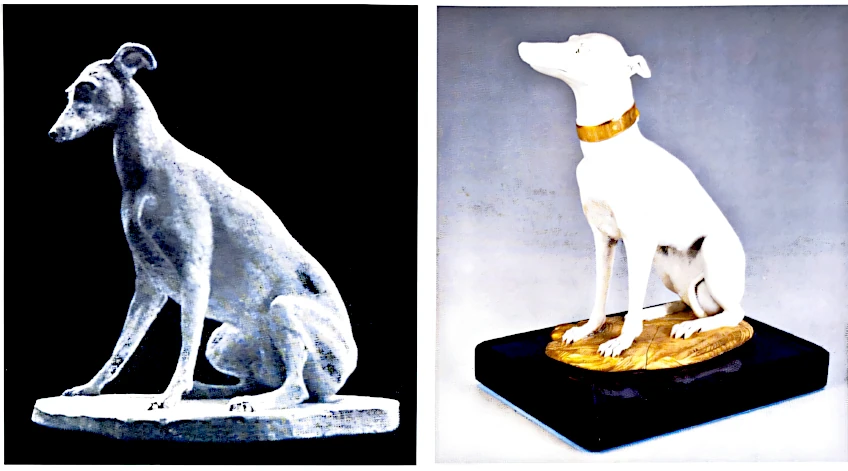
Sculpture “Italian Greyhound”, Late 1820s—1830s factory and sculptures of Baron Rausch von Traubenberg// Bisque, gilding, chasing; base—smalt. State Hermitage.
Where the Past Becomes Present: What a Forgotten Masterpiece Calls Us To
Collaboration with the Imperial Porcelain Factory became for Rausch von Traubenberg not only a period of fame, but an eternal experiment: porcelain became a laboratory of hybrid meanings, where the small has long challenged the large, and history becomes your personal toy—a key to the doors of the past.
Today, when miniatures of the past are easily dismissed as "secondary," I want to remind you: it is such "small" things that reflect great history. The monumentality sought in Rausch’s porcelain was never a “monument,” but always—a dialogue with those who look and can make themselves look at the details.
And if next time you happen to see a rigid army of "guardsmen" behind museum glass or an ensemble of the "royal hunt"—pause for a moment.
Think: isn’t your own day, your daily rituals, relationships, and passions—this small and fragile—turning into a grand story about time itself?
What if every porcelain figurine contains a real drama—just waiting for someone to tell its story?
...
And what work of art ever made you stop and think?


