What can a porcelain rider tell us?
Have you ever lingered over a porcelain figurine standing behind the glass of a museum case?
Not a pretty trinket, but a sculpture — with fragile dynamics, the history visible in the horse's gaze, the tiniest details of the uniform reflecting a whole era. As if someone, knowing times change, decided to preserve their breath in fired white clay.
Few know that behind the scenes at the Imperial Porcelain Factory — celebrated worldwide for its splendor and precision — not only creative experiments took place, but real dramas of psychology, statehood, and art. After this story you will not be able to look at a porcelain miniature the same way. You will see not merely a collectible "exhibit" but a key to a dialogue between past and future, between the artist's dream and the Empire's ideology.
Act One — A Pearl on the Front Line: Baron Rausch von Traubenberg and the Play of Small Sculpture
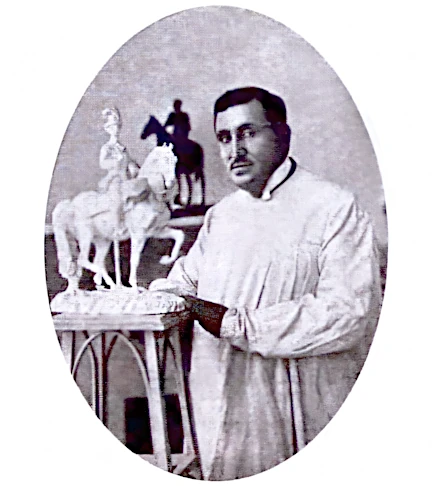
Paris, 1907. A mysterious young man, tall, always polite, with delicate military moustaches, exhibits his works at the Autumn Salon for the first time. This is Karl Karlovich Rausch von Traubenberg, a hereditary soldier, a porcelain rebel, a dreamer, a pupil of Ashbe and I. Grabar. He grows up in Bavaria, learning to model to music in Hildebrand's studio. Behind him is Europe with its bronzes, marbles, smoky shop windows, great cities and their endless rhythm of searching for a personal artistic voice.
Already it is 1908, and Petersburg pulls the baron into its cold northern whirl.
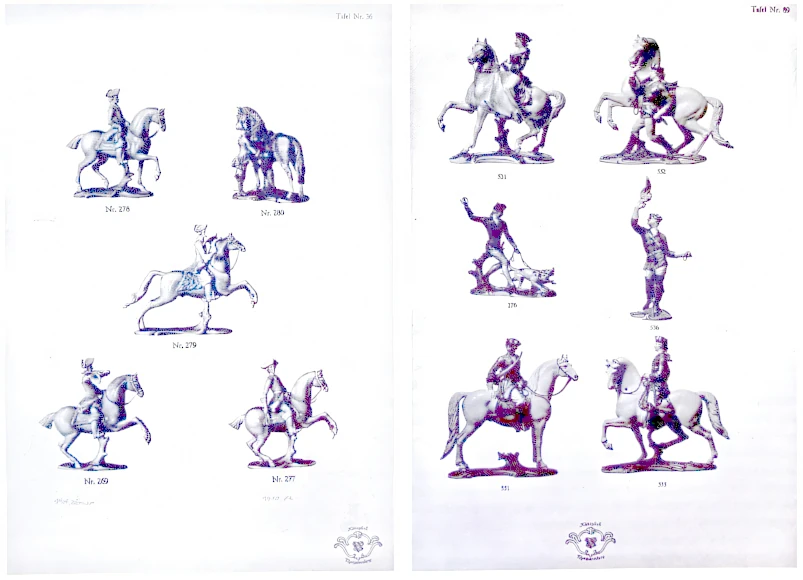
Sheet No. 89 from the sales catalogue of the Nymphenburg Porcelain Manufactory, 1912.
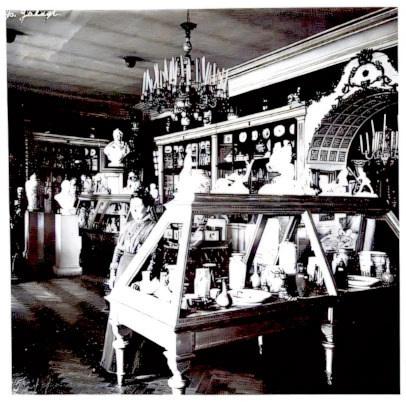
Here, at the Imperial Porcelain Factory, doors open and... tensions rise. The factory is a world of two faces: one — the academic muse of domestic traditionalism, the other — a jealous neighbor watching young artists try to breathe "new life" into porcelain. It is Rausch von Traubenberg who brings a European wind here, but his path from the start is not a quiet procession up a marble staircase.
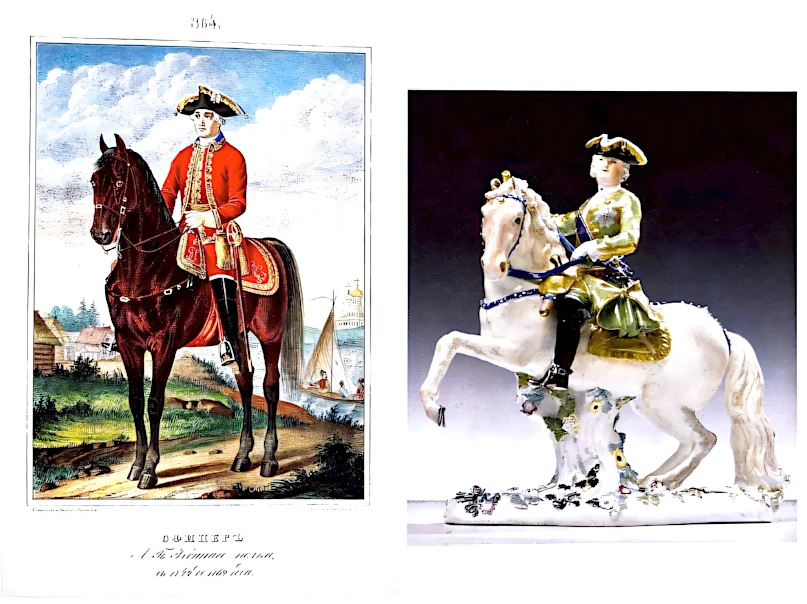
"Empress Elizabeth Petrovna on Horseback". Model by J. J. Kaendler. 1743. Meissen Porcelain Manufactory. Unmarked. Height — 23.5 cm. Dresden, Staatliche Kunstsammlungen, Porzellansammlung.
The porcelain manufactory is a stern, official lady. Its range reflects the will of the imperial court; every work is strictly regulated, and an order written by chancery pen cuts off anything bold or too lively. And yet, gradually, new faces, ideas and directions appear in this royal utopia. Nicholas Roerich wrote bluntly about this, lamenting in his notes: among talented craftsmen there are no true poets of porcelain — those who can turn clay into a reflection of the real...
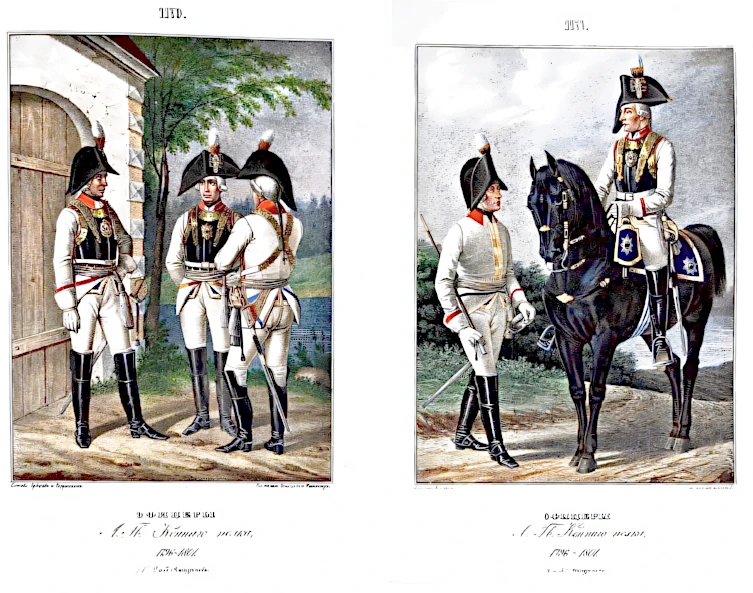
Officers of the Life-Guard Horse Regiment, 1796–1801, 4th and 5th squadrons
Just imagine: the Imperial Porcelain Factory was not simply an industrial machine — it created symbols: from national heroism to mundane napkins for empresses. And one of the first who could reshape that system was Rausch von Traubenberg. For a factory craving propagandistic power and new artistic blood, the baron was an ideal compromise. On the one hand, status, lineage, military spirit; on the other — a young European gaze, an untried audacity in composition and style.
However, any innovation struggles to take root in an environment where every brushstroke must receive the highest approval, and every shade of porcelain white must pass as strict a scrutiny as a new regiment before Peter III.
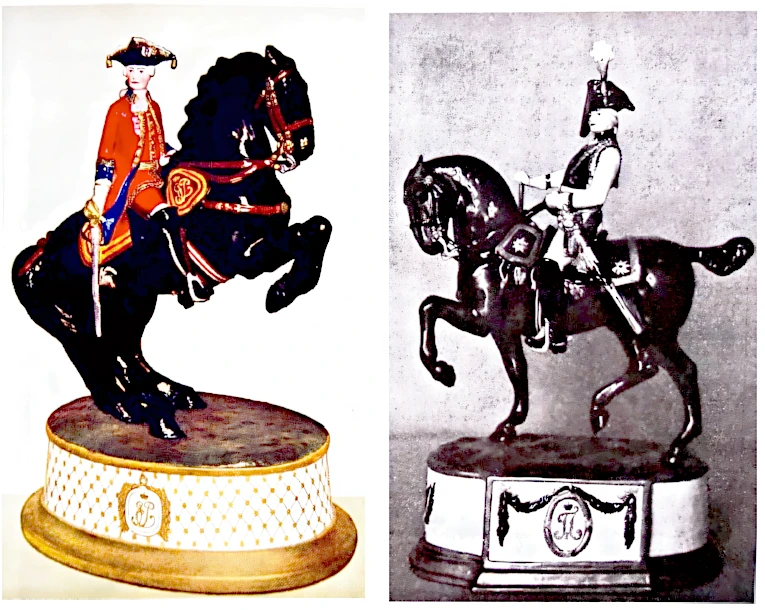
Separate impression of Apollo, 1913
Sculpture "Officer of the Life-Guard Horse Regiment of the reign of Emperor Paul I"
Separate impression of Apollo. 1913, St. Petersburg.
Act Two — Riders on Something Greater: "The History of the Russian Guards" as a Mirror of the Country
Before you is not simply a ruddy officer on an expensive horse. This is an ideologeme: the figure of the serviceman embodying the scale and splendor of the Empire. In the early 20th century the Imperial Porcelain Factory, once the court's favorite toy, finds itself at the epicenter of an ethical storm: on one hand — the grand series "Nationalities of Russia" (almost a theater of national characters in miniature), on the other — pathetic battle scenes where epochs come alive like film.
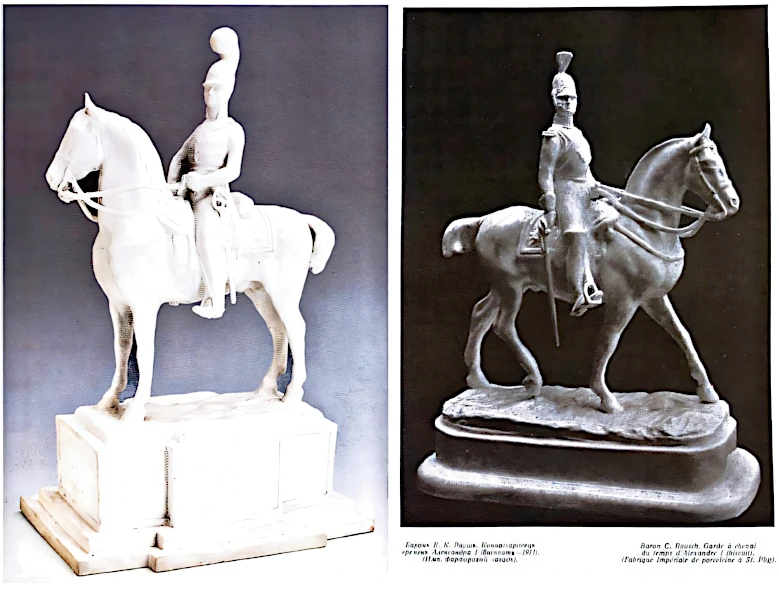
Sculpture "Horse Guardsman of the reign of Emperor Alexander I"
And here Rausch von Traubenberg appears with his "History of the Russian Guards." The Guard — the elite, on display, a system of values. The artist works on the creation of an entire series of miniatures with almost manic zeal: corresponding with military historians, leafing through multi-volume works on uniforms, correcting sketches in antique albums, delving into the breed of each horse so that it is not merely a "support" but an independent character, an actor in a personal tragedy. Every fold of the uniform, glowing in the matte blue of porcelain, matters; every movement is like a frozen nerve of the departed century.
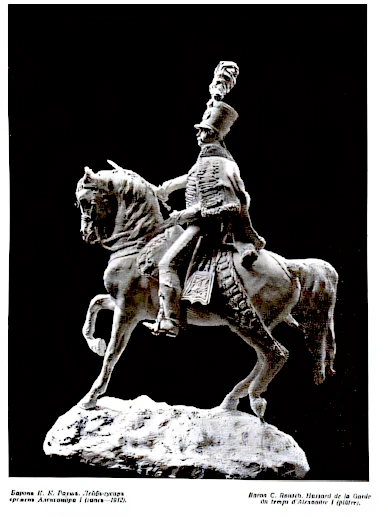
The peculiarity of these sculptures is the almost physical tangibility of an era through the material. If you listen closely, the porcelain officer of Elizabeth Petrovna's time emits a crystalline ring of plate that draws you to the spirit of the 18th century, and the Andalusian horse is recreated almost with anatomical accuracy. The baron draws inspiration from Munich manufactory catalogues, albums on the history of military costume, and even personal family legends (his uncle translated "The History of the Cavalry" into Russian). His work is not illustration but a subtle history of psychology: how society, the army, and even the image of the hero changed.
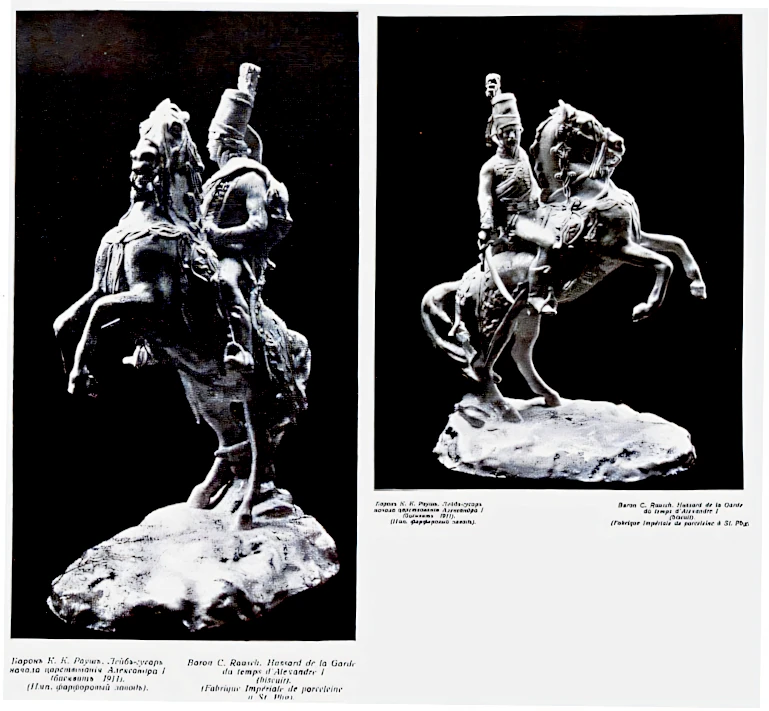
A parallel with the present: today brands, pop-culture heroes and even bloggers copy images of the elite, building entire businesses on "symbols of success." Then this code was encoded in porcelain figurines; all of Petersburg's elite wanted their symbol, their miniature of acquired eternity. Does this not resemble how we collect stories and push notifications now?
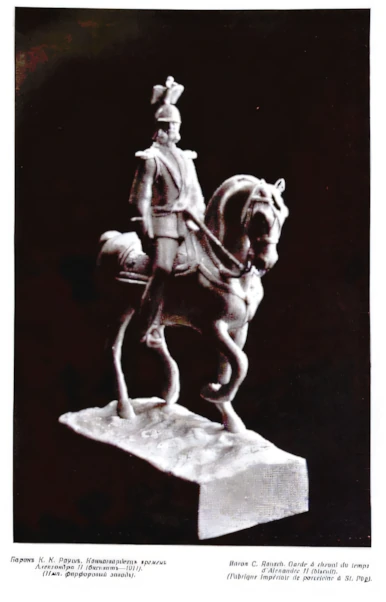
Act Three — For Whom Does the Porcelain Bell Toll? Hooves That Sound Through Time
Porcelain is a material you cannot help but feel, touch, fall hopelessly in love with. There is no room for half-measures here: Rausch describes the Andalusian horse with the obsession of the best 19th-century animalier, meticulously ensuring each rider has not just "props" but an individualized equestrian portrait. The line between art and science disappears. Could you believe that in the baron's studio they seriously argued over the shape of a hussar steed's ears, or that each officer is depicted on a strict breed because the imperial army would not tolerate a "foreign" coat?
Critics later called the porcelain sculpture "alive" — in contrast to painted mannequins: gaudy but cold. These figurines have movement, a nerve, a tint of individual fate... This is not just "minor art," the era declares, because the erased boundary between "home statuette" and cultural code no longer exists. They were created as ideological companions but outlived their era and did not become faceless artifacts. "One can only rejoice at the emergence of an artist so actively contributing to the revival among us of that charming branch of artistic production — artistic porcelain," wrote the art historian Rostislavov.
By the way, even today in the country's major museums one must still argue for the value of these works; surprisingly, masterpieces made at the intersection of physics, psychology and state will often remain "secondary." But isn't the same true for the "small" in our culture? Try to recall how short the path from true passion to oblivion can be if it is not backed by chronicling, a museum or at least a good storyteller...
Act Four — The Secret of the Tsar's Hunt: Through the Porcelain Forest
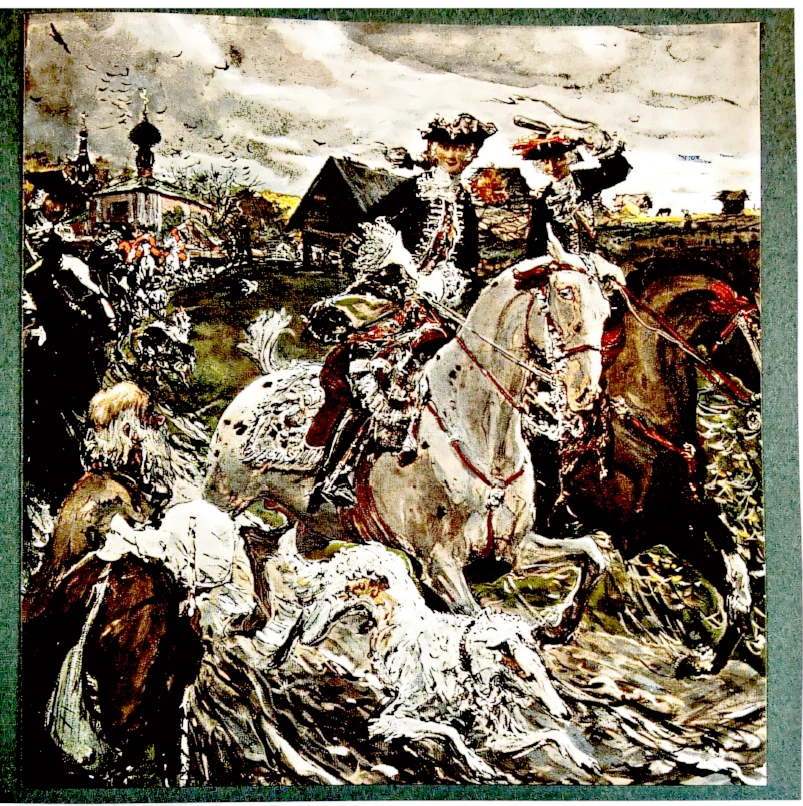
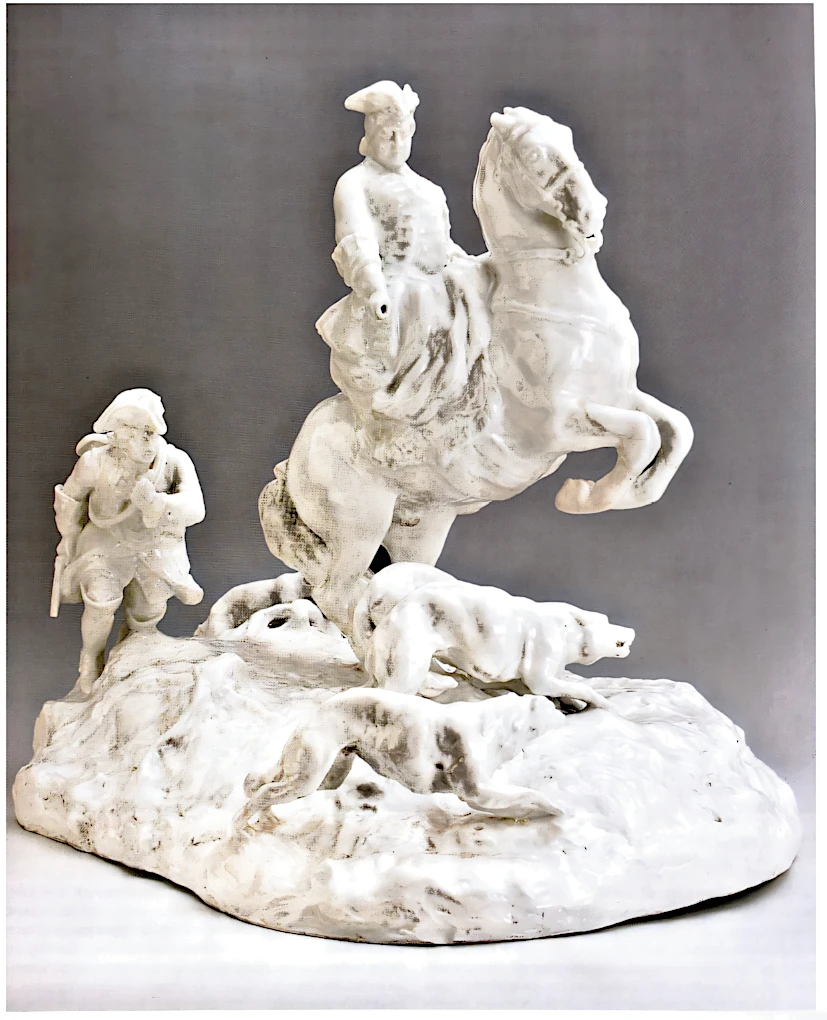
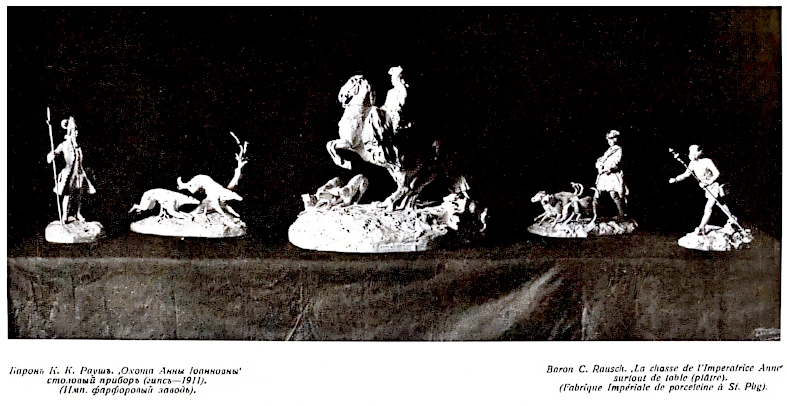
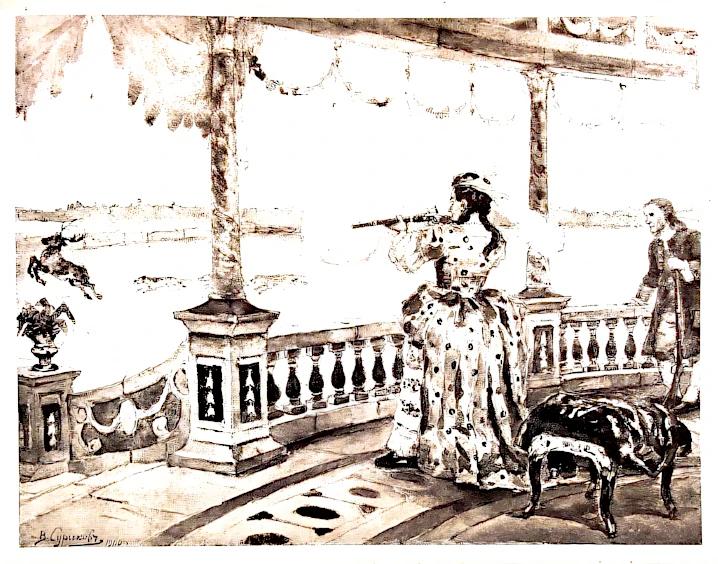
At the beginning of the 20th century Russian archaism and retrospective taste become not merely a fashion but a language of new meanings. The porcelain "Tsar's Hunt" is not only a historical reconstruction: it is an art-historical flashback, an act of cultural shamanism. The baron becomes absorbed in reconstructing 18th-century hunting scenes, inspired by Serov's paintings, Wrangel's hunting essays and Kutepov's multi-volume works. The figures in the table ornament are not just miniatures: they are a scene where excitement, luxury, the nerve of ceremonial life and psychological play have frozen. Porcelain knows no rest — even the famous Anna Ioannovna on horseback is not just a copy of an old portrait, but the embodiment of an entire aesthetic in one pose.
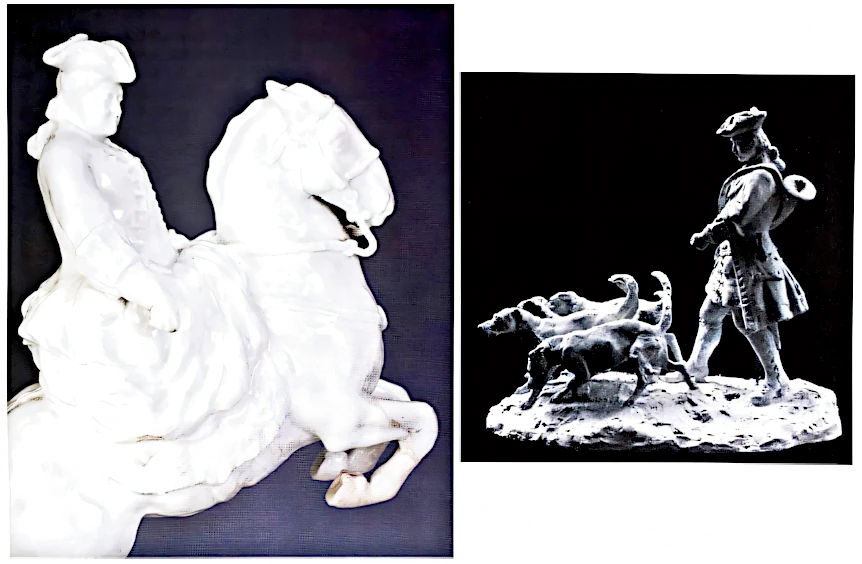
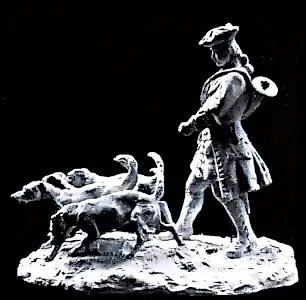
Figure of a huntsman accompanied by three dogs. Fragment of the sculptural composition "Empress Anna Ioannovna on the Hunt". Source reproduction: Rostislavov A. The Porcelain Factory and the Sculptures of Baron Rausch von Traubenberg // Separate impression. Apollo. 1913, St. Petersburg.
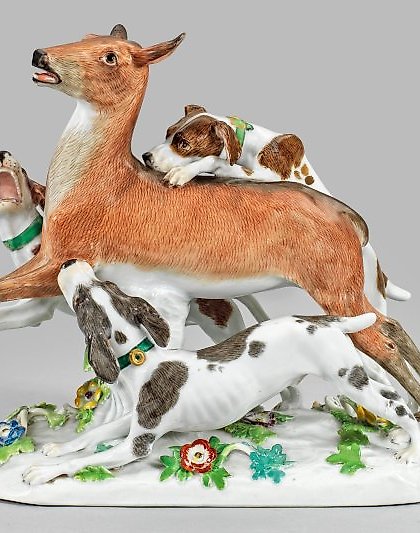
The composition has an excessive theatricality: a wolf surrounded by sighthounds, a huntsman with a hunting horn, a Moorish page in an elegant costume... Even the hunter with a garrot sounds like a sharp "sting" of time. This is theatre in porcelain, where each participant is a self-sufficient character. We look at them — and catch ourselves with associations: modern pop aesthetics, the desire for a kind of historical "cosplay" trying to find its root among the shards of memory.
Notice how the master reproduces the plasticity of animals: not just fur, teeth, whiskers — but that particular look which at first seems "empty" and then a minute later comes alive, as if it were an echo of a living beast. This is the special magic of an "impressionist of sculpture" — Paolo Troubetzkoy, from whom Rausch, like a whole generation, learned to see movement through material.
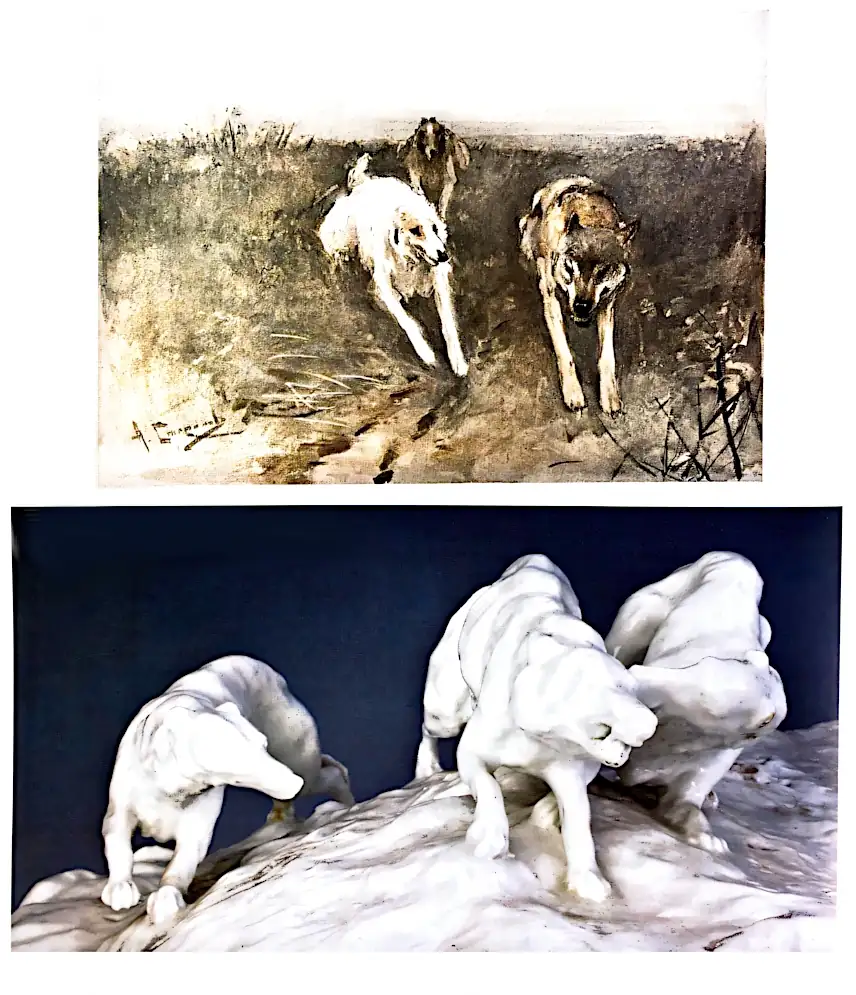
Fragment of the sculptural composition "Wolf Chase"
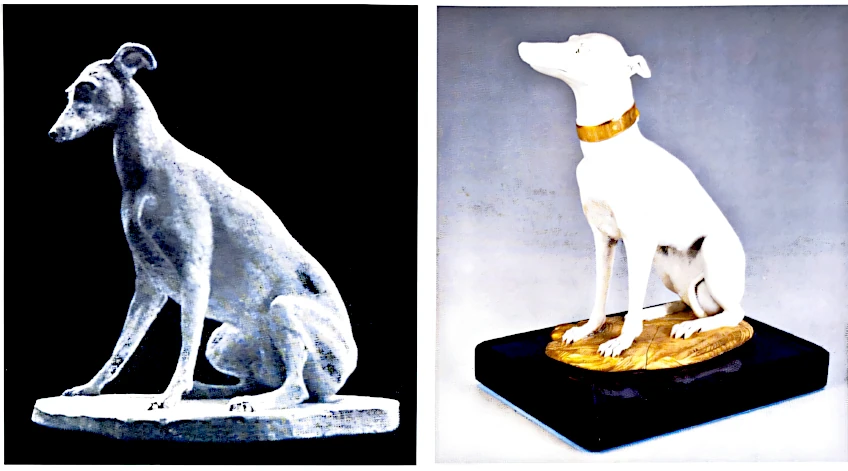
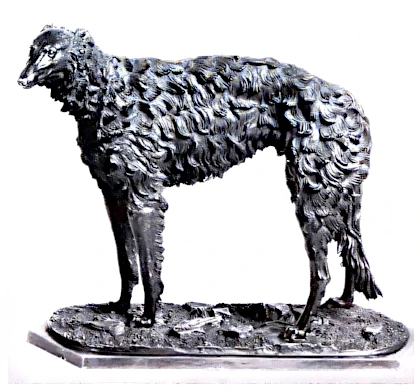
Sculpture "Greyhound", late 1820s–1830s. Factory and sculptures of Baron Rausch von Traubenberg // Biscuit, gilding, tooling; base — smalt. State Hermitage Museum
Where the Past Becomes Present: What the Forgotten Masterpiece Calls For
Collaboration with the Imperial Porcelain Factory became for Rausch von Traubenberg not only a stage of fame but an endless experiment: porcelain became a laboratory of hybrid meanings where the small has long argued with the great, and history becomes your personal toy — a key to doors into the past.
Today, when miniatures of the past are easily dismissed as "secondary," it is worth reminding ourselves: such "small" things reflect the larger history. The monumentality Rausch sought in porcelain was never a "monument" but always a dialogue with those who look and can force themselves to peer into details.
So next time you happen to see a stiff army of "guardsmen" behind a museum glass or the ensemble of a "Tsar's Hunt" — pause for a moment.
Think: might your own day, your daily rituals, relationships and passions — this small and fragile — be turning into a big story about time?
What if in every porcelain figurine a real drama is hidden — only waiting for someone to be able to tell it?
...
And what work of art has ever made you stop and think?