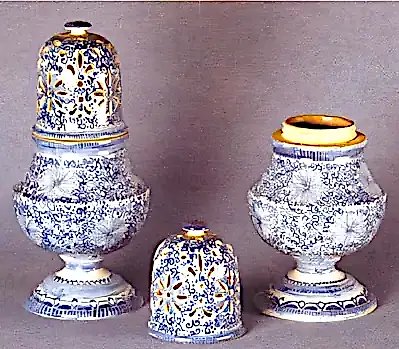
 Have you ever wondered why antique Russian tableware features futuristic motifs, English austerity, or the colors of a Dutch rainbow? What lies behind the familiar bluish-tinged plate—mere kitchenware or the imprint of a cultural revolution? Ceramics, at first glance, are quiet and humble. But that's just a curtain. Behind it are intertwined destinies, status games, dazzling technological innovations, echoes of European fashion, and, most importantly, the pulse of 19th-century Russia. Few realize that the faience ware of Arkhangelskoye near Moscow is a secret jewel of a vast country, fusing French temperament, Russian talent, and elusive English chic. Objects from the "Table Service with Bluebells," 1829-1835 A candlestick, two teapots, and a cup with saucer inscribed "ARKHANGELSKAYA FARM," 1827-1829 Unveiling this intricate artifact Prepare to be amazed: today you will see faience as a map of human passions and cultural codes. After this journey, you will never see an ordinary cup the same way again. A French spark on Russian soil: Auguste Lambert and ceramics as a passion Imagine the early 19th century. The smell of molten metal, clay dust, vibrant French exclamations—all weave a strange dream amid Russian snow. At Arkhangelskoye, the wealthy estate of Prince Yusupov near Moscow, where music resounds and whispers of European fates swirl, a small faience factory unexpectedly springs to life. Its inspiration: Frenchman Auguste Philippe Lambert, an artist and painter from the legendary Sèvres manufactory. Initially, porcelain was attempted here, but debts, failures, and the eternal Russian dilemma—where to get the best clay?—quickly shifted focus to the more forgiving, yet equally alluring, faience. Lambert was not only a craftsman but a visionary. He had what the French call "l’esprit aventureux": the knack for igniting interest in ceramics, and seeing them as a bridge to the world. He boldly took charge: sourcing Gzhel clay, building kilns, organizing teams of artisans, adopting Europe's best techniques, experimenting relentlessly with decoration—until he was so entangled in debt he became the hero of his own business novel. His sights were set on England: he wanted Russian tableware to rival the famed wares of Staffordshire. At the time, faience was considered more democratic and "malleable" than porcelain. Unlike porcelain, reserved for grand lady’s gatherings, faience was a companion of vibrant, real life—bought by both nobility and serfs. Clients came from all walks of life, and the range depended on capital and changing eras. In the shadows by the kiln, amidst the clatter of intricate machinery, serfs and free artisans shaped faience forms, trying to erase boundaries between Russian and European. Tableware from the "Service with Bluebells," 1829-1835 Lambert’s story is one of a struggle for style, quality, and the unique face of Russian ceramics. His path was thorny: first an attempt at a porcelain factory, then faience reinvention, debts, partnerships, creative combinations of German and French models, death, and the business passing to his widow and new partners. Each cup and soup tureen carries the mark of this human drama: determination, failure, and redefined priorities. The turn to secret knowledge—Why does this all matter? Studying the fate of Arkhangelskoe faience, you see the intersection not only of people, but of epochs: Russia struggling to break free from English ceramic dominance, Europe poised on the toes of fashion, and unique Russian potential. Here, faience is not just utensils. It’s a social experiment, an attempt to overcome provincialism through aesthetics. Tureen (soup tureen) from the “Service with Bluebells,” 1829–1835 A mark in the form of the “LAMBERT” impression, used on tableware of the “Service with Bluebells” and plates with the portrait of the Duchess of Courland, 1827–1835. Tureen. Faience. England. Wedgwood Factory. Echoes of this struggle persist today. Modern interior design loves to reinvent the past: cafes in “19th-century France” style, luxurious services with supposedly authentic luster. The fashion for handcraft, for the blending of traditions, for cross-cultural recipes—all of this is hidden in that distant Arkhangelskoye workshop. “Arkhangelskaya Farm” and the sacred geography of faience Let’s venture deep into the factory walls—places where the past is tangible. Have remnants survived of what masters molded and painted under Lambert’s direction? Yes, not just fragments, but entire table sets and visual stories remain. The factory’s pride: the famous “Service with Bluebells” (technically with lotus fruit, but who’s counting!), delicate faience once admired only in England. Here are grand soup tureens with volute handles, lidded bowls adorned with sculpted pear fruits, thick porous milk jugs reminiscent of German and French majolica… Stylistically chaotic yet aesthetically cohesive, all these items form a unique whole. The ornaments of English, Dutch, French, even Chinese factories are not simply copied, but interpreted. Every motif carries a Russian meaning. Plates with green-brown glaze recall Britain’s “turtle shell” fashion, cups marked "ARKHANGELSKAYA FARM" reflect the idea of local branding, pots and salt shakers evoke hands-on workmanship teetering on the edge of naivety. Plate with a portrait of E.B. Biron, Duchess of Courland, born Princess Yusupova. 1827–1835. After an engraving by J. Houbraken, 1775. Here’s the paradox: within this seemingly "cosmopolitan" art, behind the faience cup, a Russian spirit was hidden. Even if the shape was lifted from a British queen’s catalogue and the decoration borrowed from Delft masters, the fact that faience existed in a Russian manor was already a rebellion against dependency. Each new piece was a small triumph over foreign fashion. A thin wall, delicately bent handle, polychrome border, the now-familiar inscription—all these say: "Yes, Russia can do it too!" Delft faience, second half of 18th century. Rijksmuseum, Amsterdam. The story of the "ARKHANGELSKAYA FARM" service is one of branding, localization, and cultural self-respect. Every detail bears a graft of style, an attempt to show that Russian masters can boast a festive table, their own pride—no worse than Europe. From a modern perspective, we call this an authorial style, a local product, small-batch. But when looking at an old cup from Arkhangelskoye, we’re amazed: the fashion for branded items, microstudios, limited editions, and collaborations—it all began here, more than a century ago. Beyond the mirror: symbols, inscriptions, and the true psychology of art Let’s talk about the psychology of perception. Why do we love faience so much? Why does an old plate with an unnecessarily elaborate border and impractical inscription delight us? Everything matters here: the perfect shade of the body, the slightly translucent glaze, the highlighted Latin script—"LAMBERT," "ROMARINO," "ARKHANGELSKAYA FARM." Plates inscribed "ARKHANGELSKAYA FARM," 1827–1829. What’s so special about this? A 19th-century person, just like us today, seeks authenticity in details. True mastery is recognized in the strokes, true work in the marks; the stamp identifies not only the technique, but also the honesty of the ceramist. The dream of skilled craftsmanship always goes hand in hand with a thirst for experimentation. Sugar bowls inscribed "ARKHANGELSKAYA FARM," 1827–1829. Their shape echoes similar Rouen faience from the late 17th century, from the Museum of Decorative Arts in Paris. A pâte terrine lid in the form of a dove pair. The reverse side inscribed "ARKHANGELSKAYA FARM," 1827–1829. In the marks and symbols of the Arkhangelskoye factory, you find both imitation (traits of the Delft school, mystical letters and numbers, direct citations of European studios) and protest—the literal Russian inscription as a sign of independence, certifying progress. Thus is the divide between copying and self-sufficiency. Symbolism in details: each soup tureen handle echoes the debate between painstaking beauty and newfound simplicity; each sculpted flower is a sign of the desire to live beautifully but in a Russian way. Faience tableware stops being utilitarian and becomes a status symbol, a sign of heroic resistance for independent art. The play of cultural codes makes it all the more fascinating. Complex underglaze patterns and pronounced baroqueness are not only homage to western fashion but, from the 21st century perspective, the first version of “cultural identity”: to be trendy, yet remain yourself. Lambert’s craftsmen could create artifacts you want to keep as a memory, like a photograph of the era. Oyster dish, two butter dishes with dove-shaped lids, and a saltshaker inscribed "ARKHANGELSKAYA FARM," 1827–1829. The mystery of disappearance and rebirth of interest Lambert’s production was small and, it seemed, insignificant for vast Russia. Few items remain—much was lost to time, destroyed, dispersed in collections, lost their marks… After Lambert’s death, others managed the factory, new names appeared, some wares were signed in Russian, others in Latin, and many are now easily mistaken for Western European faience. The fairy tale often ends where the inscriptions are erased. Cup and saucer from the "ARKHANGELSKAYA FARM" service, 1827–1829. But, as always with true art, rebirth is only a matter of time. The value of Arkhangelskoe faience today lies not only in its rarity. It has become a symbol of cultural synthesis, a craft history with no losers, only evolving taste. Parisian cafes order handmade tableware from Russia, street artists use palettes from old services, designers seek new identities by going back to past motifs. Back of a salt shaker with the “ARKHANGELSKAYA FARM” inscription and an imitation of a Delft factory mark “Two Boats,” 1827–1829. What should we do with this knowledge? Next time, at the table or in an antique shop, hold something made by human hands, even if it’s rough. Listen to its story: it may not be just pottery, but a cipher from an age of daring, deprivation, and great encounters. Decorative vases and tulip vases inscribed "ARKHANGELSKAYA FARM," 1827–1829. Behind the light gleam of faience lies a continent of passions, changes, and cultural breakthroughs. Someone searched for true England in a Russian cup, someone tried to outdo European chic, someone simply survived—thereby creating something unique. The story of Yusupov-Lambert faience is a narrative of intertwining, searching, and a daring hope to make life a bit more beautiful and the nation a bit more independent. What story does your favorite cup hide? Could you continue the chain of inspiration started two centuries ago in a dusty workshop at Arkhangelskoye?
How a Frenchman and Debts Changed the Ceramic Face of Russia
Have you ever wondered why antique Russian tableware features futuristic motifs, English austerity, or the colors of a Dutch rainbow? What lies behind the familiar bluish-tinged plate—mere kitchenware or the imprint of a cultural revolution? Ceramics, at first glance, are quiet and humble. But that's just a curtain. Behind it are intertwined destinies, status games, dazzling technological innovations, echoes of European fashion, and, most importantly, the pulse of 19th-century Russia. Few realize that the faience ware of Arkhangelskoye near Moscow is a secret jewel of a vast country, fusing French temperament, Russian talent, and elusive English chic. Objects from the "Table Service with Bluebells," 1829-1835 A candlestick, two teapots, and a cup with saucer inscribed "ARKHANGELSKAYA FARM," 1827-1829 Unveiling this intricate artifact Prepare to be amazed: today you will see faience as a map of human passions and cultural codes. After this journey, you will never see an ordinary cup the same way again. A French spark on Russian soil: Auguste Lambert and ceramics as a passion Imagine the early 19th century. The smell of molten metal, clay dust, vibrant French exclamations—all weave a strange dream amid Russian snow. At Arkhangelskoye, the wealthy estate of Prince Yusupov near Moscow, where music resounds and whispers of European fates swirl, a small faience factory unexpectedly springs to life. Its inspiration: Frenchman Auguste Philippe Lambert, an artist and painter from the legendary Sèvres manufactory. Initially, porcelain was attempted here, but debts, failures, and the eternal Russian dilemma—where to get the best clay?—quickly shifted focus to the more forgiving, yet equally alluring, faience. Lambert was not only a craftsman but a visionary. He had what the French call "l’esprit aventureux": the knack for igniting interest in ceramics, and seeing them as a bridge to the world. He boldly took charge: sourcing Gzhel clay, building kilns, organizing teams of artisans, adopting Europe's best techniques, experimenting relentlessly with decoration—until he was so entangled in debt he became the hero of his own business novel. His sights were set on England: he wanted Russian tableware to rival the famed wares of Staffordshire. At the time, faience was considered more democratic and "malleable" than porcelain. Unlike porcelain, reserved for grand lady’s gatherings, faience was a companion of vibrant, real life—bought by both nobility and serfs. Clients came from all walks of life, and the range depended on capital and changing eras. In the shadows by the kiln, amidst the clatter of intricate machinery, serfs and free artisans shaped faience forms, trying to erase boundaries between Russian and European. Tableware from the "Service with Bluebells," 1829-1835 Lambert’s story is one of a struggle for style, quality, and the unique face of Russian ceramics. His path was thorny: first an attempt at a porcelain factory, then faience reinvention, debts, partnerships, creative combinations of German and French models, death, and the business passing to his widow and new partners. Each cup and soup tureen carries the mark of this human drama: determination, failure, and redefined priorities. The turn to secret knowledge—Why does this all matter? Studying the fate of Arkhangelskoe faience, you see the intersection not only of people, but of epochs: Russia struggling to break free from English ceramic dominance, Europe poised on the toes of fashion, and unique Russian potential. Here, faience is not just utensils. It’s a social experiment, an attempt to overcome provincialism through aesthetics. Tureen (soup tureen) from the “Service with Bluebells,” 1829–1835 A mark in the form of the “LAMBERT” impression, used on tableware of the “Service with Bluebells” and plates with the portrait of the Duchess of Courland, 1827–1835. Tureen. Faience. England. Wedgwood Factory. Echoes of this struggle persist today. Modern interior design loves to reinvent the past: cafes in “19th-century France” style, luxurious services with supposedly authentic luster. The fashion for handcraft, for the blending of traditions, for cross-cultural recipes—all of this is hidden in that distant Arkhangelskoye workshop. “Arkhangelskaya Farm” and the sacred geography of faience Let’s venture deep into the factory walls—places where the past is tangible. Have remnants survived of what masters molded and painted under Lambert’s direction? Yes, not just fragments, but entire table sets and visual stories remain. The factory’s pride: the famous “Service with Bluebells” (technically with lotus fruit, but who’s counting!), delicate faience once admired only in England. Here are grand soup tureens with volute handles, lidded bowls adorned with sculpted pear fruits, thick porous milk jugs reminiscent of German and French majolica… Stylistically chaotic yet aesthetically cohesive, all these items form a unique whole. The ornaments of English, Dutch, French, even Chinese factories are not simply copied, but interpreted. Every motif carries a Russian meaning. Plates with green-brown glaze recall Britain’s “turtle shell” fashion, cups marked "ARKHANGELSKAYA FARM" reflect the idea of local branding, pots and salt shakers evoke hands-on workmanship teetering on the edge of naivety. Plate with a portrait of E.B. Biron, Duchess of Courland, born Princess Yusupova. 1827–1835. After an engraving by J. Houbraken, 1775. Here’s the paradox: within this seemingly "cosmopolitan" art, behind the faience cup, a Russian spirit was hidden. Even if the shape was lifted from a British queen’s catalogue and the decoration borrowed from Delft masters, the fact that faience existed in a Russian manor was already a rebellion against dependency. Each new piece was a small triumph over foreign fashion. A thin wall, delicately bent handle, polychrome border, the now-familiar inscription—all these say: "Yes, Russia can do it too!" Delft faience, second half of 18th century. Rijksmuseum, Amsterdam. The story of the "ARKHANGELSKAYA FARM" service is one of branding, localization, and cultural self-respect. Every detail bears a graft of style, an attempt to show that Russian masters can boast a festive table, their own pride—no worse than Europe. From a modern perspective, we call this an authorial style, a local product, small-batch. But when looking at an old cup from Arkhangelskoye, we’re amazed: the fashion for branded items, microstudios, limited editions, and collaborations—it all began here, more than a century ago. Beyond the mirror: symbols, inscriptions, and the true psychology of art Let’s talk about the psychology of perception. Why do we love faience so much? Why does an old plate with an unnecessarily elaborate border and impractical inscription delight us? Everything matters here: the perfect shade of the body, the slightly translucent glaze, the highlighted Latin script—"LAMBERT," "ROMARINO," "ARKHANGELSKAYA FARM." Plates inscribed "ARKHANGELSKAYA FARM," 1827–1829. What’s so special about this? A 19th-century person, just like us today, seeks authenticity in details. True mastery is recognized in the strokes, true work in the marks; the stamp identifies not only the technique, but also the honesty of the ceramist. The dream of skilled craftsmanship always goes hand in hand with a thirst for experimentation. Sugar bowls inscribed "ARKHANGELSKAYA FARM," 1827–1829. Their shape echoes similar Rouen faience from the late 17th century, from the Museum of Decorative Arts in Paris. A pâte terrine lid in the form of a dove pair. The reverse side inscribed "ARKHANGELSKAYA FARM," 1827–1829. In the marks and symbols of the Arkhangelskoye factory, you find both imitation (traits of the Delft school, mystical letters and numbers, direct citations of European studios) and protest—the literal Russian inscription as a sign of independence, certifying progress. Thus is the divide between copying and self-sufficiency. Symbolism in details: each soup tureen handle echoes the debate between painstaking beauty and newfound simplicity; each sculpted flower is a sign of the desire to live beautifully but in a Russian way. Faience tableware stops being utilitarian and becomes a status symbol, a sign of heroic resistance for independent art. The play of cultural codes makes it all the more fascinating. Complex underglaze patterns and pronounced baroqueness are not only homage to western fashion but, from the 21st century perspective, the first version of “cultural identity”: to be trendy, yet remain yourself. Lambert’s craftsmen could create artifacts you want to keep as a memory, like a photograph of the era. Oyster dish, two butter dishes with dove-shaped lids, and a saltshaker inscribed "ARKHANGELSKAYA FARM," 1827–1829. The mystery of disappearance and rebirth of interest Lambert’s production was small and, it seemed, insignificant for vast Russia. Few items remain—much was lost to time, destroyed, dispersed in collections, lost their marks… After Lambert’s death, others managed the factory, new names appeared, some wares were signed in Russian, others in Latin, and many are now easily mistaken for Western European faience. The fairy tale often ends where the inscriptions are erased. Cup and saucer from the "ARKHANGELSKAYA FARM" service, 1827–1829. But, as always with true art, rebirth is only a matter of time. The value of Arkhangelskoe faience today lies not only in its rarity. It has become a symbol of cultural synthesis, a craft history with no losers, only evolving taste. Parisian cafes order handmade tableware from Russia, street artists use palettes from old services, designers seek new identities by going back to past motifs. Back of a salt shaker with the “ARKHANGELSKAYA FARM” inscription and an imitation of a Delft factory mark “Two Boats,” 1827–1829. What should we do with this knowledge? Next time, at the table or in an antique shop, hold something made by human hands, even if it’s rough. Listen to its story: it may not be just pottery, but a cipher from an age of daring, deprivation, and great encounters. Decorative vases and tulip vases inscribed "ARKHANGELSKAYA FARM," 1827–1829. Behind the light gleam of faience lies a continent of passions, changes, and cultural breakthroughs. Someone searched for true England in a Russian cup, someone tried to outdo European chic, someone simply survived—thereby creating something unique. The story of Yusupov-Lambert faience is a narrative of intertwining, searching, and a daring hope to make life a bit more beautiful and the nation a bit more independent. What story does your favorite cup hide? Could you continue the chain of inspiration started two centuries ago in a dusty workshop at Arkhangelskoye?Auction of works of art and antiques art-picture.ru provides the opportunity to purchase
purchase lots on the topic are presented "How a Frenchman and Debts Changed the Ceramic Face of Russia"
More articles
paper
Imperial Porcelain and the Lost Masterpieces of Baron Rausch
What can a porcelain rider tell us?Have you ever paused to gaze at a porce…

The Mystery of Napoleon's Porcelain Olympus
A Keyhole to Another WorldHave you ever wondered about an object that was …

Фарфоровая судьба: Когда банальность становится искусством
Длительное время этот скульптор трудился на посту главного модельмейстер…

What is porcelain
Porcelain tableware and other porcelain items have served as a symbol of w…

Porcelain figurines
Porcelain figurines are beautiful and exquisite decorative items that have…

Meissen porcelain
Meissen is a German city known for its porcelain products. Meissen porcela…

KPM plates (Königliche Porzellan-Manufaktur) from Germany
KPM (Königliche Porzellan-Manufaktur) is the oldest porcelain manufactory…

Bing & Grondahl factory figurines
The Bing & Grondahl factory was founded in 1853 in Copenhagen, Denmark…