Josef Carl von Klinkosch (1822–1888) was a leading Viennese silversmith in the late 19th century. He was born into a family of skilled craftsmen and trained in his father's workshop from 1825 to 1839, becoming a certified silversmith in 1844. His work had a significant impact on Austrian silver production, both in design and technique.
The Klinkosch firm had been producing silverware since 1789, when Josef Carl's grandfather, Josef Klinkosch, founded the company. His father, Carl Klinkosch, took over in 1815 and established a strong reputation for masterful quality. The firm became renowned for its sophisticated silver pieces, which were popular gifts at the Imperial Court and among Austrian aristocracy. In 1837, Carl Klinkosch was officially appointed court silversmith.
In 1831, the firm entered into a partnership with Stephan Mayerhofer, supplier of table silver for the Imperial household. This collaboration brought more commissions from the Imperial Court and solidified their reputation. When Mayerhofer retired in 1869, Josef Carl Klinkosch took full control of the business and became Imperial Purveyor.
By 1851, Klinkosch was heading the workshop's technical side, enhancing both design and quality of production. He combined industrial innovations with traditional handcrafting methods and worked with both local and international artists. His silverware was highly esteemed for its precision and detail. In 1855, Emperor Franz Joseph I awarded him the Imperial Order, establishing him as one of Austria's foremost silversmiths.
The workshop produced a broad array of silver objects, including tableware, cutlery, candelabra, and decorative items. Klinkosch's works were exhibited at international shows and received multiple awards. By the end of the 19th century, the firm had become one of the largest and most esteemed silver manufacturers in Austria.
In 1884, Klinkosch retired and handed over the business to his sons, Arthur and Isidor. After the fall of the Austro-Hungarian Empire in 1918, the company was sold to Arthur Krupp, who renamed it "JC Klinkosch AG." It continued operations until 1972.
Today, silverware created by J. C. Klinkosch is highly prized by collectors and museums. His works are valued for their fine craftsmanship and close connection to the Habsburg court.
Klinkosch J. C.
1822 – Vienna – 1888
Viennese silversmith.
Son of the bourgeois, and later court and Imperial silversmith Carl Klinkosch (1797 – Vienna – 1860).
In 1848 he married Elisabeth Swoboda, daughter of court and bourgeois jeweler Wenzel Johann Swoboda.
From 1835 to 1839, he studied with his father at the gold and silver factory Mayerhofer & Klinkosch in Vienna, Leopoldstadt, which was managed by his father. On November 10, 1843, he received the trade qualification of a bourgeois silversmith, and on January 25, 1844, citizenship of Vienna. After study trips in Italy and probably other European countries, he partly took over management of the factory from his father in 1847, and from 1853, full management. From 1860 to 1861, he was a member of the Vienna City Council. After his partner Stephan Mayerhofer Jr. retired in 1869, he became the sole owner of the company, which now operated under the name JC Klinkosch. In the same year, he was awarded the title kk Hof- und Kammer-Lieferant (Imperial and Royal Court Purveyor). Josef Carl Klinkosch achieved international recognition for the factory with works based on designs by artists like Theophil Hansen and Gustave Deloye, and by participating in the world exhibitions in Vienna (1873) and Paris (1878). He was awarded the Knight's Order of the French Legion of Honor and the Order of the Iron Crown III Class, which carried hereditary knighthood, for a magnificent shield commissioned by Emperor Franz Joseph I and exhibited. In 1884, he retired due to health reasons and handed over the factory to his two sons, Isidor (1852 – Vienna – 1914) and Arthur Ritter von Klinkosch (1854 – Vienna – 1899). After the First World War, the company was sold to Berndorfer Metallwaren-Fabrik Arthur Krupp AG and closed only in 1953. Josef Carl Klinkosch was a member of guild committees and the board of directors, as well as a shop steward from 1851 to 1883.
Reference: R. Price (ed.), Wiener Silber, Modernes Design, 1780–1918, Ostfildern-Ruit, 2003, p. 389
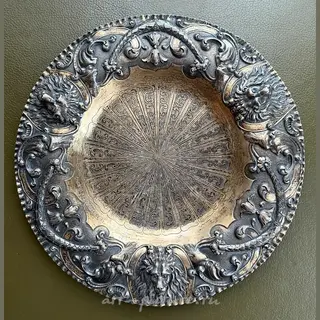
 Josef Carl von Klinkosch (1822–1888)