Why can an ordinary spoon hold more memory than thick books?
Have you ever wondered that the most unremarkable object on your table—a simple spoon—might conceal secrets of cosmic proportions? At first glance, it’s just the glint of sunlight on silver. But look more closely, and soon you’re gliding along a magical edge between past and present, where symbols shimmer, feelings intensify, and the invisible shadows of an era appear.
This article is not about cutlery, but a journey into the depths of time and human memory. Through the keyhole of a silver spoon from 1843, I will show you how the tiniest work of art can harbor imperial pride, patriotism, and mystical symbolism. You will learn to see more than shape in things—to hear their whispers through the centuries. And if you’re ready, let’s begin…
Silver, the Commander, and the Master’s Hand: The Meeting of Three Fates
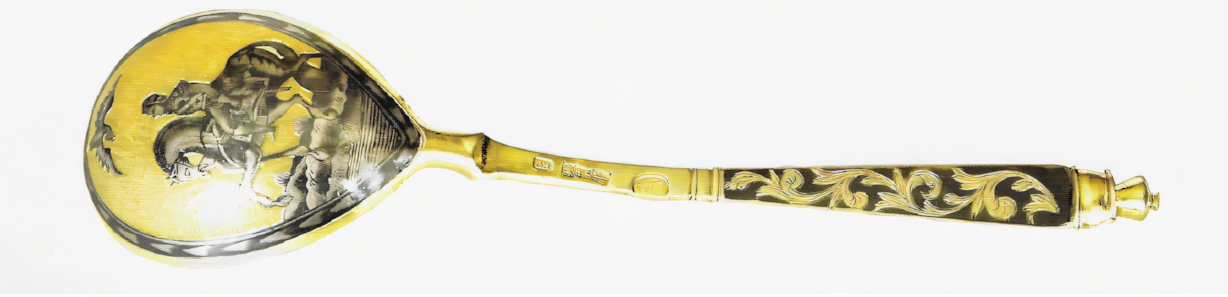
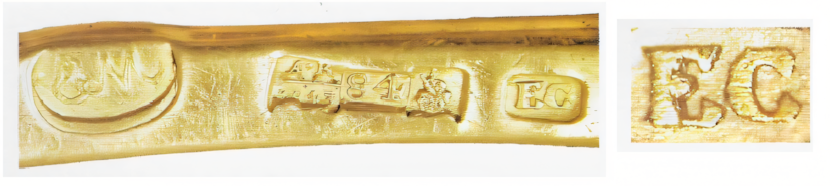
Imagine Moscow in 1843. Quiet streets, the sound of bells, silversmiths probably working by lamp—at dawn or deep in the night. One of them, hidden behind the cryptic monogram "ES," crafts a spoon not for daily use, but as a memorial, a ritual object.
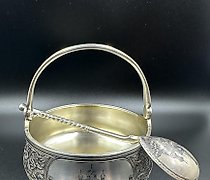
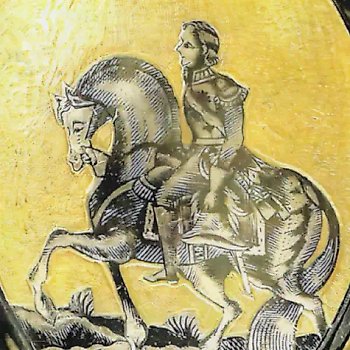
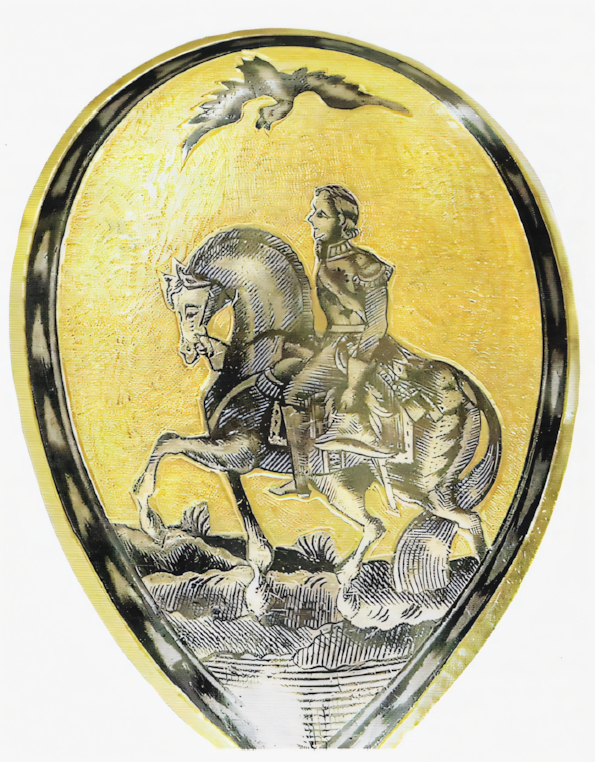
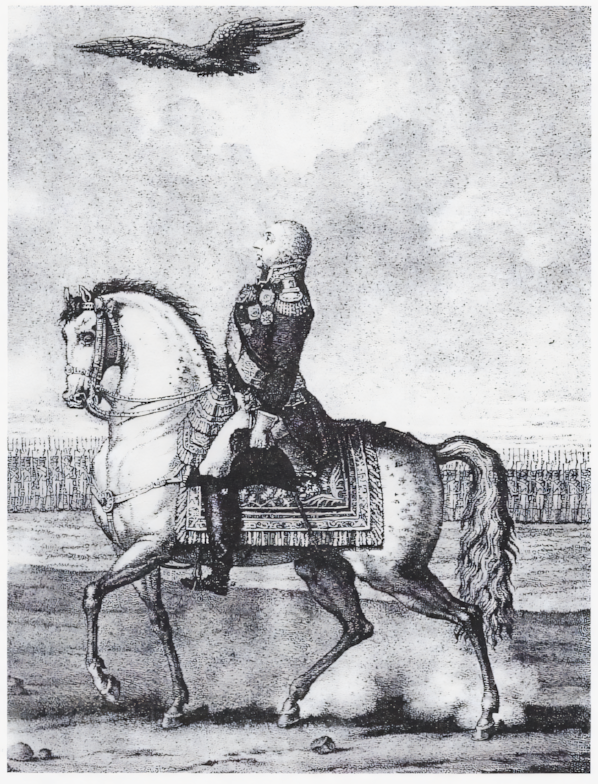
In the master’s hands, simple silver becomes a canvas for a miniature. On the spherical bowl of the spoon appears a tiny rider—a commander, in a ceremonial uniform, with three main emblems: the highest military orders, a triumphant pose, and an eagle above his head. The engraver works masterfully—the horse is rendered “dapple gray,” its neck arched with dynamic motion, while along the embossed rim, the golden background sparkles with a shimmering light. The master does not invent a new plot—he borrows it from a rare engraving by Ivan Ivanovich Terebenev from 1813 ("General Field Marshal Prince Golenishchev-Kutuzov...").
But he plays: he does not simply copy, he enlivens, saturates it with the pathos of living movement and poetic spirit.
What does he feel at these moments? Perhaps a special thrill stirs in his chest: exactly thirty years have passed since the end of the Great Patriotic War of 1812, and just as many since the commander’s passing. In Russia, fashions and emperors change, but the memory of heroes lives in objects—this is why it is important to the master to make his work not just skilled, but a feat.
Secret Codes and Myths: Why Does the Eagle Fly on the Spoon?
At first, you perceive the scene literally—a portrait of a horseman, a tiny military vignette. Yet, it is much deeper. The eagle soaring above Kutuzov’s head is not just a random reference to ancient Roman or Byzantine standards. In Christian symbolism, this eagle is one of the four creatures representing the fullness of Divine Power. The eagle denotes victory, prophecy, paternal strength, and spiritual authority.
Such an image, common in Western heraldry, is rare for Russian print graphics of the early nineteenth century. On the spoon’s miniature, the eagle is almost mythical, a symbol of triumph and foresight. It hovers—not menacing, but as if bestowing its blessing on the military spirit. It’s no wonder that Kutuzov himself is depicted not just as a decorated general: his figure is elevated, the horse caught mid-motion, wind playing with the uniform and tail, and everything radiates not weight, but the lightness of the victor.
Why did the client want all this?
In the nineteenth century, everyday patriotism was more a reminder than a slogan. The spoon is not just an object, but a monument, a medal without a ribbon, a prayer for heroism inscribed in a circle of silver.
"Russian Style" and Personal Memory: Between Celebration and Daily Life
Many see art from the past as a faceless archive. But let us guess together what such a spoon would mean to the owner, to the family, to a small circle of chosen ones.
In addition to assay marks and the enigmatic workshop “ES,” there is another mark on the handle—presumably a personal owner’s brand. Its mystery is multilayered: perhaps the spoon was commissioned to commemorate the greatest event of the era or was passed down as a family heirloom. By the late 1840s, people no longer often remembered 1812, and Kutuzov’s portrait was not as prominent as right after the war. Here, the hero is placed in his own world, at the peak of his glory—when he receives supreme command of the army, a role almost imperial and unprecedented in Russia.
The form of the spoon itself recalls old Russian spoons of the seventeenth century, while the decorative treatment beneath the horse’s hooves and the intricate eagle design refer to artistic "historicism"—a gentle synthesis of fact and legend. This “Russian style” is not only about national pride, but also the ability to transform the ordinary into the unique.
Look at the present day: handmade work, vintage, family artifacts are back in trend. What is truly valuable is not the item easily replicated by machine, but something created for a specific turn of fate. The Kutuzov spoon is an Instagram story of the nineteenth century—but higher quality: it does not fade from time or from strangers’ eyes.
Nameless Heroes, Statuses, and Questions of the Future
Who was this mysterious master?
Who was the client?
Why choose a commemorative portrait for a memorial object, considering that celebrated heroes were no longer universally adored as they were five years after the war?
Perhaps, it is the personal story beyond the engraving that is the true value of this spoon. Each of us today also creates our own “engraved spoons”—be it a photo, a post, or a family treasure. We invest memory, meaning, symbols, not always realizing what becomes a true legend. Of course, today's audience has its own heroes and forms of memory. But the idea is the same: a simple object can tell about you—even what you won't say aloud.
What have we inherited from the silver spoon?
The small silver spoon of 1843 is not only a filigree miniature and a monument to Russian engraving but also a bridge between past and future. Through it, the past envelops the present, makes it deeper, and teaches us to see personal meaning and the imprint of great history in every object.
Maybe now, looking at an ordinary thing, you’ll ask: what does it tell your future?
What kind of spoon are you engraving for those who will come after you?
Every generation creates or discovers its symbols anew. And your story is only beginning…