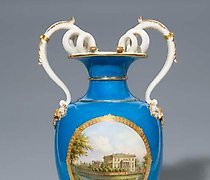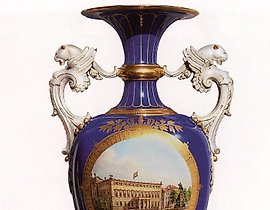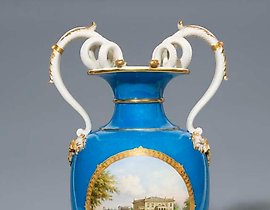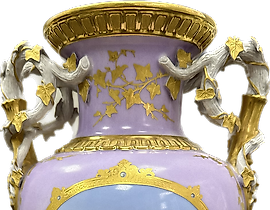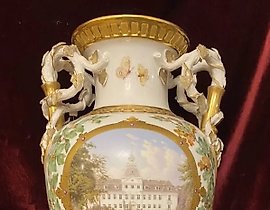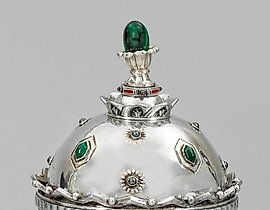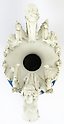


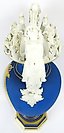

An ovoid-shaped vase on an octagonal base with biscuit porcelain handles. Made of porcelain with polychrome painting, applied relief decoration, covered with blue azure matte paint (Royal Blue background), gilt accents and paintings, chiseling. On one side of the body, within a round gold-chiseled frame, is a painted miniature: "View of the Wilhelm Palace and the Monument to Frederick II on Unter den Linden" (The Old Palace, also called the Kaiser Wilhelm Palace, was a former royal Prussian residence on the boulevard Unter den Linden in Mitte). Above the miniature, a crown framed by laurel branches in chiseled gold, handles shaped as semi-nude female figures intertwined with acanthus scrolls and flowers in high relief, protruding from inside the vase with a gilded rim. The vase was made on commission for the imperial court. Marks: "sceptre" - underglaze cobalt, "orb" and painter’s mark in overglaze red. German Empire, Berlin, 1875. Height: 63 cm.
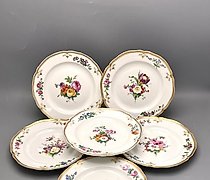
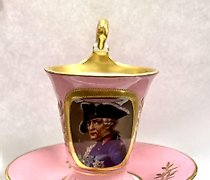
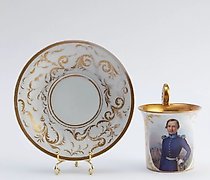
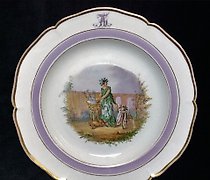
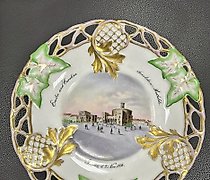
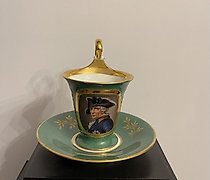
KPM Porcelain Market Overview Assessing the KPM porcelain market is quite a complex task. Many factors influence pricing: the age of the piece, its uniqueness and rarity, the quality of painting, and finally, its condition. Many collectors rely on auction catalogs for market analysis, but auction assessments are not absolute indicators of price, as auctions are third parties. Most objects are bought and sold by dealers who are happy to invest in excellent pieces. These items are often resold to collectors at prices much higher than those listed in catalogs. Recently, interest in art objects has soared in Russia. Any country experiencing a rapid economic upswing sees the emergence of wealthy individuals who, after satisfying their primary needs, turn their attention to art. Initially, major antique buyers were Arabs and Japanese, followed by Indians, and soon, Russians joined in. Now, Europe is experiencing the latest trend—Chinese collectors. The "new" Chinese are buying almost anything that can fit into their mini-Versailles! In a short time, a tremendous number of items have disappeared from the antique market. Tourists have also played an important role, buying cups or plates with beautiful views as souvenirs around Europe, especially when porcelain prices were much lower 10-15 years ago. Now, it is almost impossible to buy cityscape cups in Vienna—even Vienna-style, not just from the Vienna manufactory! The situation is the same in France and Germany, and even more so in Russia. If, in the 1990s, the Russian antiques market supply far exceeded demand, now the situation has changed drastically. Adding a quality piece to a collection is now a rare and expensive success. On the one hand, given its production volume, KPM porcelain is not rare on the antiques market. On the other, rare and unique pieces with high-quality painting are not often encountered and are highly valued. Just a few years ago, the price for ordinary cups was 300–500 euros. Now, on the European market, ordinary cups fetch 1,000 to 3,000 euros. Artistic cups with complex designs (maskarons, relief elements, etc.) and excellent painting may bring 5,000–15,000 euros. Special cups commemorating the Peace of Tilsit (1807) and decorated with portraits of Alexander I and Napoleon, as well as series dedicated to the battles of Leipzig and Waterloo with monarchs’ portraits, are indisputable rarities and may start at 25,000 euros. Notably, in the past 15 years, such cups have not appeared at European auctions. The price of Berlin ordinary plates now ranges from 1,000 to 2,000 euros each. Topographical plates may fetch 3,000 to 15,000 euros. Plates with subject paintings (1790–1840) can be valued upwards of 10,000 euros. Popular "military" plates now sell at European auctions for 10,000 to 40,000 euros, depending on their condition and age. Vases about 30 cm tall cost 5,000–10,000 euros, 50 cm tall vases are 20,000–50,000 euros. Vases exceeding 70 cm may sell for 50,000 to 150,000 euros. For example, a 70 cm vase sold at the Berlin spring auction for 130,000 euros. Naturally, KPM porcelain prices will rise over time. As with any business, antique market prices depend on supply and demand, and as demand for porcelain grows (not just Berlin, but porcelain in general) there will be fewer pieces available. Investing in art is not for everyone—there are other fields with quicker and more predictable returns. The antiques market can even allow for speculation. But the best investor is a serious collector. Investing in porcelain requires deep knowledge, a good consultant, and long-term plans. Even then, quick success is not guaranteed, as the market can be affected by subjective factors, like fashion. To objectively assess profit, at least 5–10 years should pass. It is quite possible that a KPM plate bought in 2022 for 5,000 units will double or triple in price in 10 years.
Lot location Moscow ( 77 )
A comment
Payment by agreement
Please check the payment methods with the seller when making a purchase
Delivery by agreement
Check the delivery methods with the seller when making a purchase
Approximate prices in Russia



Royal Porcelain Manufacture of KRM
Additional lots
Royal Porcelain Manufacture of KRM
Description
Similar lots
specially selected lots