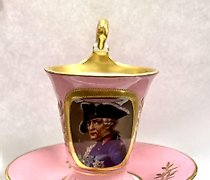
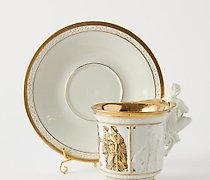
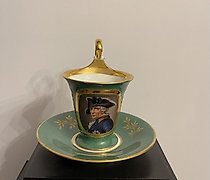
A cup with a saucer featuring a portrait of Frederick the Great in full dress uniform with medals, and a sculptural handle in the form of Archangel Michael. The cup was painted at the KPM manufactory in 1870. Presumably, the pair was made as a gift for noble aristocrats. The cup is adorned with relief-molded mythological Greek scenes illustrating two of Hercules' feats: "Hercules and the Nemean Lion" and "Hercules and the Cretan Bull." The sculptural handle features Archangel Michael with a shield in his hands. The piece is richly gilded, with ornate chasing and a band of gold pearls on the lower part of the base.
Frederick II, or Frederick the Great, also known as "Old Fritz" (German: Friedrich II., Friedrich der Große, Alter Fritz; 24 January 1712, Berlin — 17 August 1786, Sanssouci, Potsdam), was King of Prussia from 1740. This magnificent cup with saucer is unique in that it features a portrait of the King of Prussia, Frederick II the Great, also called "Old Fritz." The portrait is complemented with rich golden paste. A worthy addition to your collection! Frederick II the Great (German: Friedrich II der Große) was born on 24 January 1712 in Berlin and died on 17 August 1786 in Sanssouci, Potsdam. He was the King of Prussia (1740-1786), nicknamed "Old Fritz." One of his landmark reforms was the abolition of censorship. He made it clear to his ministers that "Berlin newspaper writers should be given unlimited freedom to write about all capital news without prior censorship." Frederick insisted that "there should be no obstacles to engaging newspapers." Deceased censors were typically not replaced during his reign – these positions remained vacant. Under him, it became possible for the first time to legally justify freedom of the press on German soil. Frederick distinguished himself as a patron of the sciences and the arts. In 1742, he established the Royal Opera, for which the architect Knobelsdorff built a building. After the Gotzkowsky factory passed to Frederick II, it became known as the Royal Porcelain Manufactory, and from the very beginning, its mark was the royal scepter. The portraits in medallions that adorned Berlin Empire-style tableware and cups are mostly the works of sculptor Leonard Posch. Biedermeier style, responding to the bourgeois love of comfort and coziness, was a reaction to cold classicism. The products of the Berlin factory in this style enjoyed widespread distribution. These were mass-produced items but retained a certain distinctive charm of the era.
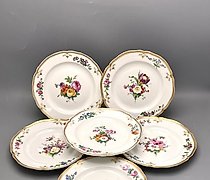
Royal Porcelain Manufactory (KRM)Transfer of the factory to another property -1763After the transition of the Gotzkowsky factory to Frederick II, it became known as the Royal Porcelain Manufactory, and its brand from the very beginning was the royal scepter. At the same time, they began to look for their own deposits of kaolin clay. And already in 1765 such deposits were found in Silesia, and in 1771 they discovered beautiful kaolin clay in Bachwitz near Halle and in Zennewitz and Morla, and the Berlin manufactory uses these deposits to this day. Porcelain made of this clay has a bluish-white hue. At that time, the factory fulfilled numerous orders of the king, among which orders for service sets prevailed. In 1765, Frederick II ordered a service consisting of a large number of heterogeneous objects for the new palace in Potsdam. It took more than two and a half years to make this service. This service became a masterpiece of the factory, it perfectly suited the style of the entire palace, and each of the items had a charming and harmonious painting. Especially the same style of painting was on the plates. Elegant motifs of shells (rocaille) move from the edges to the middle, which is occupied by a bouquet of flowers. The margins of the edges of the plates, between the patterns of shells, are covered with a thin golden mesh on an orange-red background, golden twigs are placed on other fields on a yellow background. The predominant tones are purple-purple, yellow-green and brown-red, as well as fine gilding. In addition to the described "Potsdam" service, the factory has made many others for different royal residences, such as "green", "yellow", "red", "Japanese", "with a basket of flowers". For the gift of the king to the Russian Empress , the factory made in 1772 . a golden-green service with miniatures depicting the victory of the Russians over the Turks.During this period, Polish artist Daniel Chodovetsky also did decoration projects for the factory. In addition to royal orders, the factory produced mass-produced products, not so ornate, but cheaper and more accessible to the layman. In addition to table sets, coffee sets, decorative vases and glazed figurines were produced. However, the vases and statuettes did not have the originality of forms and lightness that the products of some other manufactories of that time had - Meissen, Vienna or Sevres. In 1775, for a short time, the sculpture workshop was led by Johann Epstein. He made a number of figurines and groups of figurines, including Polish-themed ones. They depicted nobles in Polish costumes and horsemen with horses.After the death of King Frederick II, classicism began to prevail in the style of products. When Elias Meyer died (1789), the sculptor Karl Friedrich Riese took his place. The products of this period are biscuits in the classical style, made mainly according to the projects of the famous sculptor Shado- va. The architect Hans Christian Genelli, a supporter of strict classicism, worked with Shadov. During this period, there was a strong influence of Sevres and Wedgwood ceramics.The portraits in medallions that decorated Berlin Empire tableware and cups are mostly the works of the sculptor Leonard Posh. The reaction to cold classicism was the Biedermeier style, which corresponds to the philistine love of convenience and comfort. The products of the Berlin factory in this style were widely marketed. These were mass-produced products, but with a certain specific charm of this era. Biedermeier tableware, made according to the designs of Karl Friedrich Schinkl, should be especially highlighted. In the middle of the XIX century . there was a decrease in the artistic level of products that increasingly resembled mass factory production. After a period of stagnation, the artist Alexander Kipe became the artistic director in 1886. During the twenty years of his work, the factory regained its former position. At the turn of the XIX-XX centuries, when Schmutz-Baudis became the head of the painting workshop, the technique of underglaze painting underglaze was widely used here, with the help of which interesting and spectacular objects were created. He invited the sculptor Paul Scheurich to Berlin, who often referred to the good Rococo tradition in his works. The current production of the Berlin factory is aimed at the production of decorative tableware and vases, with the main emphasis on simplicity and harmony of form. During the last war, the factory was moved to Zelb for a while, where its branch was located since the XVIII century. In 1955 The manufactory returned to its former place in Berlin (on the territory of the GDR), and it now bears the name "State Porcelain Manufactory in Berlin".In the initial period, the products of the Royal Manufactory in Berlin were marked with the letters "KRM" (Konigliche Porzelcan Manufaktur) with a scepter or a Prussian eagle above the letters - the period of the king's reign. Later, a schematic drawing of a scepter was put as a brand, next to which there are often signs of artists or additional signs. Plates production Brands BrandsBerlin porcelain is Meissen's eternal rival in the struggle for industry leadership. Collectors value both brands highly, but fame has a downside. Manufacturers more often than others become the target of counterfeiters. Fakes flooded the market already in the XIX century, when small workshops painted "linen" rejected by the KRM.To protect themselves from fraudsters, the company makes changes to the trademark from time to time. This greatly simplifies the attribution of KRM porcelain by year. The main brand is applied with cobalt after the first scrap firing. Its presence confirms the high quality of products and their compliance with technical standards. Then the products are glazed and fired again, after which the dye is sintered with a coating. Porcelain of the second grade is marked with a special polished line on the scepter. The upper glaze layer may be absent. The decor items from the biscuit are marked before the scrap firing.What a collector needs to know:1. The famous brand with a scepter appeared in 1763. Before that, letter designations were applied to the products of the Berlin manufactory.2. Porcelain with hand–painted art is additionally marked with the second symbol of imperial power - the power. It is applied with enamel over the glaze layer. The color of the power depends on the subject of the painting:floral motifs and landscapes in the veduta technique are marked in red;green – layering with precious metals or monochrome patterns;blue – decor with high-temperature paints that is not "afraid" of the dishwasher.3. Each artist of the company puts a logo on their products. Usually the signature is applied manually with paint or pressed into the dough. Next to the logo, you can see additional numbers indicating the number of the decor in the unified register of the KRM. The individual logo is missing only on miniature animal figures and chef's spoons.